We asked GPT-6 Astra to edit Qwen3.5-0.8B weights to improve math.
It directly changed only 0.016% of weights, fixing 0.8B's reasoning loops & improving math up to 6x and even instruction following 3x, without gradients or training.
We call this Weight-Space Programming: frontier LLMs can now natively read/write neural network weights! 🧵
Blog: https://t.co/bOWCcFhCVq
@friedberg The fly paper isn’t saying consciousness is 64 dimensional. Poor modeling(Euclidean) needs 64 dimensions, whereas right modeling(2D hyperbolic) needs 2. The takeaway is about choosing the right latent geometry.
https://t.co/NenFXkn688
- A fan of science corner
@HariBalakrish20 I thoroughly enjoyed his class during my undergrad! I don’t remember whether Hamsa took it too 😊 It was wonderful to watch him teach again.
So after all these hours talking about AI, in these last five minutes I am going to talk about:
Horses.
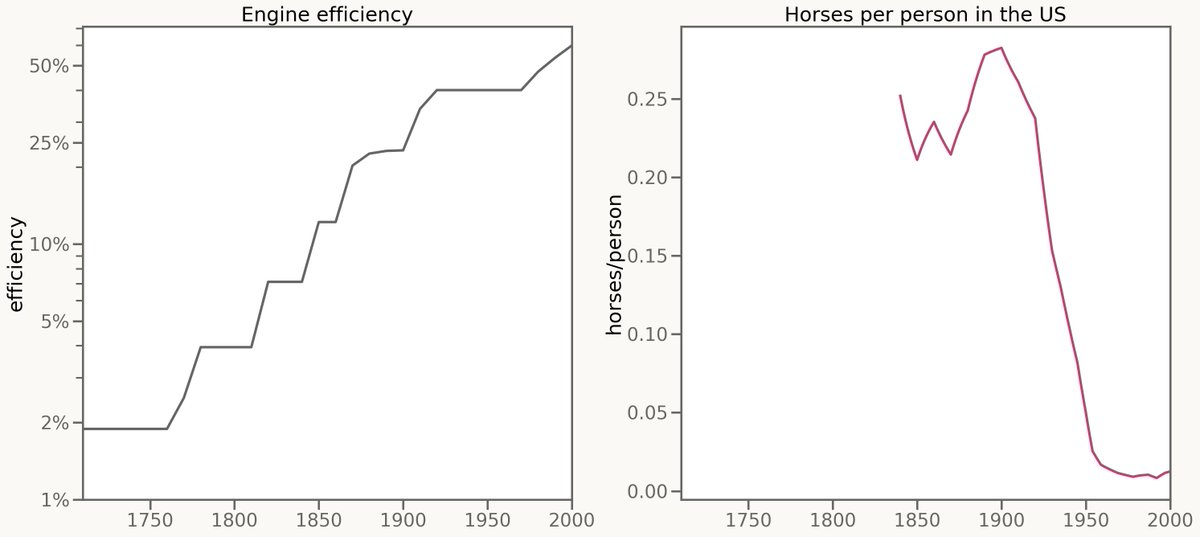
Engines, steam engines, were invented in 1700.
And what followed was 200 years of steady improvement, with engines getting 20% better a decade.
For the first 120 years of that steady improvement, horses didn't notice at all.
Then, between 1930 and 1950, 90% of the horses in the US disappeared.
Progress in engines was steady. Equivalence to horses was sudden.
@_arohan_ 5% jump is huge! Would love to see the numbers on a cost adjusted basis. If current margins are same as pre-GenAI, it’s super impressive. And likely means, many more quarters of growth ahead
Which is better for AI workloads—Mesh or Switch? Read Auradine’s VP(AI) insights on these high-bandwidth domain approaches and learn how to optimize GPU clusters!
https://t.co/wE97tdGrgr
#AI#HPC#GPUs#Accelerators#DataCenter#MeshVsSwitch
1. Breakdown of DeepSeek V3 efficiency vs Llama 3:
- Better: 11x fewer FLOPs per token, thanks to MoE [37B vs 405B activated params]
- Better: 2x faster numerics [fp8 vs bf16 training]
- Worse: 0.5x flops utilization [16% vs 33% end-to-end MFU*]
- Neutral: similar hardware platform [H800 and H100 both have 2Pflops/s dense fp8]
- Neutral: same training data volume [14.8T vs 15T tokens]
Llama 3’s design was obviously and intentionally conservative: dense model (not MoE), bf16 training (not fp8), GQA attention (not cheaper alternatives). DeepSeek benefited by being aggressive on all these fronts, at the cost of being later to market.
2. The core algorithmic improvements were already known; the closed source LLM labs were probably already doing similar things. DeepSeek’s improvements are real, but far more modest than the Llama comparison would suggest; my wild guess is closer to 1.5x improvement.
MoE was published in 2017; in 2021 Switch Transformer reported 7x speedups vs dense models, similar to DeepSeek’s 11x. OpenAI is widely rumored to have been using MoE models for years. NVIDIA published their fp8 training paper in 2022.
3. NVIDIA’s stock price is down 15% after DeepSeek. Should it be?
LLM compute is like a gas: it expands to fill the available budget. Over the last 3 years the labs have grown their budgets, despite algorithms and hardware improving. There’s no reason to expect this to change now: you win by making the best model, not by shrinking your budget.
The more meaningful question: do algorithmic improvements like DeepSeek’s mean that margins will shift from hardware vendors to labs?
Hard to see why. Algorithmic improvements are quickly copied from one lab to another, making it hard for them to maintain technological differentiation. Hardware improvements take much longer to copy.
@sundeep Great idea! Take a big, but minority, equity stake in TikTok, Stargate and intel too along side greatest entrepreneurs like Elon and let these companies be run by those great entrepreneurs
Wrote and directed this film for Fwd by Myntra featuring the world champions- @DGukesh and @vishy64theking . Produced by us at @braindaddotco but mostly by Devarsh!
@WilliamBryk Good setup! Fairly standard config. Who’s the system integrator? Curious what you are building though: Embeddings model for search? Whenever you are ready to share more…