Many of my recent conversations with other neuroscientists revealed a common concern: the alarming proportion of essentially worthless systems neuroscience papers appearing in the top journals.
Not exactly fraudulent (real fraud is actually not that common), but a familiar combination of weak data, arbitrary interpretations, and elaborate statistical or computational analyses that create an illusion of rigor. Basically highly polished garbage, with a fashionable topic and a narrative designed to appeal to editors.
Of course, none of this is new, but it's getting worse and I don't think outsiders can even get an accurate picture of the latest systems neuroscience any more. As one colleague recently put it, if the public knew just how shaky much of the evidence really is, confidence in the entire field might collapse, and we might all go down if the public loses trust in the whole enterprise, especially now that AI seems to be improving so quickly.
The deeper problem is systemic: our mechanisms for evaluating, rewarding, and propagating scientific results are broken. Scientists who produce reliable work are often marginalized. Their progress is considered too slow, and because of their perceived lack of productivity, often they can't even secure enough funding to keep their labs running. Some can't even get a job. I have seen many examples of this over the years. People with integrity are essentially punished for being meticulous. Meanwhile, the most relentless storytellers and opportunistic careerists accumulate funding, prestige, and influence, as they expand their academic families and place their people throughout the field. Criticizing a member in one of these "Corleone families" carries enormous professional costs.
The result is not just a lot of bad papers. Entire research areas become saturated with unreliable findings and unsupported interpretations, reinforced by citation networks, press coverage, and awards. The longer this continues, the harder it will be to separate fact from fiction, and the greater the eventual damage to neuroscience itself.
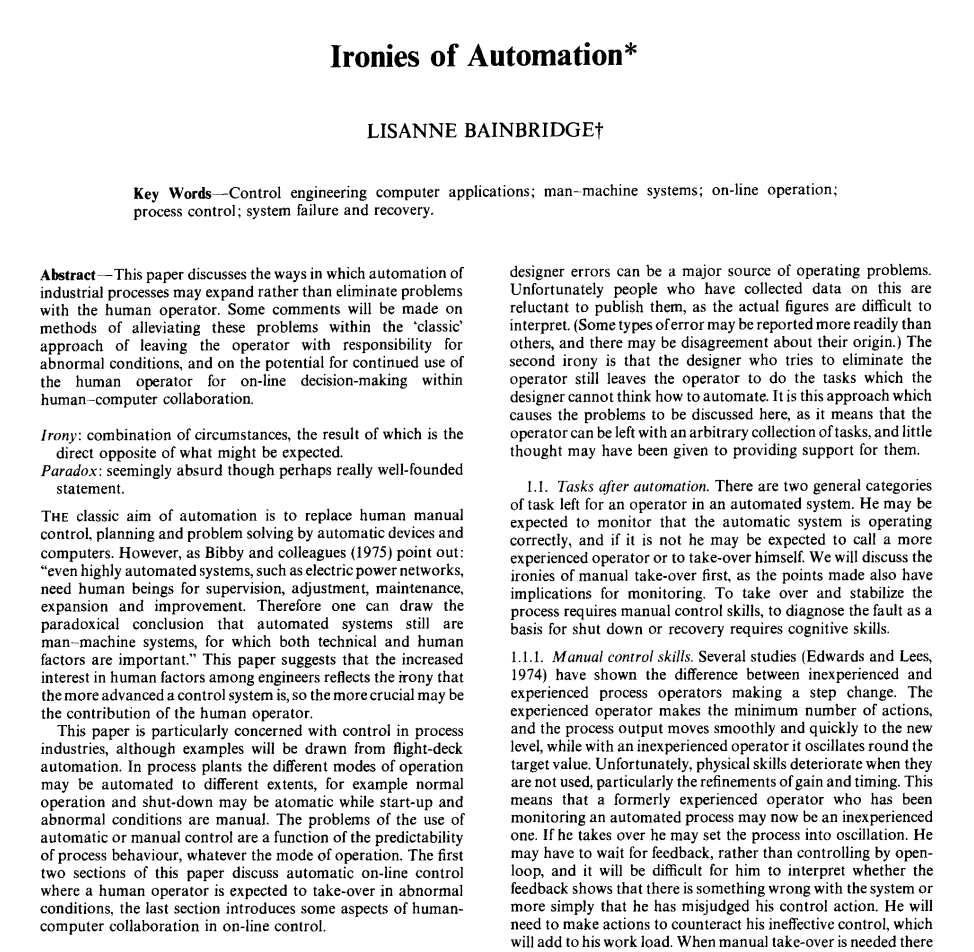
A British psychologist wrote a paper in 1983 that predicted every single problem we’re having with AI in 2026.
It's called “Ironies of Automation”
More advanced and reliable an automated system gets, the more crucial the human operator becomes.
When engineers build an autonomous system, they automate the predictable tasks. What do they leave for the human?
Only the most complex, chaotic, and dangerous edge cases that the engineers themselves couldn't figure out how to code.
We are rapidly turning developers, writers, and operators into "AI supervisors."
But cognitive skills deteriorate when they aren't actively used. If an AI agent or Copilot does 99% of the work, the human loses their deep mental model of the codebase or the system.
When the AI inevitably hallucinates or fails, it hands control back to the human. But the human is now totally out of practice, right at the exact moment they have to step in and solve a catastrophic edge case.
The Monitoring Illusion We expect humans to just "supervise" AI output. But humans are biologically terrible at maintaining vigilance while waiting for rare errors.
Worse, if an AI is deployed because it processes data faster and handles more variables than a human, it is physically impossible for the human to check the AI's logic in real time.
You cannot supervise a black box that thinks faster than you.
We aren't removing human error with AI. We are just delaying it to the absolute worst possible moment.
As we shift heavily into vibe coding and agentic workflows, the warning from 1983 is urgent.
If you just mindlessly supervise the AI and stop practicing the core skill yourself, you won't be able to step in when the machine breaks.
Most exercise and aging studies can't answer a basic question: is muscle deterioration from aging itself, or just from decades of moving less? A new Nature Aging study solved this by recruiting older adults who moved as much as people in their twenties.
The researchers from Amsterdam UMC and Maastricht University recruited four distinct groups: young adults in their twenties, older adults whose daily step counts and high-intensity activity matched the young group, older adults who had trained consistently for years (three structured hour-long sessions per week for over a year), and older adults with early physical impairment.
They took muscle biopsies before and after a one-hour cycling session, then measured over 24,000 gene transcripts, 135 metabolites, and 1,383 lipid species.
By matching activity levels between young and older groups, any molecular differences couldn't be blamed on the older adults simply moving less. This isolated aging from inactivity for the first time at this molecular depth.
Key findings:
• The defining molecular signature of muscle aging is an energy crisis. Comparing young adults to activity-matched older adults, 1,106 genes were downregulated with age. These genes build the mitochondrial machinery that produces cellular energy: ATP synthase, cytochrome c oxidase, and NADH dehydrogenase subunits. Mitochondria are the power plants of cells, converting nutrients into ATP, the energy currency cells use to function. When these genes decline, cells lose their ability to generate energy efficiently.
• NAD+ levels declined and triglycerides accumulated inside aging muscle. NAD+ is a molecule required for energy production and cellular repair. Lower NAD+ means less capacity to convert fuel into usable energy. Triglycerides are stored fats, their accumulation inside muscle indicates unburned fuel piling up as the tissue loses its ability to process it.
• More than half the molecular signature of muscle aging was absent in trained older adults. Specifically, 57.1% of age-related gene downregulation and 55.9% of upregulation were missing in the trained group. Their muscle resembled young adults far more than their chronological age would predict.
• The changes training preserved were specifically the energy metabolism ones. Genes like NDUFS1 and COX5A, which were depleted in normally active and impaired older adults, sat at youthful levels in the trained group across all five mitochondrial respiratory complexes. The single most prominent feature of muscle aging turned out to be the single most preventable.
• Being generally active was not enough. Structured training was the difference. The normally active older adults walked as much as young adults, and their energy metabolism genes declined anyway. What preserved the youthful molecular profile was structured, sustained training. Filling a step counter and being genuinely trained are not equivalent at the molecular level.
• Roughly half of muscle aging persisted regardless of training. Changes in genes controlling synaptic transmission (how nerves communicate with muscle) and WNT signaling (a pathway regulating tissue maintenance and stem cell function) appeared in all older adults, trained or not. This unavoidable half is where drugs will have to work.
• The fittest muscle mounted the largest inflammatory response to exercise. All groups activated stress and immune genes after exercise, including IL6, IL1B, and TNF. But the magnitude scaled with fitness. Trained older adults most closely resembled young adults in their response, followed by normally active, with impaired older adults showing the most blunted response. The stress response to exercise appears to be the mechanism of adaptation, not damage to be minimized.
This raises a concern about anti-inflammatory longevity strategies. If the inflammatory stress response is how exercise produces its benefits, chronically suppressing inflammation may blunt the adaptation that exercise depends on. It doesn't mean inflammation is beneficial in general, but the timing and context matter.
A separate discovery: the proteasome appears to regulate NAD+. The proteasome is the cellular machinery that breaks down damaged proteins. When researchers inhibited it, NAD+ levels rose in both muscle and liver cells to a degree comparable to NAD+ precursor supplements. This opens a new route to understanding NAD+ decline that operates through protein turnover rather than just supplying more raw material.
The study draws a clear line between what lifestyle can address and what will require therapeutics. The energy metabolism decline, mitochondrial deterioration, and NAD+ depletion that define muscle aging are largely preventable through structured training. The synaptic and signaling changes that persist in all older adults represent the unavoidable half where drugs will need to work.
The decisions made about structured training in midlife determine which molecular trajectory muscle follows in later decades. Half of muscle aging is optional. The other half isn't. Knowing which changes belong to each category is knowing where behavior ends and biology takes over.
Where the Romans fought: 1,709 land and sea battles, from Romulus (753 BCE) to the fall of Theodoro (1475), in 44 of today’s countries. Rome won 916, drew 41, lost 512; 236 more were civil wars.
Interactive map, full list, the Roman armies, sources:
https://t.co/e6CfPEelSZ
Hannah Arendt delivered this lecture, "Thinking and Moral Considerations," in 1971, several years after she had covered Adolf Eichmann's trial in Jerusalem. That trial left her with a nagging question: how could someone commit such horrific acts without being a monster or fanatic? She concluded Eichmann's defining trait was simply an inability to think — he relied on clichés and fell apart when none applied. This lecture is her attempt to work out whether moral judgment depends on this capacity to think.
To explore this, she turns to Socrates as her model of real thinking. He described himself three ways: a gadfly who wakes people up, a midwife who helps others examine their own ideas without ever supplying answers, and an electric ray that paralyzes others by first being paralyzed itself. Genuine thinking, in her view, doesn't produce fixed rules — it unsettles things, which is both its value and its risk, since that same unsettling can tip into nihilism if people mistake uncertainty for permission.
Her central insight is that thinking is really an inner conversation — a "two-in-one" dialogue with yourself. Conscience, she argues, isn't some built-in moral sense; it's just what happens when you're forced to face yourself in that inner dialogue. People who never pause for this conversation have nothing stopping them from doing terrible things, because there's no inner witness there to object.
She ends by linking thinking to judgment — our everyday ability to say "this is wrong" without consulting a rulebook. Thinking itself is quiet and produces no visible results, but in moments when society's norms collapse, people who've practiced this habit of inner questioning are more likely to recognize wrongdoing and refuse to go along with it.
https://t.co/TCQloXbdPt
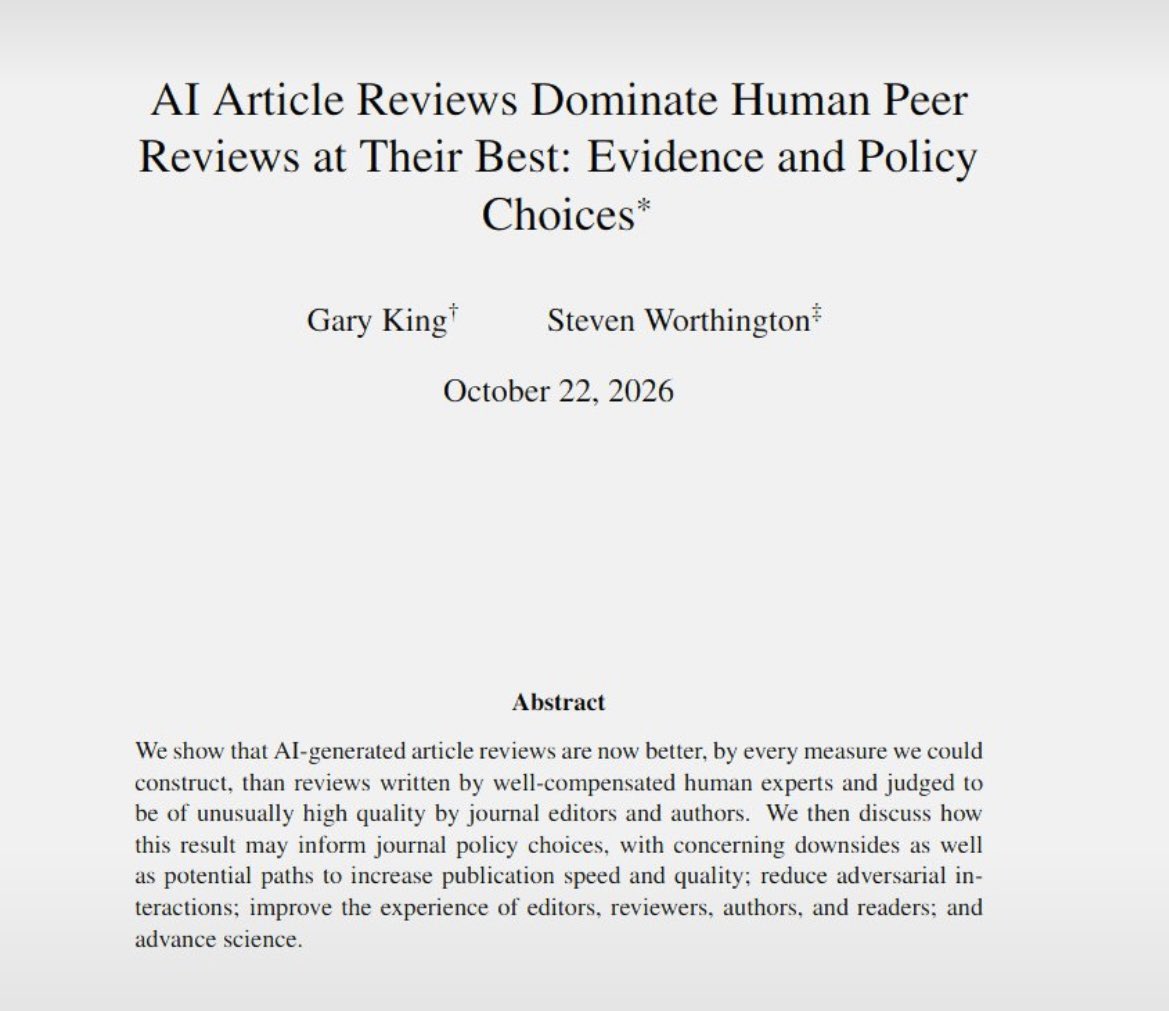
The importance of this paper cannot be overstated.
The authors compared AI reviews with 134 reports written by carefully selected, paid human experts.
The results are impressive.
Not only AI received higher ratings across all seven dimensions assessed by an AI judge.
But even three former journal editors preferred AI reviews in 90% of the cases.
The potential benefits of AI reviews for scientific advance are getting enormous: faster and higher quality feedback, less reviewing work, more time for research.
We could even imagine journals run entirely by AI editors and reviewers. This could radically disrupt a publishing system that costs researchers considerable time and money. Let me say: some disruption would be welcome.
But there are also major concerns.
What happens when a few AI systems become gatekeepers across sciences?
They might increase average review while narrowing the range of ideas that survive.
This is particularly critical at the scientific frontier, where an important contribution may challenge the assumptions that existing research takes for granted.
And even worse: let’s not forget that, near the frontier, AI systems become more likely to hallucinate.
So they might embed errors at the very core of human knowledge.
A tsunami is coming.
And we’re not ready.
*
Paper in the first reply
Cómo el dolor crónico altera los circuitos emocionales y cognitivos del cerebro El dolor crónico no es simplemente una sensación prolongada de malestar. Implica cambios en la forma en que el cerebro procesa la información sensorial, regula las emociones y sustenta las 👇
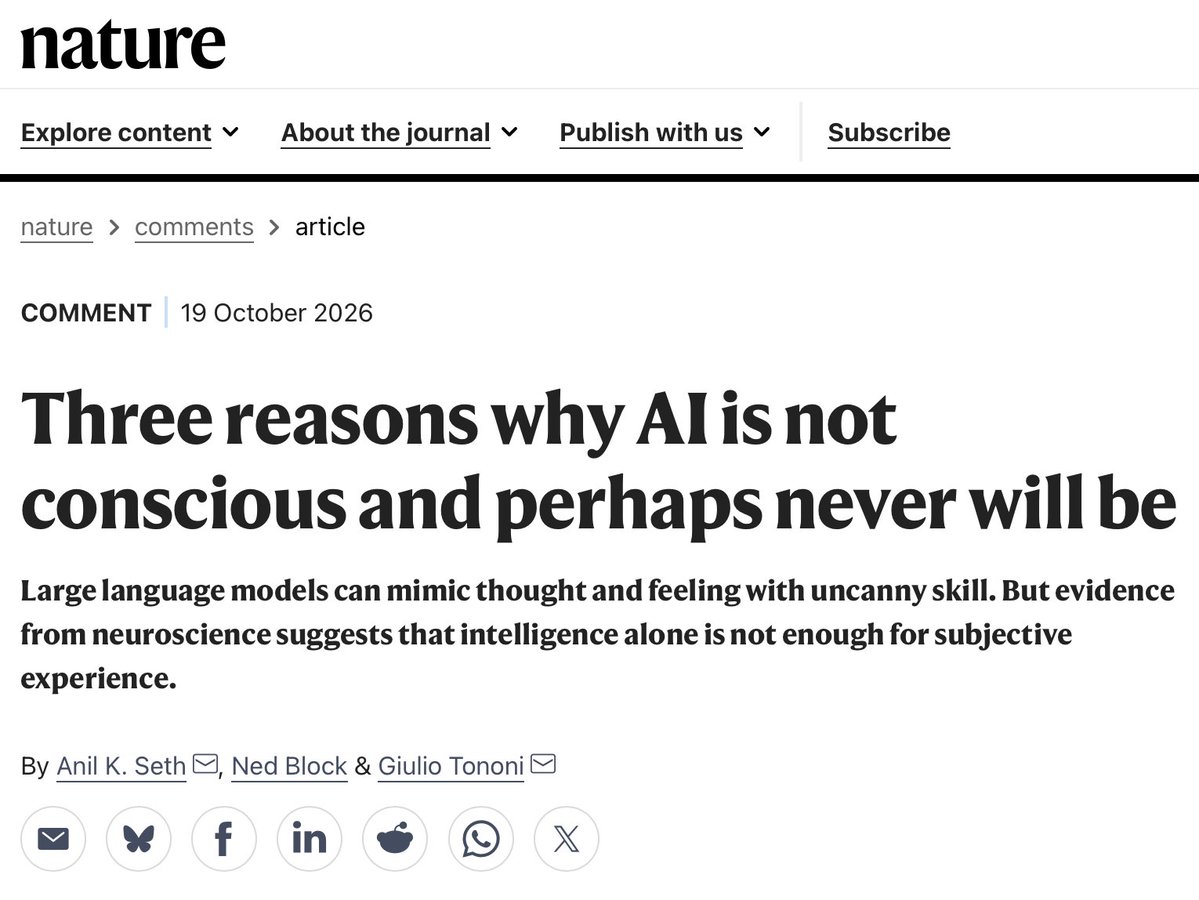
Spectacular Nature piece on why AI is not conscious and probably will never be.
Three arguments:
1) Intelligence is not consciousness.
Intelligence is about solving problems. Consciousness is about having subjective experiences.
AlphaFold can solve super difficult problems. By contrast, our brains performs complex operations entirely outside awareness.
Problem-solving and consciousness are two separate things.
2. Biology is essential.
Our brains are alive, down to every cell. Their activity is inseparable from the living tissue that produces it.
The idea that consciousness can be reproduced simply by running the right computations on silicon components who do not fight for their life is a very far fetching and, I would add, almost religious, assumption.
3) The physical organization may matter more than the computation.
According to integrated information theory, consciousness requires specific causal relationships between a system’s physical components.
The computer architectures running today’s AI lack this organization.
The comparison with AlphaFold is particularly revealing:
Almost nobody things AlphaFold is conscious, despite its inner working is very similar to an LLM
Why?
Because it does not speak.
LLMs do speak like us and therefore we fall into an illusion:
Since they speak like us, they must be like us.
But this inference is wrong.
LLMs are just a series of matrix multiplications.
They are not conscious, and they will never be.
*
Paper in the first reply
In 1983, a BBC interviewer asked Richard Feynman why two magnets push each other apart — and he refused to answer it.
What he did instead is the best seven minutes on thinking ever filmed.
Bookmark & watch today, no matter what.
Neuroscientists Giulio Tononi, Christof Koch, et al. make a strong case for real free will (not an illusion) if Integrated Information Theory (IIT) is the correct explanation of consciousness:
"If IIT is right, we do have free will in a genuine sense: we have alternatives, reasons, and values, we make decisions, and we—not our neurons or atoms—are the cause of our willed actions and bear responsibility for them."
https://t.co/2UW0jfj9rR
Autism cannot be reduced to a simple excitation/inhibition imbalance. Inhibition is not one dial: PV, SST and VIP interneurons regulate different compartments, timescales and network states. A circuit can appear globally “balanced” yet remain computationally disorganized.
BBBD provides 110 hours of synchronized EEG, eye-tracking, and physiological data from 178 participants viewing educational videos, capturing attention, motivation, and learning dynamics in BIDS format. This multimodal resource enables direct investigation of how brain and body signals couple during naturalistic cognition, supporting predictions of learning outcomes from diverse neural and ocular metrics.
https://t.co/5iFghOMzmh
This sounds like a good book countering simplistic & naive notions.
“So long as we insist that cells are computers and genes are their code,” writes Ball, life might as well be “sprinkled with invisible magic”. But, reality “is far more interesting and wonderful”
1/3
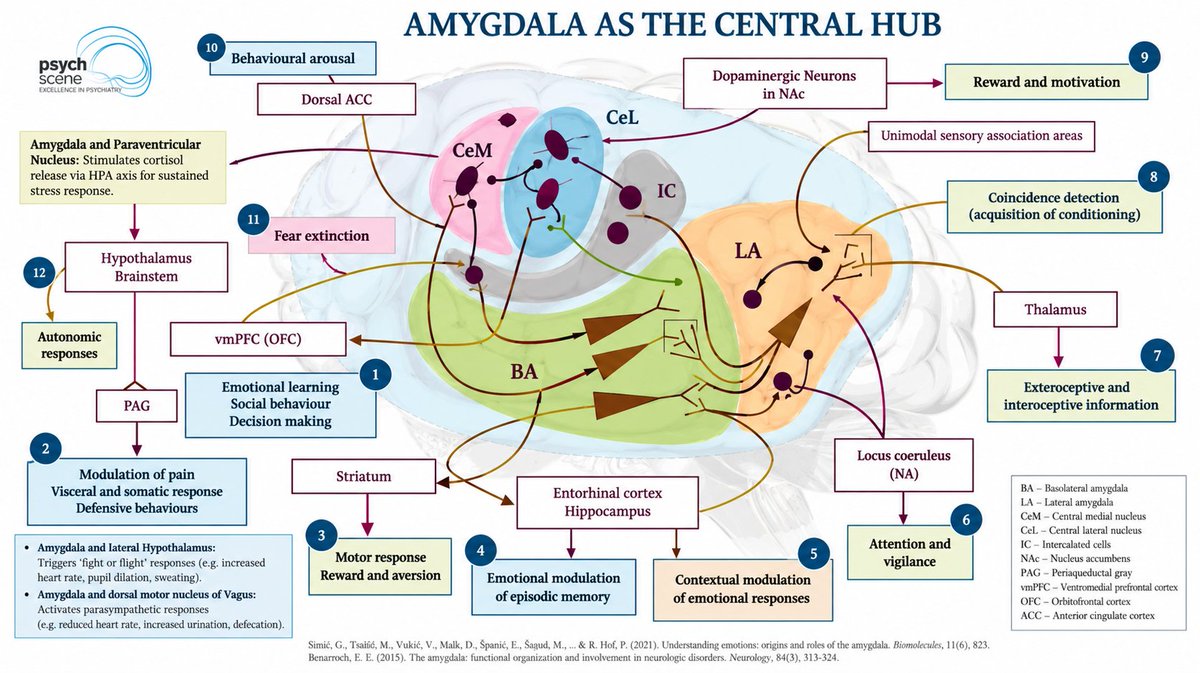
Anxiety is not simply an ‘overactive amygdala.’
Optogenetics revealed that stimulating one amygdala pathway can actually ‘reduce’ anxiety-related behaviour.
But how can different pathways in the same brain region produce such contrasting effects? 🧵👇
@Velisarios21 Υπάρχει διάκριση μεταξύ **μη** φοβικής στάσης και απώλειας επαφής με το πραγμ��τικό. Προυποθέτει όμως απουσία κολακειών και προσωπικής πολιτικής ατζέντας και προισταμένους (που επιλέγουν την ηγεσία) με εμπειρία λογοδοσίας και όχι ανθυπομετριοτήτες που είπε και ο μεγάλος Κονδύλης
@Velisarios21 Θα ήταν καλή μια ψυχιατρική εκτίμηση, μήπως ακούν φωνές που τους λένε ότι θα πολεμήσουν κανονικά και καινοφανείς σύμμαχοι δίπλα μας. Όσο για την Τουρκία, αυτό ζητά, προληπτικό πλήγμα για μακροχρόνιο πόλεμο. Κάναμε και ένα το 1919 και είδαμε το αποτέλεσμα.