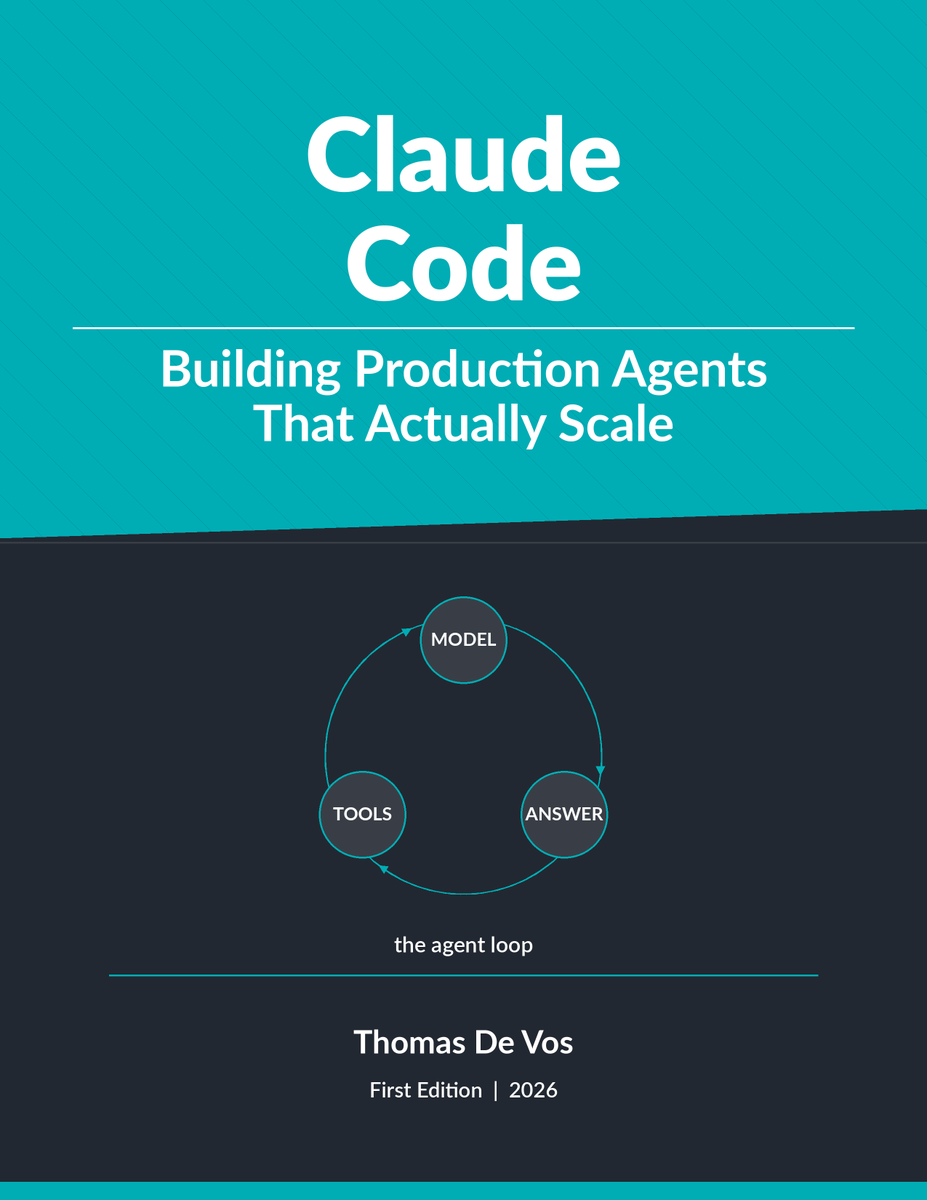
After a decade building AI systems for financial institutions, I wrote the book I wish I had when I started with agents.
"Claude Code: Building Production Agents That Actually Scale" is live on Leanpub.
https://t.co/m3iaq2Ybbl
#ClaudeCode#AIAgents#Anthropic#AIEngineering
In this Leanpub interview I talk about the gap between a useful Claude Code experiment and an agent you can trust around real users, real money, and regulated systems.
That gap is where the book lives.
https://t.co/jtgvstNlfe
The bundle Enterprise AI Agents in Production: Build and Secure Them by Thomas De Vos is on sale on Leanpub! Its suggested price is $58.00; get it for $15.20 with this coupon: https://t.co/EuRiS5Tpge @thomasdevos69
The Claude Code run I worry about is not the one that fails loudly.
It is the clean diff with no flight recorder: tools called, files touched, tests run, rollback path, and the one decision that still needs a human yes.
#ClaudeCode#AgenticCoding
Claude Code cost control is not token limits. The expensive run is the one that keeps exploring because the task boundary was vague. Put a stop condition in the task: max files, max commands, max retries, then human review.
https://t.co/7JNb6AtMVW
#ClaudeCode#AgenticCoding
Claude Code permissions need expiry dates. If a file, command, MCP tool, or network grant survives the task, it becomes invisible access creep.
https://t.co/7SxaIOVt3a
#ClaudeCode#AgenticCoding
A tidy Claude Code diff is not enough. Before approval, ask for the packet: task, files touched, tools used, tests run, open risks, rollback path.
https://t.co/1g5JlFlDKG
#ClaudeCode
Claude Code gets risky when a tool call can quietly widen scope: read one folder, touch another, hit a paid API, then make the review look small. I treat MCP tools like prod permissions: named scope, approval rule, and a log I can replay.
#ClaudeCode#AgenticCoding
A coding agent doesn't need full trust to be useful. Give it a narrow task contract, a file boundary, tests it must run, and a review packet. Autonomy works better when the human knows exactly where to look.
Checklist: https://t.co/CcblHcL1l4
#ClaudeCode#AgenticCoding
Before Claude Code touches a real repo, write the boundary down: files it may edit, tools it may call, data it must not read, and the exact point where it stops for a human.
Unnamed authority is the risk.
https://t.co/agQ19yYgpa
#ClaudeCode#AgenticCoding
Before Claude Code changes a shared repo, I want one boring line in the plan: how do we undo this if it is wrong?
No rollback note, no merge. Agents are easier to trust when failure has an exit.
#ClaudeCode#AgenticCoding
Claude Code evals should start with the run that made you hesitate.
Turn the messy transcript into a replayable case. Then tighten the prompt, tool access, or human approval line.
That is how a demo becomes a system.
https://t.co/BOu3XGX1te
#ClaudeCode#AgenticCoding
A clean Claude Code diff can hide a messy run. For production-adjacent work, I want a flight recorder: task contract, tool calls, permission pressure, evidence, review packet, rollback note.
New post: https://t.co/RqYvP8EYJu
#ClaudeCode#AgenticCoding
Small MCP rule for Claude Code teams: every tool gets a blast radius, not a vibe.
What data can it see? What can it change? What costs money? What needs a human?
If nobody can answer that, the tool stays off.
#ClaudeCode#MCP#AgenticCoding
@six_2_eight Passing tests are a receipt, not the evidence pack. For AI-generated changes I want the agent to hand back: what it touched, which risky paths it exercised, what it could not verify, and the smallest rollback plan if the review smells wrong.
@MadaShindeInai This is the right instinct. I’d rather lose a little convenience than give an agent host-level write access by habit. The sandbox boundary should be boring: mounted worktree, narrow network, explicit secrets, and a clean way to throw the whole run away.
The Claude Code review question I keep using: what decision did the agent make that a human should have owned?
Auth, data access, test meaning, rollout risk. If those slipped through, the boundary was too vague.
#ClaudeCode#AgenticCoding
Claude Code permissions are where agent safety gets real. If a run needs production data, billing config, deploy access, or a wider MCP tool, the default should be: stop and ask.
New post: https://t.co/lQipXoEjOR
#ClaudeCode
@thomasdevos69 permission budget is the missing concept. most people set claude loose and wonder why bill is high. its not about limiting what it can do, its about defining what needs human approval before execution. boundaries > limits.
MCP turns Claude Code from editor into operator.
Before the first run, write the blast radius down: data it can read, files it can change, commands it can call, money it can spend, and the stop rule.
#ClaudeCode#MCP
I did a Leanpub launch interview for Claude Code: Building Production Agents That Actually Scale.
The point I keep coming back to: experimenting with agents is easy. Trusting them near production is a different game.
https://t.co/WfmyRldO5H
#claudecode#production#ai #bestseller