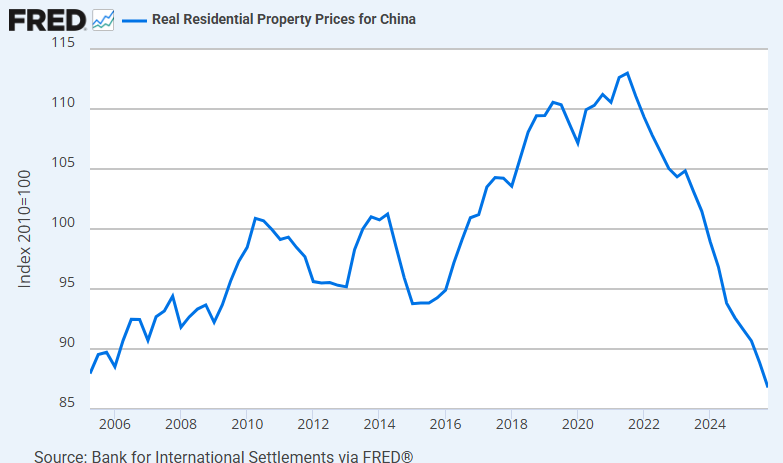
I know some people on here who argue that it's really a 15-30% fabrication in the world population in order to justify increased spending and tldr; line and number goes up means good
In just China's case, here's a few stats:
In 2016 China removed the One Child Policy and made it two children which soon followed with official CCP stats of births in Shangdong increasing by 56%, and Zhejiang 75%.
But what's interesting is that China requires all babies to get a tuberculosis shot. If you match that with 2018 data of newborns, you see a 35% gap of newborns taking it-newborn births (9.9 million births via vaccine data/15.23 million births claimed by officials)
In just 2024 to 2025 alone, birth rates dropped 17%
In 2000 the real fertility rate was about 1.2 which came up short of the expected rate they wanted, so they just changed it to 1.8 (1.24 billion to 1.27 billion) to match what they wanted the numbers to be
Local officials often also claim 20% to even 50% higher numbers of students in primary schools (51,586 reported in Jieshou, real numbers 36,234) which Jieshou received another 10 million yuan in state funding because of it
How would this make any sense for a nation that's rapidly growing in population size?
Well...
Local governments in China are highly, HIGHLY dependent on central government funding (basically federal funding in the US). They spend the vast majority of funding from Beijing YoY while not being able to collect enough tax back to stay in the black.
For example, most of the US expenditure is split half, 50/50 with states. Meaning if the US government spends $10, $5 of that is from the states.
In China, it can be 80% for provinces, while not making up the difference to Beijing via tax revenue.
Local officials are promoted based on their performance economically and politically, and receive more funds depending on how they do for the province/state/etc
You also see this in the infamous "ghost apartments" or where local governments fund themselves by giving away land & development rights to keep progress and building going and to justify the population "increases", while they mostly fail to meet the expected amount of people moving in, or they just crumble or get demolished
It's a large fraud operation where one leader or province inflates, so everyone else does to get money, recognition and eventually more power and Beijing benefits by showing the world it's growing while more gasoline gets poured waiting to be enflamed
It goes much deeper than this which I advise you do your homework on, but it's like this in many parts of the world as well which will inflate population and economic numbers to receive more foreign aid injection and cash. None of it is thoroughly investigated or vetted.
The truth is that China will never surpass us and will face the same fate that Japan had in the 90's
A power that challenged American manufacturing, investors buying up assets and stokes fear in the US of being overthrown via GDP which then eventually craters and takes decades to recover
This and the student unemployment crisis that China is having is going to cause some serious chaos. There simply just aren't enough jobs for the youth when ONE state owned company receives 1,000,000+ resumes which you have an almost 8x chance of getting into Harvard instead (CNNC)
China’s gamble of being the global south’s leader has ultimately failed. They realized that building ports, roads, railways, resource extraction sites and other important development infrastructure DOESN’T mean they can or are willing to pay it back. They bet on post-colonial resentment to uplift developing nations, but these are countries that are relatively unimportant and frankly can’t pay for all of the things China produces anyways. Compare that to the European or American markets where demand is always heavy.
The new military partnership the US and Indonesia made makes this even worse. They're entrapped on all sides and their allies are falling one by one
Never bet against the USA
There's a physicist at Stanford named Safi Bahcall who modeled this exact principle and the math is wild.
He calls it "phase transitions in human networks." When you're stationary, your probability of a lucky event is limited to your existing surface area: the people you already know, the places you already go, the ideas you've already been exposed to. Your opportunity window is fixed.
When you move, your collision rate with new nodes in a network increases nonlinearly. Double your movement (new conversations, new cities, new projects) and your probability of a serendipitous encounter doesn't double. It roughly quadruples. Because each new node connects you to their entire network, not just to them.
Richard Wiseman ran a 10-year study at the University of Hertfordshire tracking self-described "lucky" and "unlucky" people. The single biggest differentiator wasn't IQ, education, or family money. Lucky people scored significantly higher on one trait: openness to experience. They talked to strangers more, varied their routines more, and said yes to invitations at nearly twice the rate.
The "unlucky" group followed the same routes, ate at the same restaurants, and talked to the same 5 people. Their networks were closed loops. No new inputs, no new collisions.
Luck isn't random. Luck is surface area. And surface area is a function of movement.
The lobster emoji is doing more work than most people realize. Lobsters grow by shedding their shell when it gets too tight. The growth requires a period of total vulnerability. No protection, no armor, soft body exposed to the ocean.
That's the cost of movement nobody posts about. You have to be uncomfortable first. The new shell only hardens after you've already moved.
“Few people know how to take a walk. The qualifications are endurance, plain clothes, old shoes, an eye for nature, good humor, vast curiosity, good speech, good silence and nothing too much.”
— Ralph Waldo Emerson
I love these goofy anti-education losers because they think you just rocked up with a chisel at 18 and someone said 'ok so do what you want, enjoy, cathedral there please'. The guilds and apprenticeships were hardcore. It was a degree, as we'd understand it, and highly specialised
Kevin O’Leary thinks the highest paying job right now is customer acquisition on social media
“I used to pay those guys $48,000, now I’m paying them $250,000 because you can measure their work based on customer acquisition every week”
“Most of them become contractors, they make half a million dollars a year because they know how to take content, turn it into a 59 second ad on social and acquire 200 customers”
“Those people in their early 20’s are so valuable now. If you know how to use your phone, somebody wants to hire you”
If you run ads, you’ve probably heard the news:
Meta is banning credit card payments.
Which means no more points/cashback on your largest expense.
That’s millions of dollars in lost profit overnight.
Today, @slashapp changes that.
BREAKING: The Securities and Exchange Commission is preparing a proposal to eliminate the quarterly earnings report requirement and instead give companies the option to share results twice a year, per WSJ
Have to push back on this a bit
I think it has more to do with employee bloat (best example being twitter/x) than them installing agents to take over all their roles
Their stock is down like 75% over the past 5 years so I think they're past the stage of hiring to look good in front of LPs just wanted to consolidate. Probably will make the argument in future raises that they're more efficient and can grow faster without more opex