Huge thanks to my collaborators and mentors in the @BrodyLab at @PrincetonNeuro, especially co-first author Timothy Kim, for making this work possible! Appreciate the warm welcome from @UofUBiology. Excited for what’s ahead!
New study in @Nature from incoming @uofu_science prof Dr. Luo reveals neural “signatures” of decision-making using AI + brain-wide recordings. Tracked in real time—this could reshape how we study cognition.
🔗 https://t.co/KHW2M0WceD
#Neuroscience#AI#Biology#NIH
The unbearable slowness of being: Humans still clock in at just 10 bits/s. Even after peer review :) Share link for Neuron: https://t.co/P4vZlpwZWG, ArXiv: https://t.co/HdzKqnnI3d
"Ultimately, what really interests me are the important features of neural activity that make our complex thought possible..."
Profile Link: https://t.co/C7h3NqnpkF
—OneNeuro Profile: Daeyeol Lee, Bloomberg Distinguished Professor @daeyeol_lee https://t.co/VkMNoSmFIn
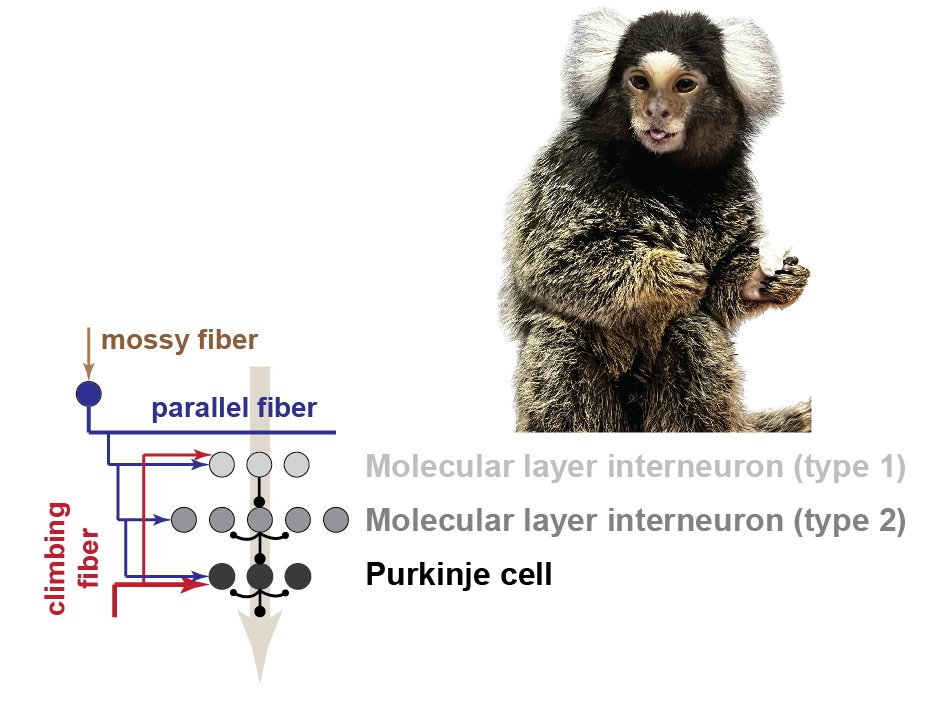
We believe that we have discovered a vector calculus for neural computation in the cerebellum: work of @ma_fakharian@just_alden @pauliehage @HElseweifi
https://t.co/mtXfVEdM9i
What does #neuroscience tell us about AI, and vice versa?
In this new PNAS paper, we find that real neurons' activation functions (f-I curves) share features with freq-used AI activation functions.
We measure many neurons w/ 2p holographic stim.
Work led by @pklafosse... 1/3 🧠📈 🧪
Nice news article in the @_TheTransmitter by @claulopezneuro featuring recent research from the @brody_lab and Tom Mrsic-Flogel's lab on decision-making.
https://t.co/83JmWVGlbc
Interested in interpretable #AI foundation models for #DynamicalSystems reconstruction?
In a new paper we move into this direction, training common latent DSR models with system-specific features on data from multiple different dynamic regimes and DS:
https://t.co/uaf1RcyTBi
1/4
@julie_charlton_ and I will be presenting at #sfn2024 on Mon, Oct 7, about cross-brain correlates of covert decision commitment, in the nanosymposium on “Neural Representation of Value and Choice During Decision Making.” Looking forward to the nano!
https://t.co/5OE2CMmdyE
How do brain regions interact with each other to give rise to a perceptual decision? @ayjreen@julie_charlton_ and I addressed this question by recording from 8 Neuropixels probes at the same time in rats doing a decision-making task https://t.co/qBMev3GDHF
When the rat commits to a choice before it makes a response, the moment of commitment could be detected earlier in M1 than any other regions studied, suggesting decision termination within the forebrain initiates in M1.
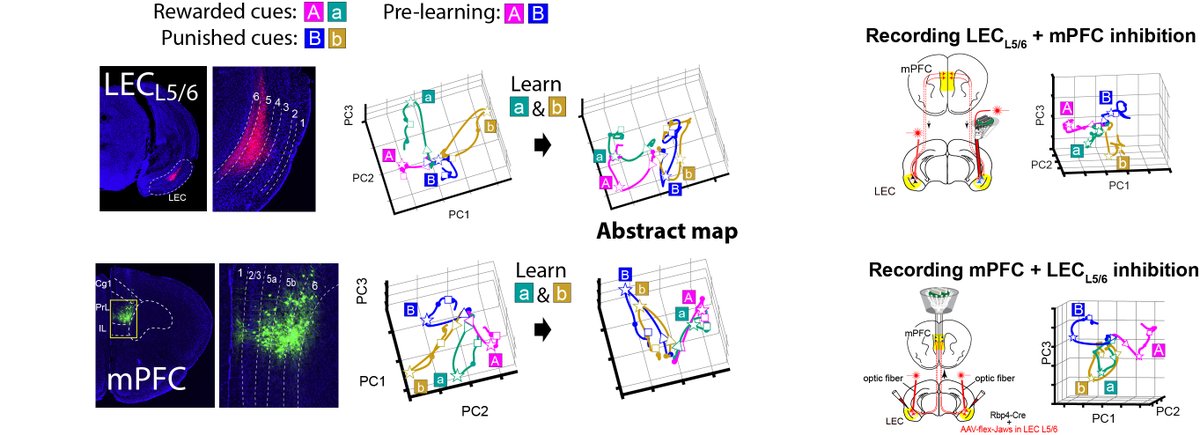
Where in the brain is abstract map generated?
It is the lateral entorhinal cortex (LEC) and the medial prefrontal cortex (mPFC), working together!!
Here is our new finding published in @Nature
Prefrontal and lateral entorhinal neurons
co-dependently learn item–outcome rules
Heechul Jun†, Jason Y. Lee†, Nicholas R. Bleza, Ayana Ichii, Jordan D. Donohue & Kei M. Igarashi*
Nature (2024)
https://t.co/nm2Ev96ej6
When you learn new items, your learned knowledge is sorted into an “internal map” of the brain. An internal map, also called as an “abstract map”, is made of population activity of many neurons.
In this new work led by Heechul Jun @jun_heechul and Jason Lee @jasonyensunlee, we found that the LEC deep layers and mPFC co-dependently generate abstract map during learning.
These two areas had bidiretional anatomical connections, making a loop circuit. Inhibition of the LEC disrupted the abstract map in the mPFC, and mPFC inhibition deleted LEC abstract map.
Our message is: LEC and mPFC are best friends!
@AnatomyNeurobio@UCIMedSchool@uci_bme@UCIEngineering@UCI_NeurCircuit@ucicnlm@ucimind@UCIrvineNews@UCIrvine
The capstone project of my PhD is now online 🤯 https://t.co/tehQ0PXESr
We argue that the cortex and striatum accumulate evidence in a distributed manner, with recurrent interactions helping to rescue computation upon perturbations.
Very excited to have posted a new preprint on my PhD work in the @brody_lab where we show that rats can achieve near-optimal time investment in a confidence-guided waiting task https://t.co/ogMkGIMN6w.