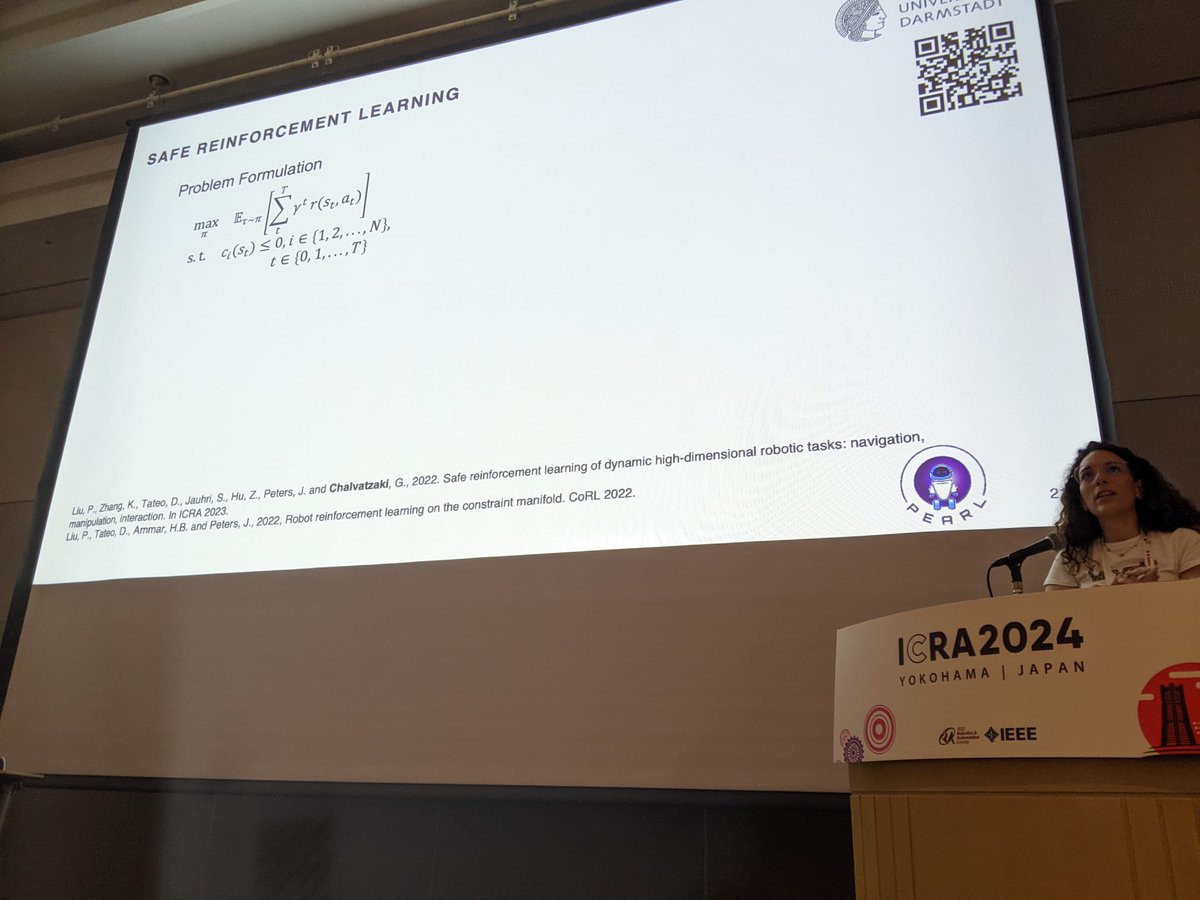
We are collating questions for the panel discussion session to be held during our Human-aligned RL workshop (https://t.co/2Rzk1vI8Wq) on 17th May at @ieee_ras_icra . What topics/questions relating to human-aligned RL for Robotics would you like to see being discussed?
If you are still considering submitting your work on Human-aligned RL, we have good news- we have decided to extend our submission deadline by an additional week! The new deadline is on 11th March, 23:59 AoE. We do not anticipate any further extensions.
The workshop on Human-Aligned RL for autonomous agents and robots will be held on 17th May 2024 at ICRA 2024 @ieee_ras_icra in Yokohama, Japan. Please find all details here: https://t.co/QOFJuocDnI
Consider submitting your article to the new spcl issue/research collection on Knowledge-guided Learning & Decision-Making in Frontiers in AI, that I am editing along w/ @devendratweetin @thommengk & @janadoppa#human_in_the_loop#ArtificialIntelligence
https://t.co/mZzJskmzJk
Happy to be recognised as a top reviewer in NeurIPS 2022! (https://t.co/1MrvpAmgQO). I hope more conferences and journals make steps towards acknowledging reviewers' efforts.
Thanks to all the participants for contributing to a successful HARL@ICDL 2021 workshop! We have made all the videos available on our YouTube channel here: https://t.co/EH8uRpWOzX
@ICDL_EpiRob
Sharing our recently published work on automatically incorporating domain priors into the reinforcement learning framework:
https://t.co/VXEwCs0F4p
Arxiv link: https://t.co/lvpXGf9gGe
Half-way through 2020, @DeakinA2I2 has 11 papers accepted at top-tier international conferences in AI, Machine Learning and Computer Vision: one in CVPR, two in ICML, two in ICLR, two in AAAI, two in AISTATS, and two in IJCAI. https://t.co/kC7hIt9DMi
There’s also a disincentive for inventors of an algorithm to thoroughly compare its performance with others—only to find that their breakthrough is not what they thought it was.
“There’s a risk to comparing 𝘵𝘰𝘰 carefully.”
https://t.co/OOAq2qMJie
Learning Human Objectives by Evaluating Hypothetical Behavior
“One benefit of our method is that, since it learns from synthetic trajectories instead of real trajectories, it only has to imagine visiting unsafe states, instead of actually visiting them.”
https://t.co/xqjuC9YiyY
The agent first learns a world model driven only by exploration, without task-specific rewards.
It then receives rewards to adapt to multiple tasks, such as standing, walking, running, flipping using either zero or only a few tasks-specific interactions.
https://t.co/5ccxqdYxUB