If machines are going to think like us, they need objective knowledge that can persist and evolve autonomously.
To that end, I’ve been exploring the construction of Popper’s World-3 as an ecosystem in which transformations evolve through variation and logical selection. To do so, I adopt Church’s λ-calculus as the natural formal language for describing such a system.
Draft paper: https://t.co/ywRaB4twFl
This is a first step toward what I’m calling Conjectural Reasoning Theory (the OSF repo name for now): a World-3-first approach to learning systems, and an attempt to make Popper’s epistemology operational.
It’s an open project, open to feedback, criticism, or collaboration.
@jchalupa_ Yeah, I agree, and that's a great way to put it. I am not making any serious objections to the idea of information, knowledge, constructor theory etc.
While reading the original constructor theory paper, I found this section interesting. Historically, I have been, and still am, not convinced about the idea of non-physical abstractions with causal power. Alas, I continue to baulk.
This is where I do find myself disagreeing slightly. Perhaps, more with the wording rather than the central point. But taking the idea of "abstractions having causal effects on physical systems" seriously, seems to weaken other important arguments.
For instance, a motivation for many worlds QM is to combat the seemingly irrational notion that an abstraction such as the wave function could affect the results of physical measurement. Which leads to the conclusion that the other worlds described by the wave function must be physically instantiated such that we observe interference phenomenon.
Furthermore, proposing that abstractions exist prior and independent to their embodiment in a physical system seems to border on a supernatural stance. It assumes the existence of a part of the universe which can greatly affect our world yet cannot be affected in return. In the former point this would be the wave function allowing "god to play dice." In our minds, this would lead to questions of free will. I.e. Are we truly creative beings if we have no control over which abstractions hijack our brains to perform physical transformations?
Nevertheless, I do rather like the definition of "real" as being anything which autonomously "kicks back". As such, I reject the proposal that abstractions are not real, as they undeniably do demonstrate this property. Rather, the concerns above leads me to require that all "real" entities, including abstractions, must exist physically in some system somewhere always.
A strange conclusion. Perhaps I am mistaken?
Anyway, this is not meant as a harsh critique, just some concerns I have had on this particular subject for a while. In short, I think it might be detrimental to claim that the source of ideas is a nonphysical world of abstractions. I can see how it could easily be criticized for its similarity to "divine inspiration/intervention".
Extract from David Miller “Critical Rationalism : A Restatement and Defence” (1994):
“Applied science is more like history than it is like theoretical science, in that when we are interested in applications we take the laws of physics for granted and search for appropriate initial conditions. How do we do this? How else than by conjecturing that some conditions will be appropriate (to produce, say, enough lift to get an aircraft aloft) and trying to show that our conjecture is mistaken? This elimination of tentatively conjectured initial conditions is characteristically done in one of two ways: theoretically— we use our scientific knowledge to rule out possibilities (that is, we exploit our knowledge) —and empirically-we try the conditions out, and see what happens. The latter method is of course decisive, but it is not 'using science'; moreover, as any test pilot will remind you, it leaves a lot to be desired. What pure science does not do is to suggest any assemblage of initial conditions that would be efficacious in achieving the kinds of practical goals that we desire. It is the business of engineers to discover sets of initial conditions that typically yield the right results. They are not just sitting there in the physics textbooks!
Efficient sets of initial conditions are often incorporated later in instruments such as potentiometers, watches, and refrigerators, or in other artefacts such as bottles of aspirin or nail-varnish remover. The behaviour of each of these human products is described by a collection of well-corroborated empirical generalizations; and, except in degenerate cases (such as consulting a watch in order to find out what the time is), these generalizations themselves have to be exploited, rather than simply applied, when there is a practical problem to be solved with their assistance.
…
…
as Mill perceptively noted …[“A system of logic, ratiocinative and inductive”](1843/1961, Book VI, Chapter VI, Section 1, 572):
‘It is not necessary even to the perfection of a science that the corresponding art should possess universal, or even general rules. The phenomena of society might not only be completely dependent on known causes, but the mode of action of all those causes might be reducible to laws of considerable simplicity, and yet no two cases might admit of being treated in precisely the same manner. So great might be the variety of circumstances on which the results in different cases depend, that the art might not have a single general precept to give, except that of watching the circumstances of the particular case, and adapting our measures to the effects which, according to the principles of the science, result from those circumstances. But although, in so complicated a class of subjects, it is impossible to lay down practical maxims of universal application, it does not follow that the phenomena do not conform to universal laws.’”
You're making this a question of authority. Let's not do that.
Just take the theory as it is. It says that "you" will split into two and that both of you will be molecularly identical and have the same shared past. The theory does not say that there is something 'in addition' that makes one of them 'you' and one of them 'not you.' That would be an ad hoc addition to the theory.
So given the theory, you tell me which is 'you'. Explain to me (without resorting to ad hoc additions to the theory) which is 'you' and which is 'not you.'
What I'm saying is that this can't be done. Thus the question is incoherent within the theory.
Yes, if you are allowed to ad hoc adjust the theory -- say, posting that there is 'something in addition' that passes to one but not the other even though the theory doesn't say this -- then sure, you can obviously ad hoc adjust the theory back to one of them being 'you' and one of them being 'not you.' But ad hoc adjustments are off limits epistemologically speaking.
Not at all. My objection would be that the thing we regard as an abstraction is not necessarily non-physical. Rather, in that case, it is information carried along by the many versions of people/machines involved in transferring the show from TV to PC.
My point being that, that information is always instantiated physically somewhere.
https://t.co/O7voKS131f
@NeilHudsonexp I deleted the last post because I think I missed your point entirely. I'll have to think about that.
My guess would be that the "license" is the court in reality, not an independent perfect abstraction of it.
@thoughtfullless Given that some tasks require extremely high precision I find the argument for perfectly precise abstract propositions sketched in this talk persuasive-are you unpersuaded? : https://t.co/sL455bnxvr
If I am understanding correctly I agree with how he frames truth with regards to abstractions, reality and statements about reality.
The only thing I'd argue against is that the precision required to represent an abstraction does not necessitate the abstraction to be non-physical.
Take his Wimbledon Court example. A complete abstraction of the court contains an infinite amount of counterfactual information, far more than any finite statement or observer can contain.
But why should we conclude from this that the abstraction is non-physical?
When I think about the court, I instantiate some finite part of that structure physically. In the multiverse picture, there are other versions of me considering different aspects of the court. Some correspond correctly to the actual court, while others are mistaken, but each is a physical state.
The abstraction is then not a separate non-physical object. It is the collection of these physically instantiated possibilities. No single observer contains the whole abstraction, but every part of the abstraction exists physically somewhere, in both erroneous and correct forms. Truth is simply the subset of those physical representations that correspond to the actual court.
I'll admit this argument is kind of hand-wavey so I'm not anchored to it but I have a hard time getting away from it.
https://t.co/w4Ix9C0e7V
@bnielson01 Thank you and if you do get around to it I'd appreciate any feedback you have! NotebookLM might be useful for getting a somewhat accurate summary.
I'll admit some parts are probably underdeveloped but I did my best to get the general ideas across.
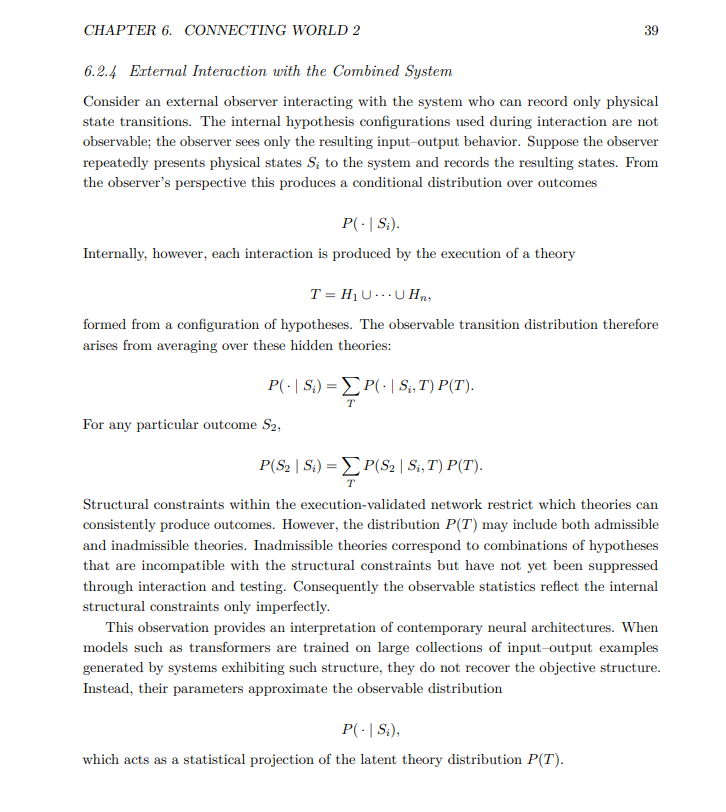
How can we explain the effectiveness of probabilistic approaches in machine learning, if the world itself does not in general behave according to probability calculus?
I attempt to answer this in the “External Interaction with the Combined System” section.
When a machine learning system is trained on input–output data, it is not learning the world’s structure directly. It is sampling from a distribution over hypotheses that an agent has already constructed. That distribution has already been constrained by interaction with the world and by internal logical structure.
Datasets are effective because they capture the behavior of systems whose hypotheses have already been filtered and refined.
Well, the second is easier. There are many successful bayesian ml models all over the place. They may well model very complex phenomenon. Their success has to be explained, rather then merely dismissed.
So apparently we can apply bayesian reasoning to the real world and not just to small artificial worlds.
That's really what I meant.
@curiouswavefn The Teachers' Conspiracy is when teachers bond over the alleged poor quality of their victims and blame them, in order to justify hurting them further.
@bnielson01 When I said, "the world itself does not behave according to the probability calculus", I meant in that it doesn't provide an observer with all possible hypotheses.
Definitely a slight misuse of the phrase on my part.
Wow, sorry, I did not see this response until the recent episode made me revisit this discussion.
Having listened to the episode and reread through our exchange, I think maybe I was just tunnel-visioned on defending the underlying ontology, which I do not think you actually disagree with. From that perspective, the statement "QT does not obey the probability calculus" made sense to me.
But I understand that your argument is more against the dismissal of probability completely by critical rationalists and the like. I would agree that any measurement of the evolution of a quantum system will behave according to the probabilities given by the Born rule. Further, a rational observer can use these probabilities to inform their decision-making.
So, in that sense, "QT does obey the probability calculus" also makes sense to me. I never intended to dismiss probability as an emergent layer.
Outside of the intentions behind our respective statements, I do not really see where we fundamentally disagree.
Sure, just as we can say A -> C represents a change in the *state* of the substrate while the substrate itself is conserved, we could say b -(C)-> d represents C changing the state of the overall constructor so that it can perform the next transformation. In that sense, the constructor as a whole may be conserved.
I think this description is mostly equivalent to treating b and d as two distinct constructors, where C alters b to build d.
The key point is that b is conserved across its own task, T = {A -> C}, so it remains a valid constructor. It is simply changed by a subsequent task.
As such, I prefer to view this as a role shift.
In the first claim, the cell state is the substrate and the expression machinery, b, is the constructor. In the shifted claim, the roles reverse: the machinery becomes the substrate, and the cell state physically acts upon it.