THEO VON: “Was there anybody who was immune to COVID-19?”
DR. MCCULLOUGH: “There’s one adult group. You’re going to laugh.”
[Theo Von listens closely for the reveal]
DR. MCCULLOUGH: “Smokers… They got very mild cases. And they don’t get long COVID.”
THEO VON: “Why?”
MCCULLOUGH: “Because smokers maintain a level of nicotine in the bloodstream… Smoking blocks the spike protein. It’s amazing. I thought smokers were going to go down.”
THEO VON: “Do you think that’s a good idea [to use nicotine patches] on a regular basis?”
DR. MCCULLOUGH: “I think [it’s a good idea] if they have long COVID... Nicotine, don’t forget, is a nootropic. A nootropic is a drug that makes the brain function more effectively... It’s addictive, but it’s not harmful to the human body... Nicotine patches are perfectly safe.”
A great way to see Van Gogh's "Starry Night" is to stare at the center of the spiral for 20 seconds and then look at the painting.
Why Starry Night was so famous: https://t.co/P8BvRGohvu
US inflation is persistently running above the Fed’s target:
US PCE inflation has surged +28.5% since February 2018, to an all-time high.
Had inflation run at a steady 2% target, it would have risen +17.4% over the same period.
In other words, the current path overshot the target by +11.1 percentage points.
The gap began to widen in 2021 following massive economic stimulus in response to the pandemic and near-zero interest rates in 2020 and 2021.
As a result, PCE inflation has been above the Fed's 2% target since April 2021, spanning 60 consecutive months.
The most recent reading for March stood at 3.5%, the highest since June 2023.
Inflation in the US remains way too high.
@JesseCohenInv It may turn out, the current manipulation is to get the price of oil down as low as possible, a buffer if you will, then the strikes can resume.
$120 a good headline it does not make, but the masses are used to $100, $105.
30 gunshots fired at the White House Today
2016: Shots at the White House
2018: Shots at the White House
2020: Shots at the White House
2021-2024 No shots at the White House
2025: Shots at the White House
2026 Shots at the White House
The Democrat Party is the party of Violence
Did you know the Founders' Congress wasn't handed fat annual salaries? From 1789 to 1855 (with one short exception), Members of Congress were paid per diem — by the day, only for days they actually showed up in session. Started at $6/day in 1789 (roughly $170–$180 in today's money). Later bumped to $8. Plus travel allowance. No work, no pay.
Early Congress didn't sit year-round like today. Sessions were short — often a few months. Lawmakers had farms, businesses, and real lives back home. Per diem kept them citizen-legislators, not a permanent ruling class. It matched the vision: public service, not a lucrative career.
Then in 1816, Congress tried switching to a fixed $1,500 annual salary. Public outrage exploded. Voters saw it as self-dealing. Congress repealed it the next year and went back to per diem. It wasn't until 1855 that annual salaries stuck — and the slow creep toward today's $174,000 base (plus benefits, pensions, and perks) began.
Fast-forward: Congress now works ~100–150 legislative days a year but collects full-time pay regardless. Many fly home most weekends. Per diem created natural accountability. Annual salaries removed the incentive to finish the people's business quickly and return home. It professionalized a job meant to be temporary.
Revive per diem. Pay Members a reasonable daily rate (say, adjusted for inflation and cost of living in D.C.) only for certified days in session or official travel. Tie the rest to performance and actual attendance. No more guaranteed six-figure salary for part-time effort.
Congress can set its own pay. The 1816 backlash proved the public can demand change. It's time to make them earn it — by the day.
What do you think? Should we push for per diem reform?
This would:
* Force shorter, more productive sessions
* Reduce careerism
* Cut costs to taxpayers
* Bring back citizen-legislators who live under the laws they pass
Under the Biden administration, the Federal Housing Administration began insuring mortgages by private lenders to non-citizens
Matt Walsh “These loans are intended for low-income Americans, but instead foreigners, people who are not even citizens, are getting them. Yes, non-citizens, even if they didn't have a steady income or collateral or good credit, have been walking into new homes by putting only 3.5% down”
“So while you were doing the responsible thing and saving up $80,000 to put down on your $400,000 home, an illegal alien only had to spend around $14,000 for the same home. That's what you've been competing against.”
Yes, this really happened. Here’s what Democrats did
FHA loans insured by the Federal Housing Administration offer low down payments (as low as 3.5%) and more flexible credit and income requirements
In January 2021, right after Biden took office, FHA issued guidance expanding eligibility for certain non-permanent residents
This allowed some non-citizens to qualify for FHA-insured mortgages under the same terms as American citizens and permanent residents
You can’t afford a home but noncitizens were being given home loans
This Jesse Ventura episode in 2009 was cancelled
Watch it and you will see why.
The details this lady provides of things that would come to pass a decade later are shocking.
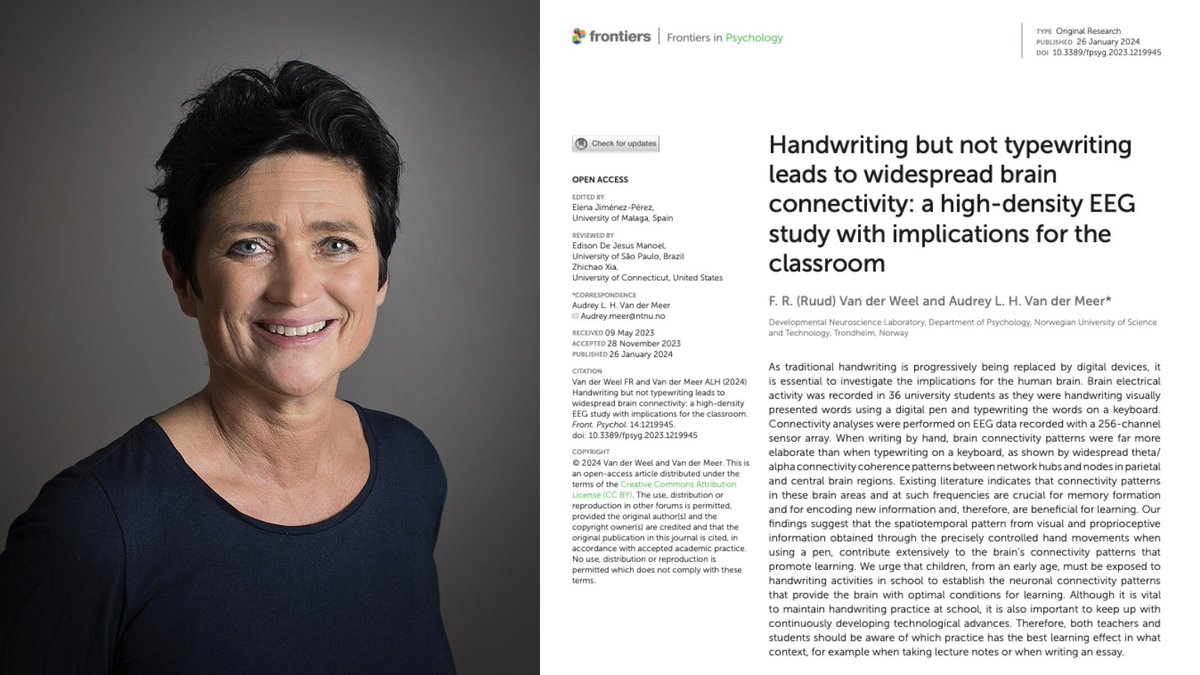
A Norwegian neuroscientist spent 20 years proving that the act of writing by hand changes the human brain in ways typing physically cannot, and almost nobody outside her field has read the paper.
Her name is Audrey van der Meer.
She runs a brain research lab in Trondheim, and the paper that closed the argument was published in 2024 in a journal called Frontiers in Psychology. The finding is brutal enough that it should have changed every classroom on Earth.
The experiment was simple. She recruited 36 university students and put each one in a cap with 256 sensors pressed against their scalp to record brain activity. Words flashed on a screen one at a time.
Sometimes the students wrote the word by hand on a touchscreen using a digital pen, and sometimes they typed the same word on a keyboard. Every neural response was recorded for the full five seconds the word stayed on screen.
Then her team looked at the part of the data most researchers had ignored for years, which is how different parts of the brain were communicating with each other during the task.
When the students wrote by hand, the brain lit up everywhere at once.
The regions responsible for memory, sensory integration, and the encoding of new information were all firing together in a coordinated pattern that spread across the entire cortex. The whole network was awake and connected.
When the same students typed the same word, that pattern collapsed almost completely.
Most of the brain went quiet, and the connections between regions that had been alive seconds earlier were nowhere to be found on the EEG.
Same word, same brain, same person, and two completely different neurological events.
The reason turned out to be something nobody had really paid attention to before her work. Writing by hand is not one motion but a sequence of thousands of tiny micro-movements coordinated with your eyes in real time, where each letter is a different shape that requires the brain to solve a slightly different spatial problem.
Your fingers, wrist, vision, and the parts of your brain that track position in space are all working together to produce one letter, then the next, then the next.
Typing throws all of that away. Every key on a keyboard requires the exact same finger motion regardless of which letter you are pressing, which means the brain has almost nothing to integrate and almost no problem to solve.
Van der Meer said it plainly in her interviews.
Pressing the same key with the same finger over and over does not stimulate the brain in any meaningful way, and she pointed out something that should scare every parent who handed their kid an iPad.
Children who learn to read and write on tablets often cannot tell letters like b and d apart, because they have never physically felt with their bodies what it takes to actually produce those letters on a page.
A decade before her, two researchers at Princeton ran the same fight using a completely different method and ended up at the same answer. Pam Mueller and Daniel Oppenheimer tested 327 students across three experiments, where half took notes on laptops with the internet disabled and half took notes by hand, before testing everyone on what they actually understood from the lectures they had watched.
The handwriting group won by a wide margin on every question that required real understanding rather than surface recall.
The reason was hiding in the transcripts of what the two groups had actually written down.
The laptop students typed almost word for word, capturing more total content but processing almost none of it as they went, while the handwriting students physically could not write fast enough to transcribe a lecture in real time, which forced them to listen carefully, decide what actually mattered, and put it in their own words on the page.
That single act of choosing what to keep was the learning itself, and the keyboard had quietly skipped the choosing and skipped the learning along with it.
Two studies. Two countries. Same answer.
Handwriting makes the brain work. Typing lets it coast.
Every note you have ever typed instead of written went into your brain through a thinner pipe. Every meeting, every book highlight, every idea you captured on your phone instead of on paper was processed at half depth.
You did not forget those things because your memory is bad. You forgot them because typing never woke the part of the brain that would have made them stick.
The fix is the thing your grandmother already knew.
Pick up a pen. Write the thing down. The slower road is the faster one.
@TheChiefNerd "But, as by this theory innumerable transitional forms must have existed, why do we not find them embedded in countless numbers in the crust of the earth?
Charles Darwin, On the Origin of Species (1859), Chapter 6 ("Difficulties on Theory").
#charlesdarwin
🚨WOW!!!
Tim Sparks has confirmed he purchased 80 PIZZA HUTS and brought back EVERYTHING that made them iconic!
Pac-Man is back.
Salad bar is back.
Red cups are back.
Booths for families.
"I want to rebuild places for families to connect and put their phones down..."
@CitizenFreePres ~10-15% (roughly 50k–75k of the 500,000) attend small colleges; analyses point to dozens of small private institutions facing severe risk or closure (~ 1–5%). ~18% of Chinese students tied to US economic espionage.
Sources, https://t.co/HdmQP6NYo6 and forbes
@KobeissiLetter The explosion in global liquidity is a key reason we're seeing record leverage—it's the monetary "permission slip" for the current risk-on behavior. Loose policy → asset inflation → more borrowing.
#globalmoneysupply#margin
@Bannons_WarRoom President G HW Bush also had Scowcroft deliver a personal letter to Deng Xiaoping that is equal measures shameful and disgusting. It's worth a look if you want to see a President embarrassing America. China knew it had nothing to worry about from the US. https://t.co/tc9FcMxfoj
Friendly Reminder:
If your income has not risen by at least 30% since Covid hit, you are now poorer.
And that is using the government’s own data.
The real number is likely 40% plus.