Reliable wind-and-solar-based electricity systems need to be designed taking more years of weather data into account than is now common practice, because weather is quite variable even at continental scale.
Paper: https://t.co/20VXSMl6VR
Research Brief: https://t.co/CxHeJBeAFs
Check out my first-author paper, published in @ACSPublications@EnvSciTech, exploring the value of single- and multi-storage portfolios in #energy systems reliant on #solar and #wind.
• Paper: https://t.co/mqE2OaSHWP
• 2-page brief: https://t.co/NpyUZ01mN7
#Renewables
This is an excellent group asking big questions at the intersection of #Economic#development and #climate
I was privileged to join @KenCaldeira and team as I transitioned from studying particle physics to low-carbon energy systems
I highly recommend these positions to others
Are you looking for a position as a postdoctoral research scientist and thinking about how we could provide better information and tools to make decisions at the intersection of economic development and climate goals?
https://t.co/dAPTBYrAUC
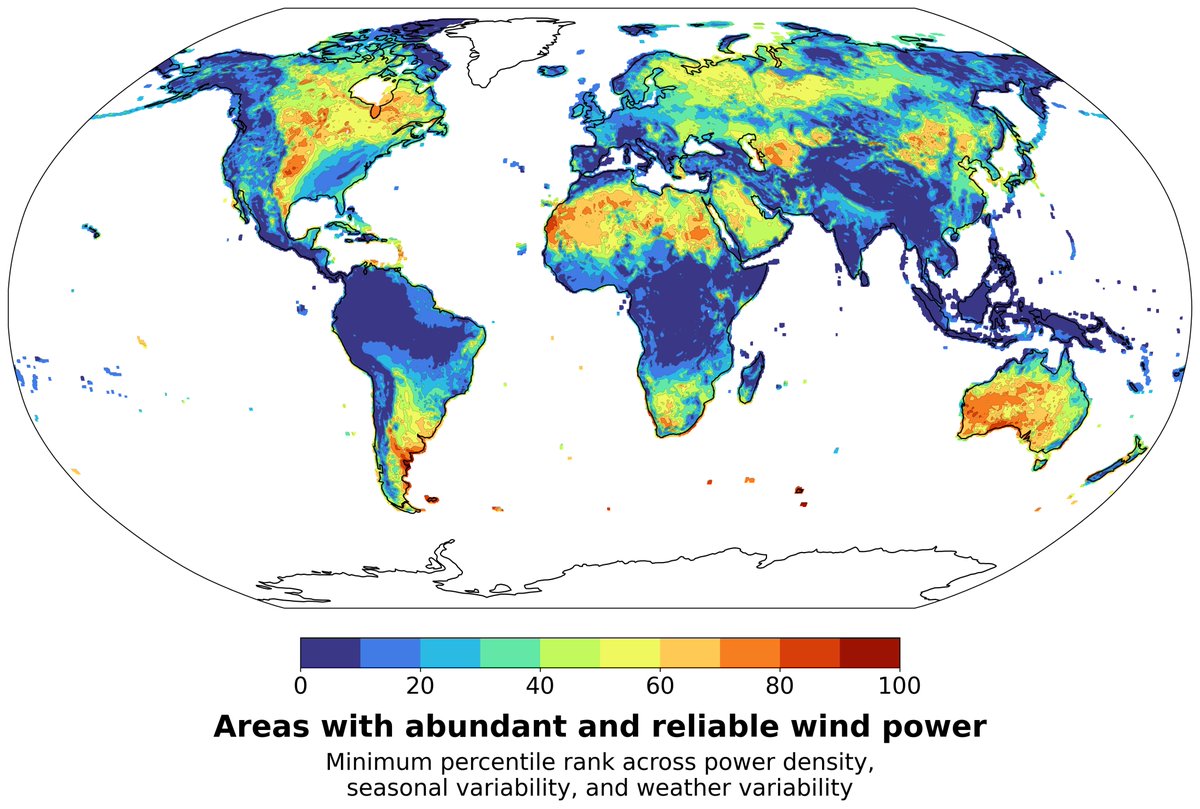
Ever heard about wind droughts – prolonged period of low wind power generation?
In a new paper, we identify global patterns of wind droughts, their frequency, and places that instead have highly reliable winds.
🧵👇
https://t.co/XfbFx9bwti
Where is wind power the most abundant and most reliable?
Was the European wind drought of 2021 due to climate change or are winds in Northern Europe just that variable?
A new paper by Enrico Antonini and colleagues has the answers.
https://t.co/9LU1LDJ7wP
@CarnegieScience
@RKonidena@ERCOT_ISO@JEBistline@MISO_energy Thanks! I can find the cleared quantities in these reports. I still don't see how to know if an asset was deployed or not in those reports.
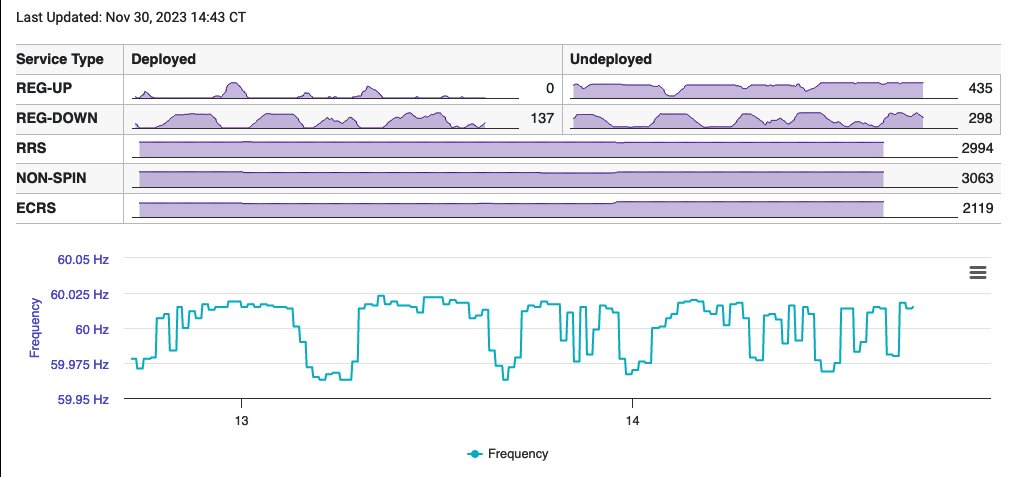
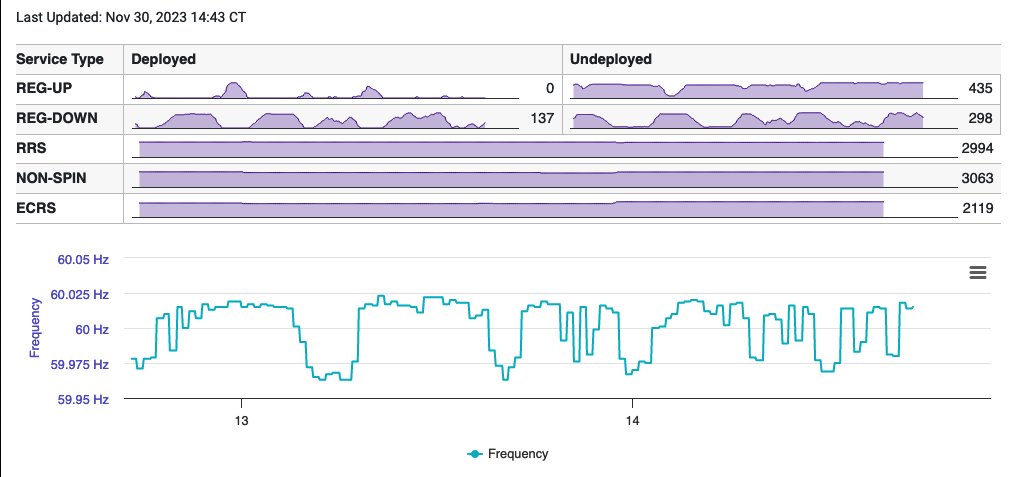
Back to the ERCOT figure. Not all RegUp are being deployed most moments, but the undeployed (yet cleared) are still being compensated, no?
Ancillary Services Question for #energytwitter:
Are there public resources showing how often different AS have been deployed in different ISOs? Specifically, I want to compare the rate of deployed vs. just clearing the market. Thanks!
@RKonidena@ERCOT_ISO@JEBistline I want to understand how often a resource is compensated for AS, but not actually called upon to provide.
In the FERC figure you shared, it is possible the resources that cleared were called upon many times for peak events, or not at all over the course of a year.
@RKonidena Something like this @ERCOT_ISO chart showing deployed and undeployed Reg-Up and Reg-Down. I want the sums over the full year. Plus, RSS, Non-Spin, and ECRS, which appear to be cleared and online, but not necessarily deployed in the figure. https://t.co/RuSITCnXFP @JEBistline
@RKonidena I had started with the individual market monitor annual reports
I've found avg cleared capacities and avg $/MW-h cleared and some examples of deployment during scarcity events
But no simply quantification of deployed / cleared
@EmielVanDruten@KersevanRoberto@JesseJenkins@EvelinaStoikou That's amazing that the high 2030 value from this 2021 analysis is almost the same as the low 2030 value from the 2023 analysis.
There must be more than just a change in raw material costs between these two analyses.
@EmielVanDruten@JesseJenkins@EvelinaStoikou How are these trends translating into installed costs for grid-scale battery energy storage? What is a reasonable "Li-ion battery pack" cost to "installed" cost multiplier?
@NWRAT @Davis_StevenJ Huge thank you to the Technical Support Unit for their delivery of this figure. I just sent them excel tables and labels.
#NCA5#NationalClimateAssessment
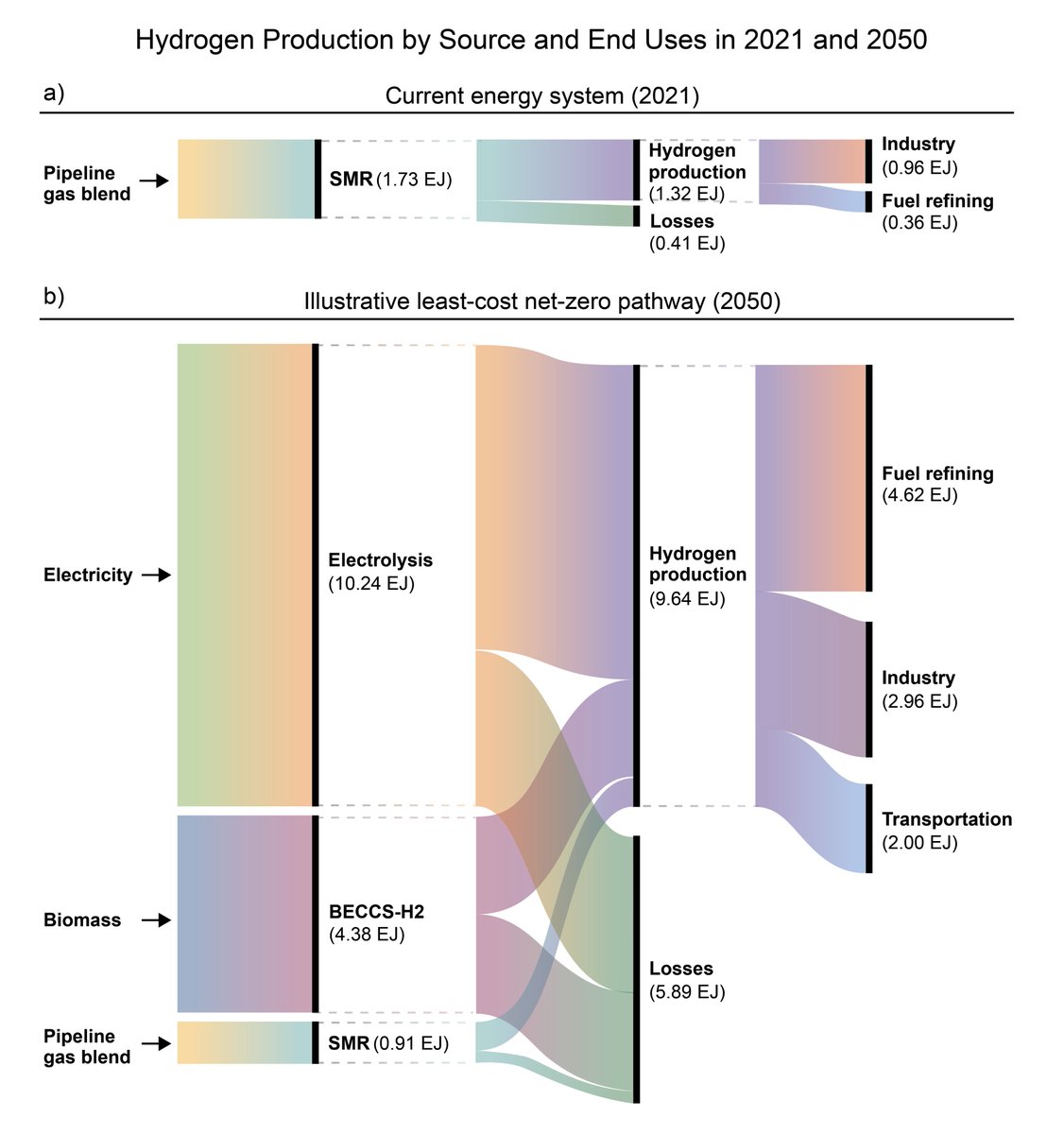
The 5th National Climate Assessment was released last week. I had the pleasure to develop the "#hydrogen box", which presents challenges and opportunities for H2 to aid in decarbonizing, along with @Davis_StevenJ, Ryan Jones, and the rest of the authors.
https://t.co/r9E6tIzuY1
The figure show #hydrogen production, energy losses, and uses now and a possible illustrative 2050 scenario. The 2050 scenario is adapted from the Annual Decarbonization Perspective (ADP) 2022 illustrating H2's possible role in the #EnergyTransition
https://t.co/aFx3avg1Ii
@guntherglenk Bravo! I've been using and discussing your electrolyzer cost learning rates with colleagues since this was first available in pre-print. I'm so glad to see it here.