Its interesting how narrow the definition of an "economic theorist" has become.
Back in the 1980s someone could be a "micro theorist" and publish papers on the JPE about the history of economic though. Today, one's work has to be very narrow, usually about decision theory, bayesian persuasion, some forms of applied math.*
If one does theory of anything else, then one becomes a "macro theorist" or an "applied theorist." The second term can be regarded as a logical contradiction.
My definition of an economic theorist is just someone whose work is not just about extracting information from data but involves theoretical innovations in any field of economics. All great economists such as Adam Smith, Ricardo, Malthus, Jevons, Mill, Marshall, Keynes, Hayek, Friedman, were theorists, even if sometimes they wrote books on the monetary history of a country.
*Interestingly, since game theory and graph theory (networks) are fields of mathematics with economic applications, one can be in fact a pure mathematician in all their publications and still be regarded as an economic theorist.
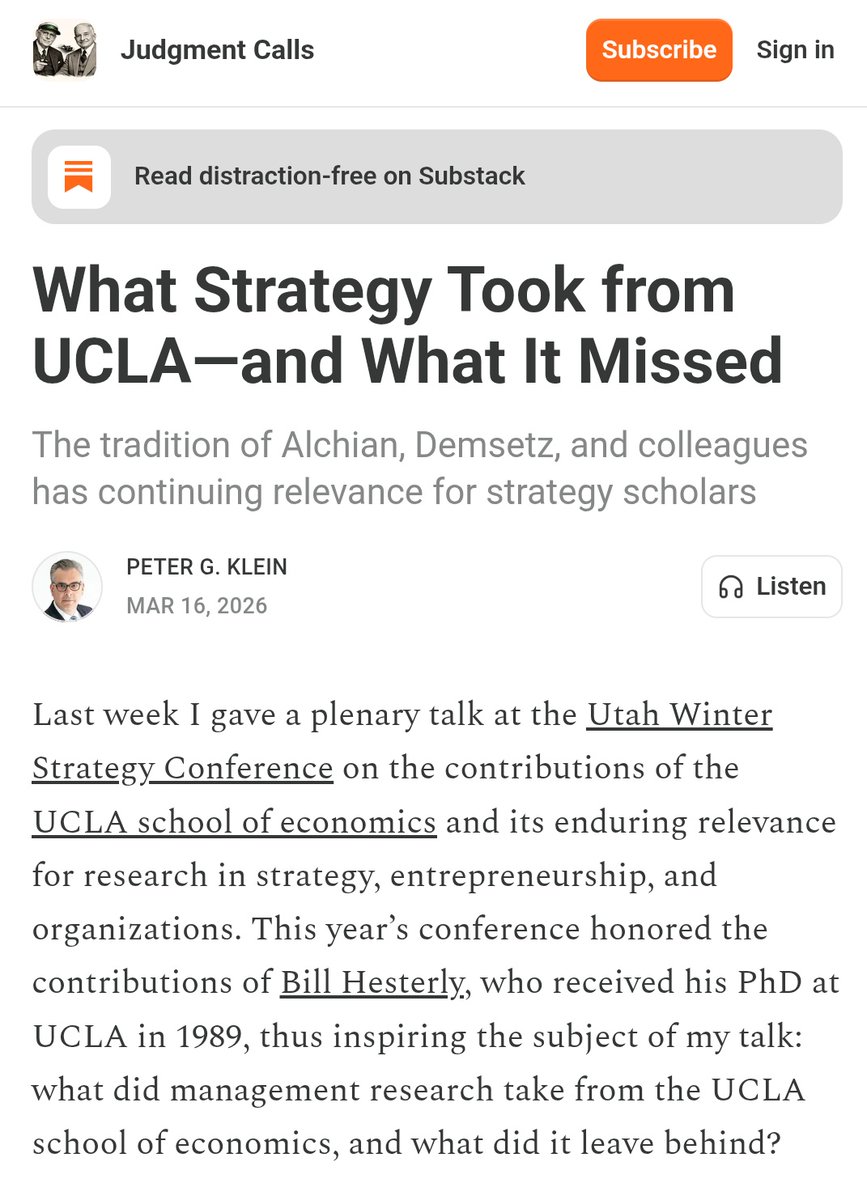
Kevin Murphy’s opening lecture is an amazing glimpse into an alternative approach to, yes, antitrust but I think much of economics
Gains from trade as the unifying theme
I don’t know what to say. I use it every day in part because I was a small part of it as ucla was my first job and Chicago my second. The funny thing is that Harold could not conceive for him self how it was applicable to strategy. He told me this….
Peter is right - the UCLA school is the most underrated school of economics among the general public. So many great ideas in every other 70s UCLA paper. And of course a huge influence on Rumelt, who you will know from Good Strategy, Bad Strategy (read this one also!)
I'm sad to hear that Prof. Takeshi Amemiya of @Stanford has passed. He was a brilliant econometrician and gifted teacher. As a student, I took several classes with him.
My favorite memory: Whenever a student would ask him a hard question, he would stop short and stare straight up at the ceiling in awkward silence. Suddenly, when the answer came to him, a look of glee would appear on his face. "Ahh!" he'd say and meticulously write out a fully worked-out proof on the chalkboard.
He had such a clean way of thinking about probability, statistics, and econometrics. I will always be grateful for everything he taught me.
I wish all comfort to his family and to all who knew and loved him.
Paul Ehrlich has died. He was 93.
He is survived by 8,300,678,394 people (134% increase from 1968), with a daily worldwide average calorie intake of 2,800 kcal (a 22% increase).
When AI first arrived on the scene, I worried it would make economists, or even critical thinkers more broadly, less valuable. In my travels in the past 6 months to work with non-profits, for profits, and government agencies, I have observed how people are actually using AI. I have watched them fumble around with insights they clearly did not create themselves.
My fears are now assuaged. One observation is that AI can produce something that in some cases is very wrong and in others looks nearly right, but is not quite there. Even if in time AI improves to "nearly right" or "exactly right" every time, a second issue still arises: explaining the materials.
Explaining why an answer is almost correct but subtly off requires exactly the critical thinking skills that created the knowledge in the first place. Even explaining "exactly right" material takes critical thinking. I've watched smart people confidently present AI-generated material they clearly don't fully understand. The words sound right. But when someone pushes back just a little bit, the sand castle crumbles.
It is quite difficult to defend what you didn't build. This leads me to now make the optimistic case for human expertise. The value of deeply understanding something — of having built the knowledge yourself — hasn't diminished with AI. If anything, it's increased. The people who can tell the difference between "nearly right" and "right" are more valuable than ever. The people who can explain the subtle details about something that is exactly right are invaluable.
Creating knowledge still matters. Maybe now more than ever.
ICYMI: The credit-card routing mandate would backfire on consumers, weaken security, and increase fraud, warns ICLE Senior Scholar @Julian_Morris. While lowering merchant costs is understandable, interchange-fee revenue helps balance the two sides of the market. 🔗⬇️
Everything you learn in the gym applies to life.
-Reps are the only way to get better
-Showing up over and over is the only hack that works
-Losing the fear of failure is the only way to accomplish anything big
-Do a little more every week and tiny wins build into something huge
To be clear, Akerof's lemons is a beautiful theory. The question is, does it apply and when? Like Coase for externalities, it can be an opening to seeing institutions that solve the information problem, not just excuses for the benevolent planner to ruin health insurance because "markets fail."