Traces of Texas reader Carol Horn graciously sent in this photo of @WillieNelson that, as far as I can tell, has never appeared on the internet. It was taken in 1950 in Abbott/ Waco, and shows Carol's cousin, Jo Nichols, with her friend Willie Nelson, who showed up in his Air Force uniform. Willie was in the Air Force for about 8 months in 1950 and early 1951. Look at him! Look at young Willie looking sharp in his uniform!
Thank you, Carol. This is AWESOME.
Now that the US is knocked out, I am formally extending an invitation to the American people to support Norway.
Why?
1: The Vikings discovered America before Columbus.
2: There are more ethnic Norwegians in the US than in Norway.
3: Next weekend we can pillage the English peasants together.
4:
The Arcane Texas Fact of the Day: Beaumonsters Edgar and Johnny Winter sat in for a gig with the great B.B. King at the Raven club in Beaumont back in 1961. I had heard of this event but never knew much about it and certainly did not know that there was a photo of it until "Sweetwater Sal" posted about it on my TOT forum. I found an interview with Johnny in which he mentioned it and said it essentially came after he begged B.B. to let him and his brother sit in. "He didn't even know if I could play or not," Johnny said later. "I'm surprised he let me play but he finally did after I bugged him to death. But I really wanted him to hear me play plus I wanted to play for a black audience and see how that worked." The Raven was a club that appealed primarily to an African-American clientele, and I wonder what the crowd made of the two brothers as they sat in with the great B.B. King. And the music! Oh, to be a fly on the wall that night! Shown here, L-R: Bobby Reeder, Johnny Winter, B.B. King, Edgar Winter and Isaac Peyton Sweat.
Thanks so Sweetwater Sal for sharing this photo, which was taken by a man named Steven Beal.
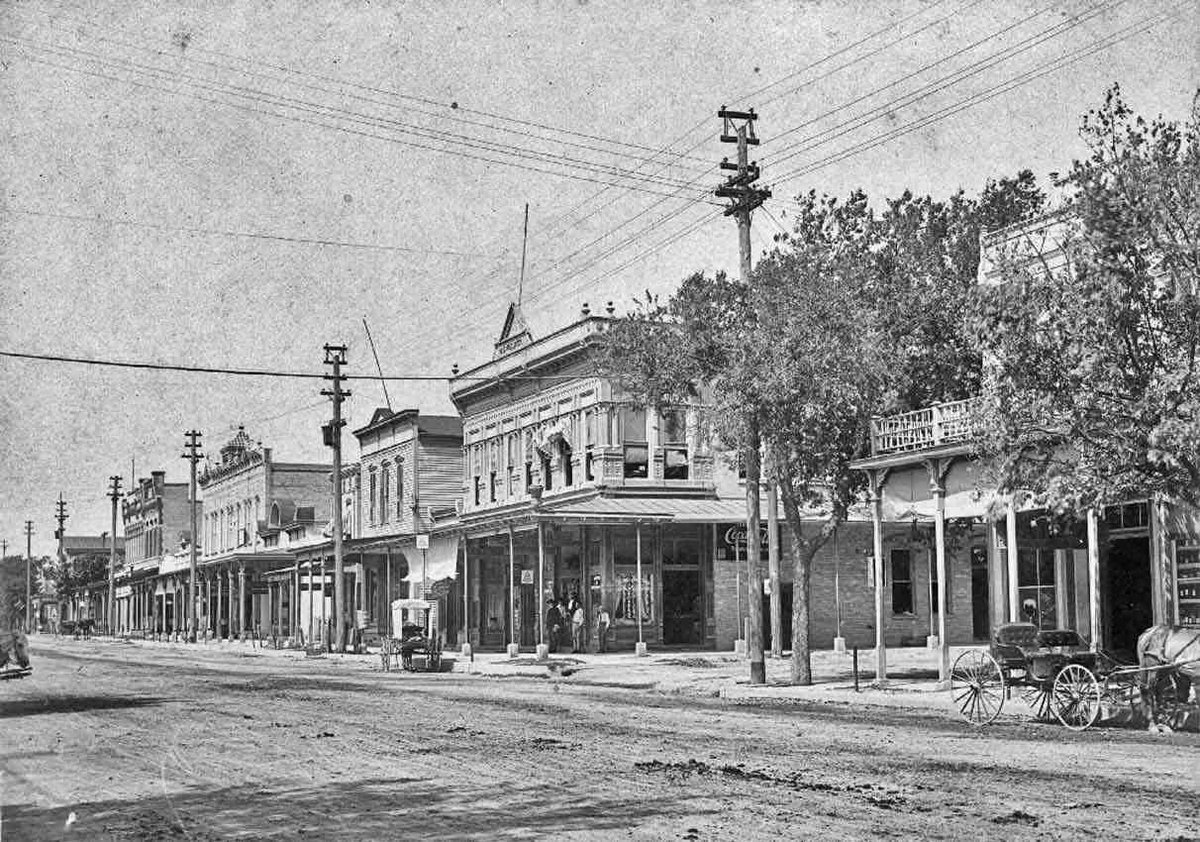
The Arcane Texas Fact of the Day: 182 years ago today, on July 1, 1844, Prince Carl of Solms-Braunfels, the first commissioner general of The Adelsverein, arrived in Galveston. He bought land on Matagorda Bay for a port of arrival he named Carlshafen (later Indianola), traveled extensively in Texas, and subsequently advised the Adelsverein to buy specific tracts of land. The first German settlers arrived at Indianola in December, 1844 but did not reach their new home --- New Braunfels ---- until Mar. 21, 1845. And the next thing you know, bread was being baked, beer was being brewed, and they were planning Wurstfest.
In the past, I tried to think of the courage it must have taken to completely uproot oneself from a place in which you were born and raised, get on a ship, travel 5,350 miles to a place in which a different language is spoken, different crops grow etc ... And I wondered why somebody would do that, so I've been researching it for the past few days. It turns out that it wasn't just the siren song of freedom's call that caused them to take the chance. Rather, it was a combination of that song and desparation.
Briefly: First, it's important to remember that "Germany" did not yet exist as a unified nation. Instead, there were dozens of independent kingdoms, duchies, principalities, and free cities loosely organized within the German Confederation. Many of these states were struggling economically. Population growth had outpaced available farmland, particularly in rural areas. Families that had once expected to divide farms among their children found that there simply wasn't enough land to go around. A peasant's son might inherit a field too small to support a family, or nothing at all.
Economic hardship was widespread. The beginnings of industrialization disrupted traditional crafts and trades. Artisans, weavers, and small farmers often found themselves squeezed between rising prices and declining opportunities. In the years just before Prince Carl's recruiting efforts, a series of poor harvests and food shortages made matters worse. The potato blight that devastated Ireland also affected parts of continental Europe, and grain prices soared.
There were political pressures as well. Many Germans lived under conservative governments that restricted freedom of speech, censored newspapers, and discouraged political participation. After the defeat of Napoleon, European rulers had worked hard to suppress liberal and nationalist movements. Young, educated Germans who dreamed of constitutional government and greater personal liberty often found themselves frustrated by the rigid political order.
Texas, by contrast, was marketed as a place of extraordinary opportunity. The promotional literature distributed by the Adelsverein painted a picture that must have seemed almost fantastical: abundant cheap land, political freedom, a mild climate, and the chance to build prosperous farming communities while preserving German language and culture. To a struggling farmer in Hesse or Nassau, Texas appeared as a vast blank canvas.
Of course, as we all we know, there's marketing and then there's reality, and woe be unto he who conflates the two. Prince Carl himself quickly discovered that central Texas was far more challenging than brochures suggested. Many immigrants arrived with unrealistic expectations, and thousands suffered terribly during the difficult overland journey from the coast to the interior. Many of them walked the 130 miles from Carlshafen to New Braunfels. Can you imagine? The heat, the mosquitoes ... EEESH! But they were tough, smart folks and they succeeded.
So my take is this: German migration to Texas was driven by a combination of "push" and "pull": Germany pushed with poverty, overcrowding, and political frustration, while Texas pulled with promises of land, freedom, and the possibility of starting life over on an entirely new frontier. The Germans came and it was ausgezeichnet. Personally, I'm glad they did, on account of I'm a huge fan of apple strudel. And beer, of course.
By the way, I really recommend "Revolutionary Spring: Europe Aflame and the Fight for a New World" by Christopher Clark for folks more interested in this subject.
Shown here: New Braunfels circa 1895.
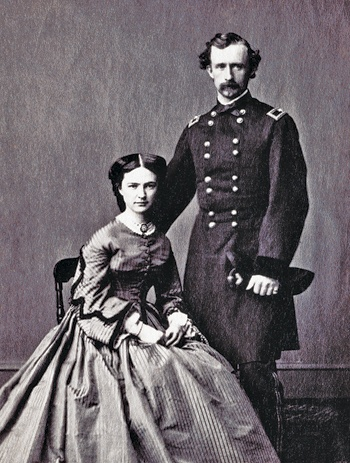
When George Custer died at Little Bighorn in 1876, his wife Libby was 34.
She had followed him everywhere. Lived in tents on the open plains. Slept in forts on the edge of nowhere. Then in one afternoon he was gone, and she was a widow with almost no money and a husband whose name was already being dragged through the mud.
Most women in 1876 would have remarried. She had offers. She turned every one down.
Instead she picked up a pen. Three books. Lecture tours. She built his legend with her own hands.
And she defended him so fiercely that the officers who blamed Custer for the disaster just kept quiet. They were not afraid of the Army. They were afraid of her.
So they waited. Year after year, for the widow to finally pass so they could talk without her tearing them apart in print.
She made them wait almost 57 years.
Libby Custer died in 1933, four days short of 91, having outlived nearly every man who ever doubted her husband.
She is buried right next to him at West Point.
That is what loyalty looks like.
HAVE YOU SEEN GRACIE? A giraffe is on the loose in the Texas Hill Country, and her owners are asking for the public's help to bring her home: https://t.co/l7L95X2TW9
Happy Birthday, Houston!!!! You're 189 years old today. It was on June 5, 1837 that the Texas congress incorporated the town of Houston after the Allen brothers started advertising the previous August that they were going to build a town they would call Houston. I always wonder what they'd say if you to drive them from Katy to downtown Houston on I-10.