Introducing HeroUI v3.2.8! 🚀
Your agent can now theme HeroUI for you.Describe the look you want, and the new `heroui-theming` skill writes a complete theme, light and dark, with global CSS only
Tailwind Variants 4.0.0 is out! 🚀
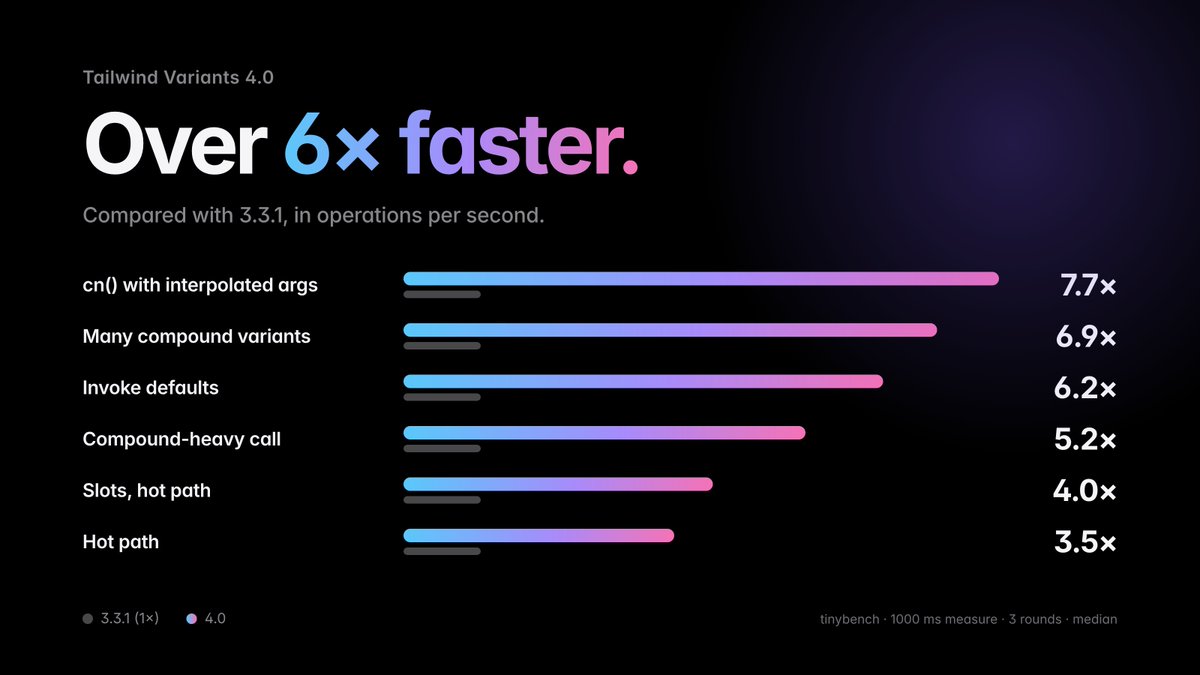
✓ tv() → up to 6× faster
✓ cn() → up to 6× faster
✓ Zero dependencies → no more peers
✓ New /merge & /config entries
✓ Multi-extend → extend: [a, b, c]
✓ Debug mode (experimental) → see why a class wins
Major release, migration guide included.
Full release notes ↓
https://t.co/LUJFlYIr4B
The Duo fold animation is everywhere, but the product viewer slider is the part that feels right: magnetic ends, just enough resistance, and it actually follows your finger.
Recreated it with react-aria and tailwindcss: https://t.co/6BjLZjTUJM
The Duo fold animation is everywhere, but the product viewer slider is the part that feels right: magnetic ends, just enough resistance, and it actually follows your finger.
Recreated it with react-aria and tailwindcss: https://t.co/6BjLZjTUJM
Origin, our code hosting platform, is now live.
It's fast, easy to use, and deeply integrated with Cursor.
Get started by syncing your repos from GitHub.
@sof_u3 Totally fair, for simple components, inline classes or ternaries are often simpler.
compound-variants really shine with multi-slot components and large design systems where styling rules need to stay centralized. It really depends on the complexity and scale
@soph7_u Spot on, indirection is definitely a trade-off with config-based variants
Once variants pile up, figuring out which class won can be painful, I’m exploring a debug tool for this, and would love to hear what you’d find useful
Just shipped a prettier plugin for tailwind-variants — formats tv strings and arrays while keeping structure, then sorts with the official tailwind plugin 🚀
https://t.co/hEKTGuhJOe