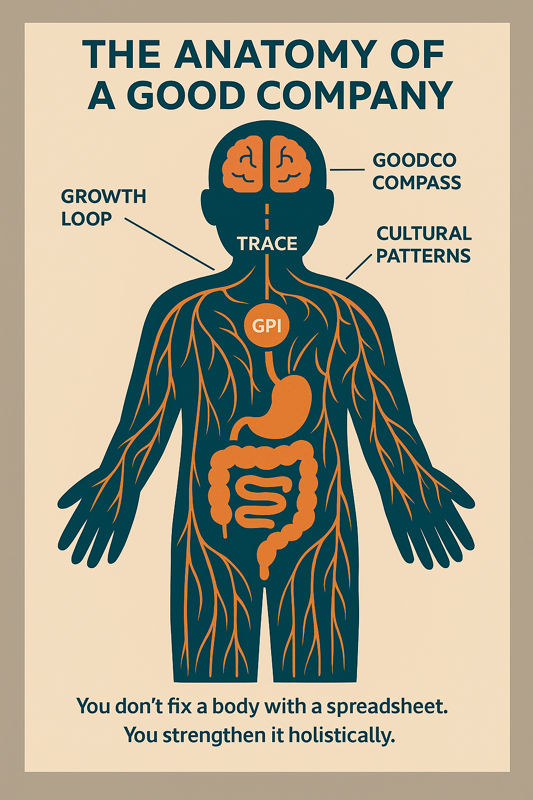
Most companies still treat culture like branding and performance like a dashboard light.
But an organization isn’t a machine. It’s a complex adaptive system: more like a living body than a factory floor.
That’s how we designed the GoodCo Ecosystem:
The Compass is your nervous system sensing, orienting, and guiding response
The GROWTH Loop is your muscle + bone enabling adaptive movement
GPI is your vitals panel revealing stress, safety, and systemic health
TRACE is your executive function linking intent to action over time
You don’t need to replace your organization.
You need to understand how it actually works.
🧵 Why the Big 5 Consulting Firms Keep Winning — Even When They Don’t Change a Thing
1/7
Everyone complains about the Big 5 consulting firms: @McKinsey@BCG@BainandCompany@Deloitte and @Accenture...
...and yet, companies keep hiring them.
Not because they drive transformation.
But because they reinforce the "right" patterns — for the people already in power.
⬇️
Most SAFe adoptions don’t fail because they’re misunderstood. They fail because they succeed at the wrong thing.
They scale reporting.
They preserve hierarchy.
They rename the org chart.
But they don’t change behavior.
They don’t reduce org debt.
They don’t shift the patterns.
And still, people defend them passionately.
Because SAFe doesn’t endure because it transforms. It endures because people can’t afford to admit it didn’t.
@madplatt That was a notification to “stay woke, “ as it would have originally been used pre-appropriation. Very sad to hear of this senseless violence. Please stay safe!
Exploring the future of work, a group of 40+ mappers, 10 hours, many maps and perspectives created. End result, where to invest depends upon your purpose - benefiting society or making money.
Josh. Individuals working in the “scatter/gather” model will _always_ be less efficient. They form individual bottlenecks as people wait for them. They create unnecessary integration steps and a failed integration adds considerable dev time. Since they don’t have external expertise available as they work, they spend time looking stuff up and flailing around. They cannot benefit from the learning inherent in working collaboratively with people who have skills they don’t have. Their code requires an extra review step. Their tests are typically inadequate, so there’s an extra testing phase. I could go on. These issues can easily double or triple development costs. The question, then, is whether the company is willing to eat those additional costs. It’s a simple cost/benefit calculation. Sure, people can refuse to work collaboratively because they don’t feel comfortable with it. That’s equivalent to a carpenter refusing to use power tools because they don’t feel comfortable around them. Yes, they can get the work done, but there’s a cost.
I should add that if there are “intense social interactions” in an Ensemble, you’re probably going about it wrong. You cannot work in an ensemble without psychological safety.