非常推荐大家去看 @YangLi_leo 写的这篇文章: The Next Scaling Problem。前段时间也受到了群里大佬的高度赞赏。
文章里几个比较重要的章节和理念值得大家一看:
1. A computer should be something the agent calls, not somewhere the agent lives
2. Write ahead of execution
3. A durable participant
4. Scaling the system around intelligence
介绍了为什么要让 agent live outside of sandbox,把cloud agents存算隔离的架构解释得非常透彻,以及提供了架构如何enable multi-agent workspace 的非常好的insight。
https://t.co/u0fVnRBNYZ
Most people do not understand how OTC desks allow institutions to accumulate Bitcoin without moving the chart. Here is how it actually works.
OTC desks match buyers and sellers off exchange. If a fund wants 5,000 BTC, the desk starts hunting for miners, early whales, VCs, market makers, and distressed holders who want to unload size. None of that goes through the order books, so the chart never reacts.
They also tap into deep private liquidity that most retail never sees. Miners selling block rewards, VCs offloading tokens, market makers rotating inventory, even corporate treasuries rebalancing. All of this happens quietly behind closed doors.
And these large orders are never filled at once. A 5,000 BTC request might take weeks. The desk collects supply piece by piece, then matches it when enough size is found. This avoids any visible price spike.
Only when they cannot source enough Bitcoin privately do OTC desks touch the open market, and that is always the last resort. They stretch the process as long as possible to prevent price impact.
This is why you only see the sell side on the chart, not the institutional accumulation happening in the shadows.
The controversies behind Binance listings🚨
1. The Zerebro case (October 2025)
Founder Jeffy Yu said Binance asked for $1 million in cash to list his AI token ZEREBRO on Solana.
2. Limitless CJ Hetherington’s accusation
Limitless’ CEO claimed Binance demanded 9 % of the total supply and a $2.25 million “security deposit.”
The breakdown he shared:
• 3 % for Binance airdrops
• 3 % for marketing programs
• 3 % for BNB holder rewards
Binance called these claims “false and defamatory.”
3. The Tier-1 case Simon Dedic (October 2024)
Investor Simon Dedic, CEO of Moonrock Capital, said Binance requested 15 % of the total supply from a major project that had raised about $100 million.
He valued the listing alone at $50–100 million.
4. Employee and internal scandals
Former staff member Amrita Srivastava reported a colleague for taking bribes to speed up client onboarding in Binance Link.
She was fired a month later and filed an unfair dismissal lawsuit in the UK.
5. “Girlfriend Coins” rumors
Between 2024–2025, community rumors spread about listings allegedly linked to Yi He, Binance’s co-founder.
Projects like Hooked and Sleepless AI were mentioned as “favorites.”
Yi He denied everything
6. Market-maker controversies
Wintermute was accused by Jeffy Yu of taking 10 % of $ZEREBRO’s supply for market-making
Other firms like GSR Markets and DWF Labs usually take 1-5 %, often with vesting to prevent dumps.
In 2025
Movement Labs suffered a 90 % price crash after a market maker allegedly sold 66 million tokens (10 % of supply) right after its Binance listing
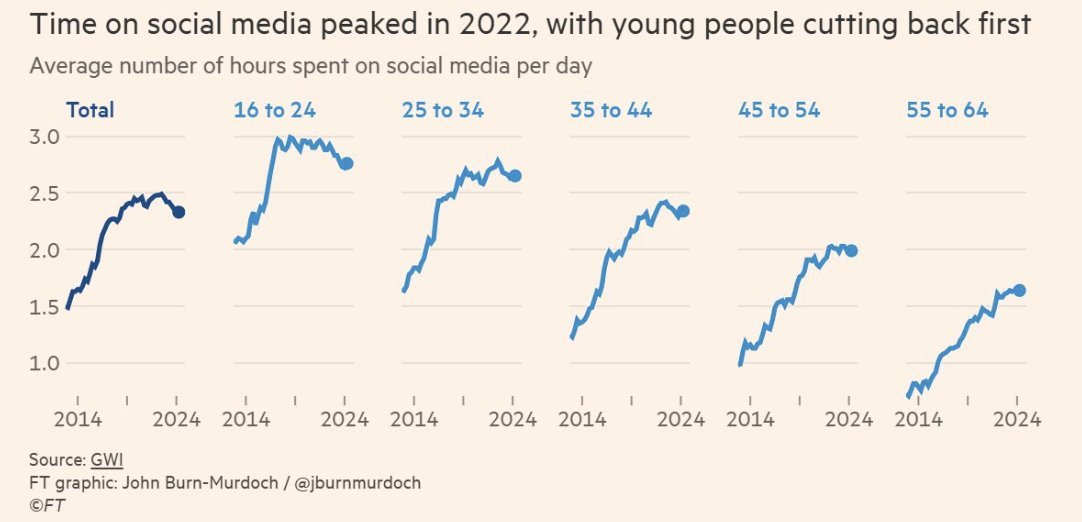
THIS chart is the CLEAREST signal of where the internet is heading.
social media time is SHRINKING for the first time in HISTORY, and young people are leading the pullback.
Brainrot is OUT.
they grew up online, saw the full cycle of social platforms, and learned early that endless scroll doesn’t make you happier or smarter.
they’re the LEADING indicator. their parents will follow in 3-5 years.
AI slop is the nail in the coffin.
every feed feels synthetic familiar faces, identical voices, recycled ideas. the “factory smell” of it all finally broke people’s curiosity.
but there’s an upside. every trend creates its anti-trend.
attention is shifting back to things that feel real, slow, and intentional.
people are paying for spaces that make them feel grounded, informed, and connected again.
the next $100M+ companies will engineer density, trust, and time well spent. they’ll build containers for meaning, then use AI to keep them organized, not optimized.
the internet’s oldest assumption that more engagement equals more value is breaking.
the white space i think is...
• "slow media" formats: weekly briefs, serialized content etc
• private groups that operate like clubs with applications and rituals
• provenance and identity layers that verify real creators and sources
• brands with offline gravity like real events, real belonging
• curated directories and vetted marketplaces
• paid memberships that deliver depth
• note: we share business ideas around this on @ideabrowser
• IRL anything - dinners, meetups, shared experiences
young people are abandoning social media faster than their parents are discovering it.
If you understand what that means, that's a big deal.
i can't stop thinking about this FT/GWI chart.
brainrot is OUT.
meaning is IN.