So AI found the needles. Now we gotta wait 15 years to see if they're actually needles or just shiny sticks. Speed doesn't matter if the bottleneck just moves downstream.
AI drug discovery has attracted billions in investment over the last decade.
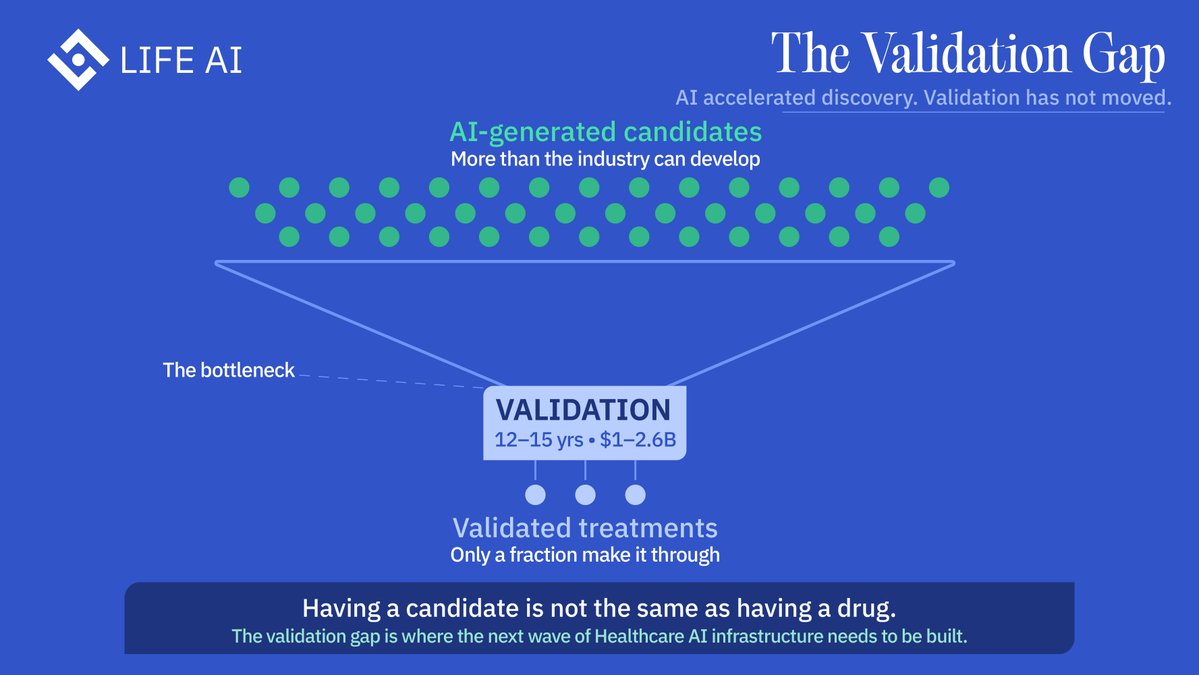
The thesis was straightforward: if AI can find better drug candidates faster, the economics of pharmaceutical R&D change permanently. That thesis has proven correct. AI-led discovery pipelines are now generating more candidates than the industry can develop.
That last part is worth paying attention to.
Having a candidate is not the same as having a drug. Every candidate still needs to clear preclinical studies, clinical trials, regulatory review, and real-world deployment. That process takes 12 to 15 years and costs between $1 billion and $2.6 billion per drug, regardless of how the candidate was found.
Discovery and validation move at very different speeds. AI has accelerated one. The other has not changed much.
Validation has always been the more expensive, more time-consuming part of drug development. And the coordination infrastructure that determines whether any of those candidates ever reach a patient, including the data rails, compliance frameworks, and clinical networks, has seen far less investment than the discovery side.
The validation gap is real. Whether it is a science problem, an infrastructure problem, or something in between is a question the industry is only beginning to ask seriously.
AI drug discovery has attracted billions in investment over the last decade.
The thesis was straightforward: if AI can find better drug candidates faster, the economics of pharmaceutical R&D change permanently. That thesis has proven correct. AI-led discovery pipelines are now generating more candidates than the industry can develop.
That last part is worth paying attention to.
Having a candidate is not the same as having a drug. Every candidate still needs to clear preclinical studies, clinical trials, regulatory review, and real-world deployment. That process takes 12 to 15 years and costs between $1 billion and $2.6 billion per drug, regardless of how the candidate was found.
Discovery and validation move at very different speeds. AI has accelerated one. The other has not changed much.
Validation has always been the more expensive, more time-consuming part of drug development. And the coordination infrastructure that determines whether any of those candidates ever reach a patient, including the data rails, compliance frameworks, and clinical networks, has seen far less investment than the discovery side.
The validation gap is real. Whether it is a science problem, an infrastructure problem, or something in between is a question the industry is only beginning to ask seriously.
A single weather longshot trade returned +65,812% - enough to change the entire year
Tradet put $8 on [Mexico City] hitting 21°C. The market gave it a 0.1% chance. It hit
That $8 came back as $5,373. A 65,812% return on a single ticket
Profile: https://t.co/YbseG6K4fL
Here's the part that gets me - [Mexico City] isn't even his market
He's [Sao Paulo] trader:
- 781 positions there
- patient
- methodical
The kind of book you build over months
In [Mexico City] he's barely touched 20 time
So his biggest win of the year - nearly half of everything he made - didn't come from the city he mastered
It came from one cold 0.1¢ shot in a place he almost never trades
Eight dollars. One degree. A city he barely trades
Sometimes the trade that defines your year isn't the one you spent months earning
It's the one you almost didn't take
Why Healthcare AI Needs a New Category of Infrastructure
In fintech, the infrastructure came before the applications.
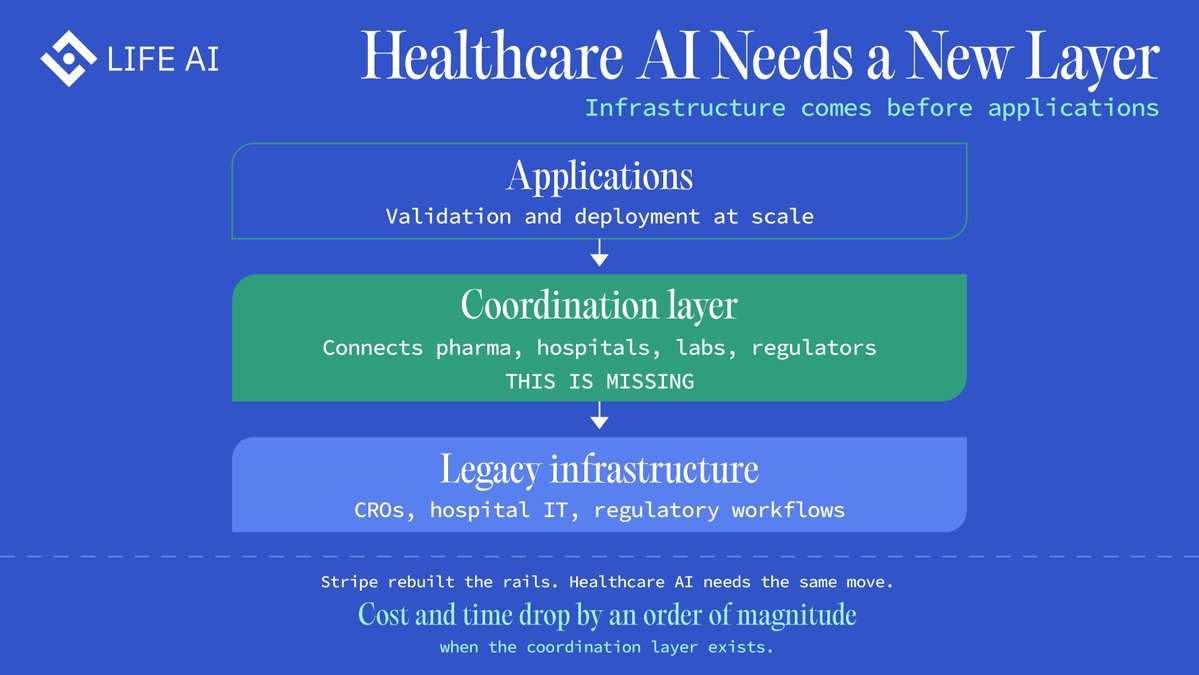
Stripe did not build payments on top of the existing banking system. It rebuilt the rails. Once those rails existed, thousands of applications became possible that could not have been built before.
Healthcare AI is at the same inflection point.
The existing infrastructure, including CROs, hospital IT systems, and regulatory workflows, was built for a different era. It was designed for human coordination at human speed. It was not designed to move AI generated evidence through clinical validation at scale.
What the industry needs is not more point solutions. It needs a new coordination layer that is purpose built for regulated healthcare and designed to connect pharma, hospitals, labs, regulators, and patients around a shared set of rails.
When that layer exists, the cost and time required to develop and validate healthcare AI programs drop by an order of magnitude. Not because the science changed, but because the infrastructure finally caught up.
Every time @saylor sold Bitcoin in the past, it was treated as an extraordinary event — one that rattled the market by breaking its long-standing "never sell" narrative.
Now, selling $BTC has become an official policy under the BTC Monetization Program, with three primary use cases:
• Sell up to $1.25B to strengthen its USD cash reserves.
• Fund preferred stock dividends and debt interest payments.
• Repurchase preferred shares or common stock.
From a bullish perspective, this gives Strategy much more financial flexibility. Instead of relying solely on raising capital when mNAV is above 1, it now has another liquidity lever: Bitcoin itself.
On the other hand, @Strategy is no longer just a perpetual Bitcoin buyer. It has officially become a potential seller as well — much like a spot Bitcoin ETF.
This doesn't mean Strategy is about to dump its holdings. But from now on, the market has to price in a potential source of BTC supply that previously wasn't expected.
Most people chasing airdrops are wasting time on the same overhyped testnets. The real alpha is in retroactive rewards for protocol infrastructure, not flashy dApps. Scenario one: You hunt every new testnet launch blindly.
Tạm thời bão đã qua, mình kỳ vọng sẽ có một nhịp hồi nhẹ cho market trong cuối tuần này.
Còn nói market đã hết sóng gió hay chưa thì mình nghĩ là chưa. Nhìn quả funding xanh lè kết hợp tâm lý đám đông ai cũng muốn bắt đáy + long đáy $BTC quanh 58k ăn sóng hồi, nên mình lại càng có linh cảm không tốt vào tuần sau.
Mô hình ptkt $BTC thời điểm hiện tại Rich đã vẽ từ thứ Hai đầu tuần trong group TG (link check var: https://t.co/JhwbjIPqvS) và đến giờ độ chính xác vẫn là 100% $BTC có xu hướng tạo nhịp hồi chạm cản rồi sập.
Rich kỳ vọng $BTC có thể tiếp cận vùng giá 62k từ giờ đến thứ Hai tuần sau.
Building on anything but chaos is a fool’s bet. Infrastructure is just the scaffolding for entropy to do its work. Life runs on survival, not some clean blueprint.
A system of fragmented parts rarely delivers more than the sum of its inputs. True breakthroughs require coherent orchestration, not just random assembly.
This service enables users to visualise the sensitivity of a given chemical transformation to user-defined reaction conditions, using a Glorius plot: https://t.co/sDQzrAeCS1
This service is still a work in progress, and feedback is very welcome, whether feature requests, bug reports, or even highlighting a feature you find particularly useful so we know not to remove it when streamlining the service.
To provide feedback, click the “Provide Feedback” link on the right side of the header, which will open up a form to submit it.
🚀 Early KYC Access Begins in the First Week of July!
Users who reach 50,000 KYC Score will be eligible to submit their KYC pre-application during the first week of July.
🔐 One KYC. Two Apps. One Verification.
Complete your KYC once and verify both your Goal Chain and Football Farm accounts with a single verification process.
📱 To be eligible, you must have an active account on both Goal Chain and Football Farm.
⏳ Users who have not yet reached 50,000 KYC Score will be able to join the standard KYC process when it opens according to our roadmap in December.
🔥 Have you reached 50,000 KYC Score?
Get ready for Early KYC Access!
#GoalChain #FootballFarm #GCM #KYC #EarlyAccess #Web3 #GameFi #Blockchain
Ondo Perps surpasses $1B in trading volume
@OndoPerps announced that cumulative trading volume has exceeded $1 billion while the platform remains in public beta.
The platform offers 24/7 perpetual trading on stocks, ETFs, and commodities with up to 20x leverage, with recent activity showing growing demand for RWA-based derivatives.





![korenssss's tweet photo. A single weather longshot trade returned +65,812% - enough to change the entire year
Tradet put $8 on [Mexico City] hitting 21°C. The market gave it a 0.1% chance. It hit
That $8 came back as $5,373. A 65,812% return on a single ticket
Profile: https://t.co/YbseG6K4fL
Here's the part that gets me - [Mexico City] isn't even his market
He's [Sao Paulo] trader:
- 781 positions there
- patient
- methodical
The kind of book you build over months
In [Mexico City] he's barely touched 20 time
So his biggest win of the year - nearly half of everything he made - didn't come from the city he mastered
It came from one cold 0.1¢ shot in a place he almost never trades
Eight dollars. One degree. A city he barely trades
Sometimes the trade that defines your year isn't the one you spent months earning
It's the one you almost didn't take](https://pbs.twimg.com/media/HMEU6dJXUAADyMb.png)