Inverting the Blockchain Growth Model
Consumer crypto has historically been optimised for speculation and grants and not durable relationships.
When incentives run out, activity collapses since capital and attention are usually very mercenary in nature.
This is because incentives create a scenario of “borrowed demand, not earned behavior.”
Mechanics that make activity collapse once rewards dry up:
• When users are paid for actions in various ecosystems, they naturally spread attention and capital and chase the highest net yield. As soon as your incentive falls below a rival’s, they switch
• Big rewards (usually) attract the least loyal users first. Your early cohorts skew towards airdrop farmers, volume gamers, arbers and mercenary traders
• If a project has no way of categorising/ remembering their users (identity, history, preferences) or changing their state (progress, status, benefits), there’s no skin in the game for them since its literally just “come for our incentives, but you can leave anytime risk-free”
• Our dopamines are fried and our attention span is small. If you don’t convert it into a habit within days/weeks (through clear progress, streaks, unlocks), people will just revert to doomscrolling or chase the next shiny drop
It is clear that for projects to succeed, they need to be able to walk a journey with their users, who should be able to see progress (missions, rewards, streaks, spend) in all of their interactions.
- - - - -
The @Sophon thesis
Every meaningful action by users should yield a verifiable proof that apps/brands can trust, all without exposing private context.
Those proofs become the “behaviour layer” that powers personalisation, rewards, and status across domains.
Thus we identify the Sophon stack
• App: the primary gateway → verify habits, complete missions, spend with the Sophon Card; each action grows your Aura (a visible journey of verified participation represented as a digital ID)
• Social Oracle (zkTLS): the intelligence layer → converts off-chain behaviour to on-chain proofs; builds a composable identity graph (“digital DNA”)
• Sophon+: loyalty & rewards → turn proofs into tiers/points/perks; gamifies consistency; strengthens long-term engagement and most importantly retention
• Card: the payments/utility interface → each transaction reinforces behavioural data on-chain, closing the loop from spend → proof → reward.
Sophon is also built on the same ZK stack as @zksync, which recently posted their recent ZKsync Atlas update. They now inherit 15k+ TPS, 1-second ZK finality, and near-zero fees with direct Ethereum liquidity (highlighted by @VitalikButerin as well).
- - - - -
The flywheel (closed-loop distribution)
Each layer amplifies the next: more actions → more proofs → better personalisation → more relevant rewards → higher retention.
Unlike fragmented stacks where data, rewards, and payments are siloed, Sophon is built to be a single continuous flow.
From rails to habits
Spending is the most universal behavioural proof. On stablecoin rails, every purchase becomes a micro-interaction: verified spend → adaptive reward → tailored recs → renewed participation.
These micro-loops compound into habit formation and belonging.
- - - - -
Sophon’s edge
• Privacy without friction: zkTLS proofs give targeting accuracy with user agency
• Vertical integration = control of outcomes: owning the interface + proof layer + loyalty + payments lets Sophon guide the value chain from action → outcome
• Distributional moat: information on users attracts better campaigns; campaigns create more proofs; personalisation gets sharper; retention increases → a self-reinforcing distribution flywheel.
In our opinion, some of the notable KPIs to watch would include Verified Actions / MAU (proof density), % of users with the Sophon Card attached to Aura (to close the loop) and a 30/60/90-day streak retention (habit forming), to determine whether Sophon is actually compounding its distribution.
Sophon operationalises a simple idea with value: actions should pay users back in rich experiences, rewards, and belonging. By unifying App, Social Oracle, Sophon+, and Card into one flywheel loop, Sophon effectively turns behaviour into programmable value and bakes experience into its moat.
Full report below 👇
GAIB: The bridge for compute-backed real yield
DeFi needs scalable, auditable income; AI/robotics need sustained, data-driven financing. @gaib_ai connects the two with a dual token flywheel and a stack designed for transparency.
Problem
• DeFi and RWA’s “real yield” are at times cyclical and opaque in nature
• Compute/robotics capex throws off measurable cashflows (utilisation, contracts, uptime) but lacks an on-chain channel
Result: untapped spread between crypto’s capital base and machine productivity
- - - - -
The product stack
a) Design overview
• AID: reserve-backed transactional token: funding rail + redemption/peg layer with explicit reserve policy (assets allowed, rebalancing triggers, redemption SLAs, emergency actions)
• sAID: yield-bearing since it accrues from borrower repayments (minus fees and reserves); designed to be composable collateral across DeFi
b) Underwriting & monitoring
• Collateral: hardware, POs, receivables, parent guarantees where applicable
• Data layer: operator telemetry + attestations, oracles for revenue/uptime, on-chain checkpoints
• Enforcement: notice → cure → seize → liquidate; pre-negotiated logistics for asset recovery
c) Cash-flow disclosure
• Publish a simple schedule per deal: coupons, amortisation, fees, expected vs. actual receipts, and roll-up to sAID accrual
• Pendle PT/YT, liquid lockers, money markets (as collateral), structured vaults for duration/risk tilts
- - - - -
Positioning
Compared to generic private-credit RWAs, GAIB’s edge is asset specificity (compute/robotics), data-rich monitoring, and composability by design. Important to note that GAIB emphasises financing + repayment streams rather than network bootstrapping
Risks & mitigations
Hardware can go obsolete very quickly due to the speed of technological innovations, so GAIB keeps loan-to-value ratios conservative to protect downside. Operator performance can also vary by company, which is why deals include utilisation covenants and continuous telemetry to catch slippage early.
Another important point to consider are regulations which can change overnight, GAIB maintains a clear issuer/KYC perimeter with transparent disclosures to stay inside the lines If oracles or attestations fail, multi-source data feeds and circuit breakers provide redundancy and a safe backstop.
If the team executes this with tight reserves, auditable underwriting, and credible integrations with strong partnerships, GAIB can become the canonical settlement bridge for compute-backed yield → essentially financing AI growth while giving DeFi a durable, programmable income layer.
- - - - -
Read the full report: https://t.co/da31ZArwbC
Pokémon RWA TCG
This vertical is forming into a real on-chain economy (muh ICM?): “RWA × Gacha with real revenues” where mobile-scale demand meets crypto-native distribution.
Pokémon TCG Pocket (TCGP) did close to $915m in 6 months; Pokémon GO is ~$8.6B lifetime. H1’25 app spend ~$478M shows persistent appetite for digital pack-opening behavior (in-line with the current craze for blind boxes such as Labubu).
The sector volume hit an ATH ~$114.5m in Aug ’25, up ~6.2× vs Jan, led by @Courtyard_io (on @0xPolygon) and @solana platforms (@Collector_Crypt, @phygitals, and @TCG_Emporium).
Notable mentions include @ripdotfun, @beezie, @tocatcg and @dripshop_live.
Gacha is where most of this platform derive most of its revenue: 90–99% of flow is gacha. Gacha spend grew 4.9× Jan --> Aug ($10.4m to roughly ~$61.1m).
In terms of marketshare snapshot (data as of Aug ’25): Courtyard is the leader at around ~61.4%, Collector Crypt ~36.5% (from ~9.8% in Jan), Phygitals at ~2% and lastly Emporium ~0.12%.
Platforms and their margins
• Courtyard: ~$203M YTD gacha, ~21.5% net; ~5.9% of users drive ~90.5% spend --> raised a $30m round in July this year
• Collector Crypt: ~$75.3M YTD, ~12.5% net; deeper “power collector” base (~49.6% spend >$1k) --> token is $CARDS
• Phygitals: ~$2.0M YTD, ~30.7% net via on-claim procurement
• Emporium: ~$0.35M YTD, ~20.5% net; mid-to-high spender skew
Key takeaways
• Gacha drives each project's PnL but secondary marketplaces isn’t the core --> this make sense since the web2 side of this is already efficient
• What drives net margins: buyback cadence, fee stack, and inventory model set the range (≈12%–30%+)
Read the full report (with charts): https://t.co/5uoXTXkYGW
Hyperlane: Sovereign Interoperability for the Modular Chain Era
The problem most bridges never fixed
Every new roll-up, alt-VM or app-chain still petitions a whitelisted set of guardians for a route to liquidity.
Allow-list governance keeps capital gated, slows eco launches and forces devs to inherit the same monolithic security assumptions whether they trust them or not.
In 2025, devs can spin up a chain in minutes, but cross-chain rails are stuck in the archaic 2021 custody models which have serious flaws.
Enter @hyperlane
Hyperlane’s core idea: sovereignty first
The protocol ships as a lightweight “mailbox” contract plus off-chain relayers. Anyone can deploy it, no need for any approvals or multisig.
Security is modular: an Interchain Security Module (ISM) sits in front of each app and verifies messages however the app chooses → Merkle proofs, optimistic fraud windows, proof-of-stake committees, or a mix.
Developers are able to customize trust like they customise their own smart-contract library.
Embedded infra
With the Sovereign SDK roll-ups on @Optimism OP Stack, @0xPolygon CDK, Rollkit or @celestia can import Hyperlane into their node software, so interchain messaging is live in their first block production.
Chains launch with routes to Ethereum, @solana and Bitcoin L2s and any other network that has a mailbox → this means that no separate bridge or extra governance is needed.
Warp Routes: native assets that travel
Hyperlane’s token standard lets a project mint a single token supply that moves across chains without wrappers or custodial lock-ups (gone are they days for a mint and burn function).
Benefits include liquidity that never fragments; no double counting of TVL; governance doesn’t juggle “e-tokens.”
Builders ship one token, users hold one balance, markets list one asset.
Adoption statistics
More than 50 mainnet/testnet and several @celestia sovereign chains already pass messages and assets through Hyperlane.
Daily volume in 2025 regularly top 8figs; average confirmation time stays under one minute even during spikes. No exploit has touched protocol funds since launch.
What’s next
This quarter brings permissionless query/response (true interchain oracles) and the first on-chain marketplace for ISM modules, letting DAOs swap security models by governance vote rather than redeploying contracts. Longer term Hyperlane is working with RWA issuers on multi-jurisdiction compliance flows.
With regards to the token, $HYPER has just been listed on @Official_Upbit and @BithumbOfficial and already available on @binance which improves the accessibility of the token.
In a landscape racing toward thousands of execution layers, Hyperlane’s permissionless, configurable messaging is the missing base case.
Read more here: https://t.co/WaHPQ0lXhf
Stargate Finance: the liquidity backbone of the omnichain era
Over the last cycle DeFi scaled execution by spinning up roll-ups, alt-VMs (Move, SVMs and Bitcoin related chains) and app-chains; what it still lacks is a native, composable way to move capital between them. We now have over 155 layer 1s and 2s chains (per @DefiLlama) and liquidity fragmentation is a real problem.
Enter @StargateFinance has evolved from “another bridge” into an integrated liquidity coordination protocol --> solving the Bridging Trilemma, bootstrapping new ecosystems (from day 1 of mainnet) and turning passive reserves into high-velocity liquidity.
1. Why liquidity (not throughput) is a significant bottleneck
DeFillama has tracked 155+ chains, each a fresh liquidity silo since they operate as a standalone chain.
What this entails is every ecosystem having problems attracting liquidity and TVL from other chains, and with no liquidity there are no users, and hence no devs will be attracted to come and build good dApps.
Thin markets, low liquidity and absence of users + devs make many chains ghost towns and makes new networks failing to reach the critical mass.
Another problem is canonical bridges (native bridge that allows transfer of assets in its original form, and not by using a wrapper) fragment capital and expose users to custody (since canonical bridges typically use a lock and mint function) or synthetic risk (these bridges typically follow the security of the underlying blockchain).
2. The Bridging Trilemma cracked + Unified Transfer Protocol
Stargate V1’s Delta algorithm was the first to deliver native assets + unified liquidity + instant finality in one seemless design. V2 replaces static credits with an AI Planning Module that reallocates liquidity and fees in real time, keeping routes solvent and all associated costs competitive under heavy load.
Stargate’s Unified Transfer Protocol is a chain-agnostic coordination layer that abstracts gas, routing and execution across 74 integrated networks. They have built plug-ins for @LayerZero_Core, @circle CCTP and future messaging rails to select the optimal path per asset and destination, so builders can finally integrate once and inherit best-in-class security and speed.
3. Hydra --> liquidity-as-a-service
• Protocol-locked pools on hub chains mint 1-for-1 OFT representations on any Hydra-enabled network
• Day 1 access to USDC, USDT, WETH and EURC eliminates emissions-heavy bootstrapping (that is common with every new chain that is launched)
• Success case studies: @plumenetwork reached ~$113 m TVL in 6 weeks; @berachain crossed $3b within a month, with Stargate moving $650-720 m of USDC.e monthly
Thus we have the Stargate flywheel clear as crystal: Liquidity gateway for new chains --> New DeFi primitives launch --> diverse user activity --> protocol revenue --> higher veSTG yields --> deeper POL --> faster next-chain activation to repeat the process.
Each new Hydra path strengthens the market share of the protocol, compounding capital efficiency across all participants.
*A note on veSTG, from July 2025, 50% of all protocol and treasury fees flow to veSTG stakers (up from 10% of protocol-only fees); the remaining 50% accumulates as POL, reinforcing long-term solvency and growth.
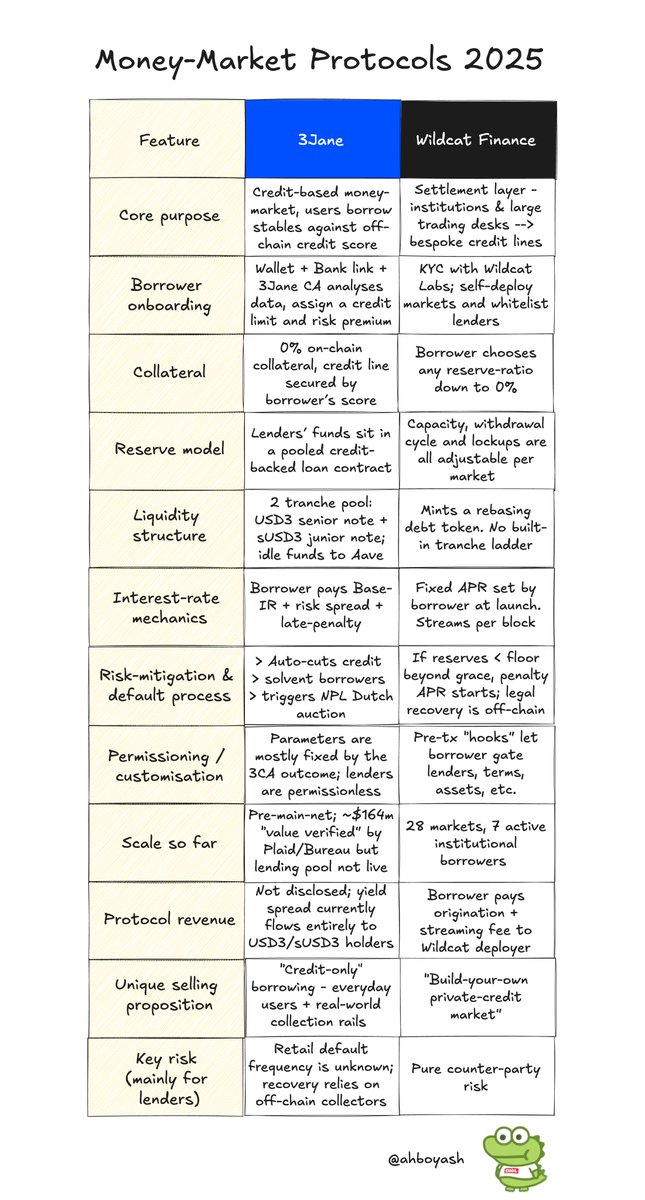
Two new (credit line) money markets have recently made headlines
• @3janexyz --> FICO-style consumer credit by @_yakovsky
• @WildcatFi --> toolbox for sophisticated trading desks to offer private credit by @functi0nZer0
- - - - - -
3Jane --> “Borrow Against the Future”
• Credit-based money market allowing U.S. retail users instant, unsecured credit lines
• Zero on-chain collateral
• Proprietary 3Jane Credit Algorithm (CA) underwriting engine analyses on-chain assets, off-chain cash flows and VantageScore data to estimate the credit line line
• Depositors supply USDC and receive USD3 (senior) or stake it for sUSD3 (junior, first-loss), while idle cash farms sweet @aave yield
• If a borrower defaults, the “Credit Slasher” slashes their score, redistributes late interest to healthy borrowers and auctions off the non-performing loan
- - - - - -
Wildcat --> “Build-Your-Own Private-Credit Market”
• Targets trading desks and funds that want bespoke on-chain credit terms.
• A whitelisted borrower deploys a vault, setting its reserve ratio , fixed APR, withdrawal cycle, grace period up-front
• Lenders deposit and receive a rebasing debt token
• If reserves dip below the floor past the grace period, a penalty APR kicks in until the borrower pays or lenders pursue off-chain enforcement
• Wildcat takes 0–10% of the base APR as protocol rev and lets borrowers determine KYC, size-minimums or other role-provider “hooks” for access control
• Largest under-collateralised credit protocol
TLDR: 3Jane imports consumer credit into DeFi while Wildcat offers instis a way to spin up custom credit lines. If both protocols are well managed, they can scale very fast (overcoming the traditional over-collat model in crypto)
Kaia: Asia’s Best Bet for Mass Adoption
Crypto’s next wave of users will be onboarded inside the super-apps they already trust and use on a daily basis. Many chains have good mindshare in crypto but fail to have a unique distribution angle.
Enter @KaiaChain, an L1 ecosystem that has a mobile-first strategy through Asia’s largest messaging app, Line, and is building a suite of products (wallets, gaming, DeFi and payments) directly into 200m+ LINE and users’ daily routines.
A summarised overview of the ecosystem and platform, read the full report in the link in the next tweet.
- - - - -
1. Distribution Leverage
• Exclusive Web3 mini-dApp SDK in LINE (200m+ users in Japan and SEA) and native wallet flow in KakaoTalk (50m+ users in Korea)
• 35.2 M total wallets and 6.25 M daily transactions so far (data taken April 2025)
• Currently the 3rd largest EVM chain by active wallets (behind Ethereum and BNB chain)
- - - - -
2. High-Performance Chain
• 1s block times with near instant finality
• Up to 4k TPS; gas fees roughly 1/100 of Ethereum
• Full EVM equivalence via Kaia Virtual Machine (KVM) with additional precompiled contracts → optimised for a mobile-first usage
- - - - -
3. Developer-First Tech Stack
• Solidity support for devs, comprehensive toolkit including Unity WebGL compatibility
• JavaScript/TypeScript/Rust SDKs, embedded wallet components
• “Ignite on Kaia” → an onboarding programme supported by 150+ infrastructure partners
- - - - -
4. Ecosystem Growth
• 35.2m cumulative Mini Dapp wallet users, 3rd largest EVM chain
• Strong monetization: $4M in on-chain purchases with 13% paying user ratio
• $481 Average Revenue Per Paying User (ARPPU) across top 3 Dapps
• DeFi infrastructure in place, 42 live Mini Dapps (e.g. @KyuzosFriends, @fatewarofficial and @KeitoKunyarn) and native USDT integration and upcoming RWA integrations
Four initiatives that offers multi-layered support:
• Kaia Ecosystem Fund (KEF): Developer engagement and service development
• Kaia Infrastructure Fund (KIF): Core blockchain infra and technical R&D
• Ignite on Kaia (IOK): Builder onboarding with technical and GTM support
• Kaia Wave: Consumer adoption initiative with LINE NEXT
- - - - -
5. Tokenomics and Funding Model
• The $KAIA token is used to secure the network and is used to pay for on-chain transactions
• Block reward split: 50% to validators/stakers, 25% to the Ecosystem Fund (KEF) and 25% to the Infrastructure Fund (KIF)
• Grants, hackathons and the “Kaia Wave” campaign have driven roughly USD $36m on-chain GMV since February 2025
- - - - -
6. 2025 Plans
• Integrate fiat on/off-ramps for users through LINE Pay and Kakao Pay → payments thesis
• Expansion of RWA verticals for more yield sources
• Mobile-first gaming growth through Unity SDK and the mini-dApp portal
In short, Kaia = unique distribution angle + good support for devs + amplified reach through Mini Dapps with healthy DAUs and ARPUs
Unlocking Bitcoin's Full Potential - @SolvProtocol
2024 was a landmark year for Bitcoin and crypto. The approval of the BTC ETF, coupled with pro-crypto administrations and nation-states adopting Bitcoin, brought it into the financial spotlight. This momentum drove Bitcoin to a historic all-time high of $100,000, with its market cap nearing $2 trillion.
Despite its dominance, most Bitcoin remains idle, generating little to no yield and leaving billions in untapped value. Attempts to address this have relied on centralised providers (e.g., Celsius) or semi-centralized solutions like WBTC/BTCB, which offer limited yield on DeFi platforms like @aave and are constrained by Bitcoin’s inherent limitations due to its Proof-of-Work consensus mechanism.
Enter Solv Protocol
Solv offers a transformative solution with its Staking Abstraction Layer (SAL), standardising Bitcoin staking across ecosystems. SAL delivers transparency, security, and a seamless user experience.
At its core, SolvBTC aims to become the Bitcoin Reserve for Everyone, enabling yield generation and integrating with DeFi. Security is central to Solv’s approach, with a tiered reserve system, partnerships with top custodians, rigorous audits, and innovations like Solv Guard ensuring funds are safeguarded.
As an early innovator in the BTC-Fi sector, Solv Protocol has emerged as a leader in chain coverage and integrations, positioning itself as a pivotal player in DeFi.
With a robust suite of products, it empowers Bitcoin holders to access diverse yield-generating strategies, including staking rewards, validator incentives, trading profits, and RWAs.
Strategic partnerships, like its collaboration with @HashKey_Global Chain, bridge institutional infrastructure with decentralised solutions.
Backed by investors like @BinanceLabs, Solv has built trust and confidence in its offerings.
Their mission in redefining Bitcoin’s role in crypto is just beginning. By combining DeFi principles of security, scalability, and accessibility with its SAL framework, Solv unlocks Bitcoin’s potential, extending its use cases and shaping the future of decentralised finance.
Read more below 👇
AI Agent Economy
@Spectral_Labs is pioneering the Onchain Agent Economy, enabling users to create autonomous AI agents to execute complex blockchain interactions through their Spectral Syntax platform. This marks a significant step toward democratizing access AI in crypto and Stage 3 of AI development - the Agentic Age.
The current AI landscape faces key challenges: high barriers to entry, operational complexity, lack of community governance, limited monetization opportunities and more.
Blockchain and crypto emerges as the ideal foundation, offering transparency, decentralization, and robust economic incentives through the use of tokens.
Spectral's SYNTAX framework seamlessly integrates LLM capabilities with blockchain transactions. The system uses a Listen, Evaluate, and Act (L.E.A) Framework to ensure precise, deterministic outcomes in the probabilistic world of AI.
The launch of Syntax V2 introduces a transformative experience in interacting with AI Agents, featuring several key innovations revolving about its Onchain Agent Economy:
• Frictionless onboarding for users to create Agents
• Fully democratized governance over deployed Agents
• The ability to equip each Agent with esoteric, customizable functionalities and unique personalities
The $SPEC token powers this ecosystem through multiple value accrual mechanisms: launch fees (0.01 ETH + 0.7% agent token supply), swap fees (0.1-1%), staking rewards, and automated buybacks from trading profits.
The relationship between Users, Creators, and Agents within the network creates a powerful flywheel effect: Creators build agents, Users pay for services, fees incentivize further innovation, improved agents boost retention, and staking benefits deepen participation.
Spectral has already showcased remarkable traction, with over 2.2 million smart contract code generations and nearly 18,000 memecoin deployments facilitated through their platform. The launch of Syntax V2 is expected to further amplify this momentum, driving growth beyond these impressive milestones.
Spectral Labs stands at the forefront of the Agentic Age, combining robust infra, proven traction, and sustainable tokenomics to create a democratized ecosystem for autonomous AI agents in crypto.
Through its innovative Syntax platform and upcoming Inferchain protocol, Spectral is not just advancing crypto but fundamentally reshaping how autonomous systems will operate and collaborate in the future.
Read more below 👇