Data centres consume 5% of America’s electricity, up from 2% a decade ago. The International Energy Agency projects nearly 10% by 2030. More at today's Chartbook Top Links:
There has been a lot of casual chatter along the lines of “AI capex has contributed nearly all of the 2025 real GDP growth, without which we’d be in a recession”. @ernietedeschi has done some nice clarifying accounting by properly subtracting from gross computing capex imports, which form the lion’s share. After doing so, it becomes obvious that non-capex GDP, most of which ordinary consumption, still comprises the overwhelming majority of the growth.
It’s also important to note that even if AI capex was a majority of the GDP growth, the counterfactual wouldn’t be simply subtracting AI capex either. Without AI capex, a different set of economic dynamic could’ve emerged whereby inflation and rates would come down faster, housing sector could’ve recovered sooner etc. Not saying they would, just that it’s not right to simply subtract a portion of what has happened to generate the counterfactual scenario.
The AI Boom’s Real Economy Problem
While AI CAPEX is exploding, the payoff isn’t. Meta’s $70B/yr is only notching $3-5bln in incremental revenue. The kind of poor sector ROI exposing the diff between the dream and real economy reality.
https://t.co/mehuJVPTf0
1/5
JP Morgan has identified 41 AI-related stocks, 8% of the S&P 500. These stocks now account for 47% of the Index's market capitalization, a new record.
The other 459 stocks, 92% of the S&P 500, are 53% of the Index's market capitalization.
We are welcoming our final Track 2 panel to the stage, featuring Jonathan Dixon of IAIS, Kelly Hereid of @LibertyMutual, Norio Hida of The Norinchukin Bank and Cindy Paladines of @TCWGroup to tackle the highly relevant topic of physical climate risk
Is the U.S. the "world's largest emerging market"? Tune in to a new Current Account, where Clay is joined by IIF's Emre Tiftik to discuss this question and other topics relating to the record levels of global #debt seen by end of 2023.
Listen 🎧: https://t.co/NdndkCadJ7
The 2023 update of the debt reporting heatmap is out. Check out what type of public debt data LICs publish on their websites (tip: click on the cells to get the URLs). 1/2 https://t.co/VcJbIbZCs4
Sovereign debt restructuring approaches must transition to integrating both private & official bilateral claims simultaneously. The Global Sovereign Debt Roundtable is well placed to lead discussions on designing rules.
More: https://t.co/Y2VD91XTHh
https://t.co/Y2VD91XTHh
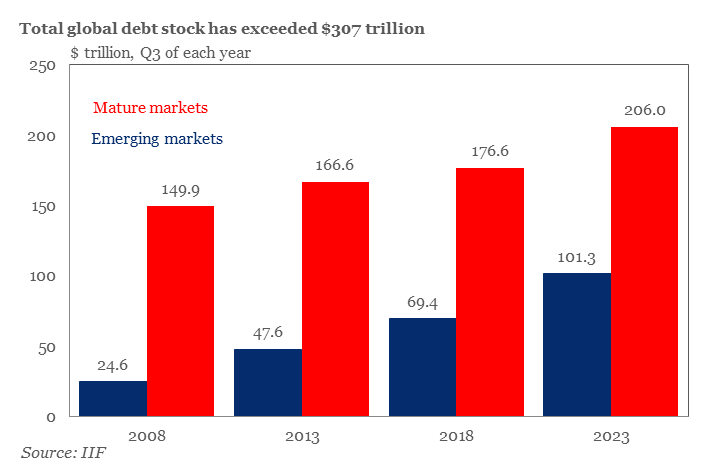
NEW Global Debt Monitor: Global #debt reached a staggering $307 trillion in Q3 2023, with a big increase across the board in both mature markets (U.S., Japan, France, and the UK) and EMs (China, India, Brazil, and Mexico).
Read more: https://t.co/RCQEEpZGeW
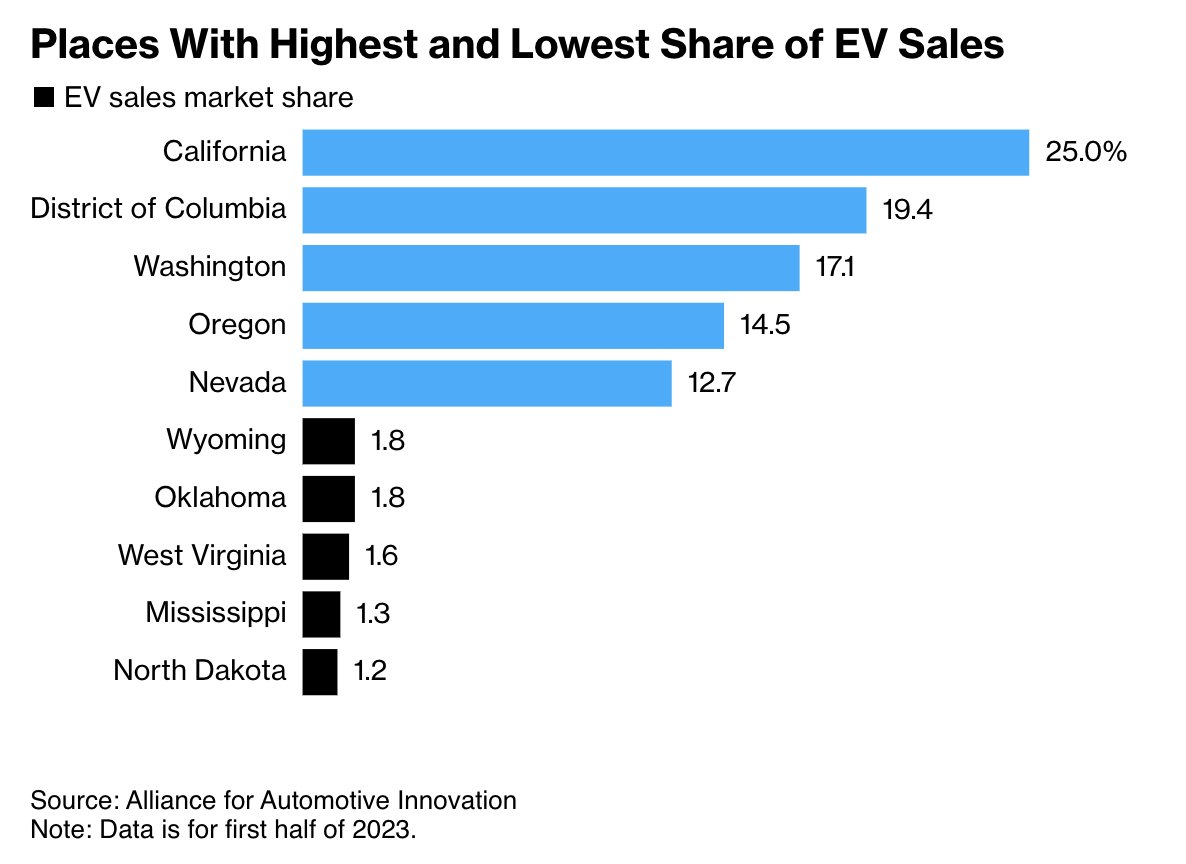
Partisan politics appear to be shaping consumers’ adoption of electric vehicles, as sales lag in Republican strongholds where gas prices are cheaper https://t.co/DlLYPu2EcU
More funding is needed for EM economies for #sustainable development. What can banks, insurers and investors do to help & what is the role of public-private partnerships in mobilizing #climate capital? Tune in to the #IIFMarrakech panel @FABConnects@SBGroup@EBRD@SwissRe
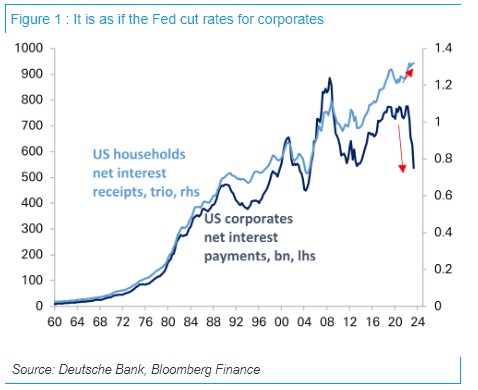
"Net corporate interest expense has gone down this year. It is effectively as if the Fed cut rates. Why? Because corporates took advantage of QE to term out borrowing at record-low rates and are now earning 5%+ interest on their cash:" DB's George Saravelos