Ko smo se odločali za vstop v EU, si ni nihče predstavljal, da bo v kaki njeni članici in uniji nasploh mogoče brez posledic:
1. Razveljaviti predsedniške volitve (Romunija);
2. Ukiniti informativni program na nacionalni RTV (Madžarska);
3. Poslati policijo na Ustavno sodišče (Poljska);
4. Tri tedne pred volitvami poslati v zapor predsednika stranke, ki vodi v anketah (Slovenija);
5. Zasesti nacionalno RTV s policijo in zamenjati vodstvo (Poljska);
6. Prekiniti mandate vodstvu nacionalne RTV in izvesti čistko zaposlenih (Slovenija);
7. Poslati v zapor člane prejšnje vlade brez možnosti obrambe (Madžarska);
8. Podeliti skoraj milijon državljanstev ilegalnim migrantom po hitrem postopku (Španija);
9. Zapreti novo Nuklearno elektrarno in zgraditi plinovod do Rusije (Nemčija);
10. Obdavčiti ogljične energetske vire ob hkratnem zapiranju NE ter preseliti industrijo v države z nizkimi ekološkimi standardi pod pretvezo, da tako rešujemo planet.
Nastala je EU, ki se mora reševati sama pred sabo.
Oh he sent me an email, I think I’ll respond.
So yes, actually you did do something wrong President Trump, let’s first start with your broken campaign promises.
You protected your pedophile rapists friends instead of women who were raped when they were just teenage girls and you STILL REFUSE to release the Epstein files.
You started an unprovoked war with Iran that the vast majority of Americans do NOT support. You killed hundreds of children at a school in Iran and innocent people and are responsible for 21 U.S. service members deaths and 865 wounded. Your stupid war that you claim you have won like 50 times has destroyed our bases in the Middle East and hundreds of billions of dollars worth of military equipment and weapons, while depleting our weapons and ammunitions.
You are supporting, funding, and aiding genocide in Gaza that has resulted in approximately 22,000 children murdered, thousands of children with amputations, and over 70,000 orphans. And your so called Board of “Peace” has done nothing to stop war and is planning to oversee the very profitable reconstruction and take over of Gaza. One can only guess who all will get those blood money contracts, the Epstein class and associates.
And let’s talk about the basics that every single US president is supposed to guarantee to its citizens. Affordable cost of living and affordable fuel in which you have 100% failed to deliver and actually driven inflation and irresponsibly driven the cost of gasoline and diesel to record high levels.
So did you do something wrong?
Yes in summary, YOU are the snake that you warned us all about in the poem you read over and over.
You never cared about putting America first or making America great again.
You are the deep state, the Epstein class, and America last.
And my mistake was supporting you in the first place.
We're expanding our approach to content provenance to include text in response to EU regulatory requirements, while recognizing the significant limitations of current text watermarking technology.
Our tools already help verify whether an image or audio file was created with our models. This work builds on those efforts to help people better understand when content may have been generated or edited with an OpenAI model.
In the EU, we’ll start watermarking eligible text from ChatGPT and Codex over the coming weeks to comply with the EU AI Act.
Customers using our API can turn on text watermarking for select models worldwide today.
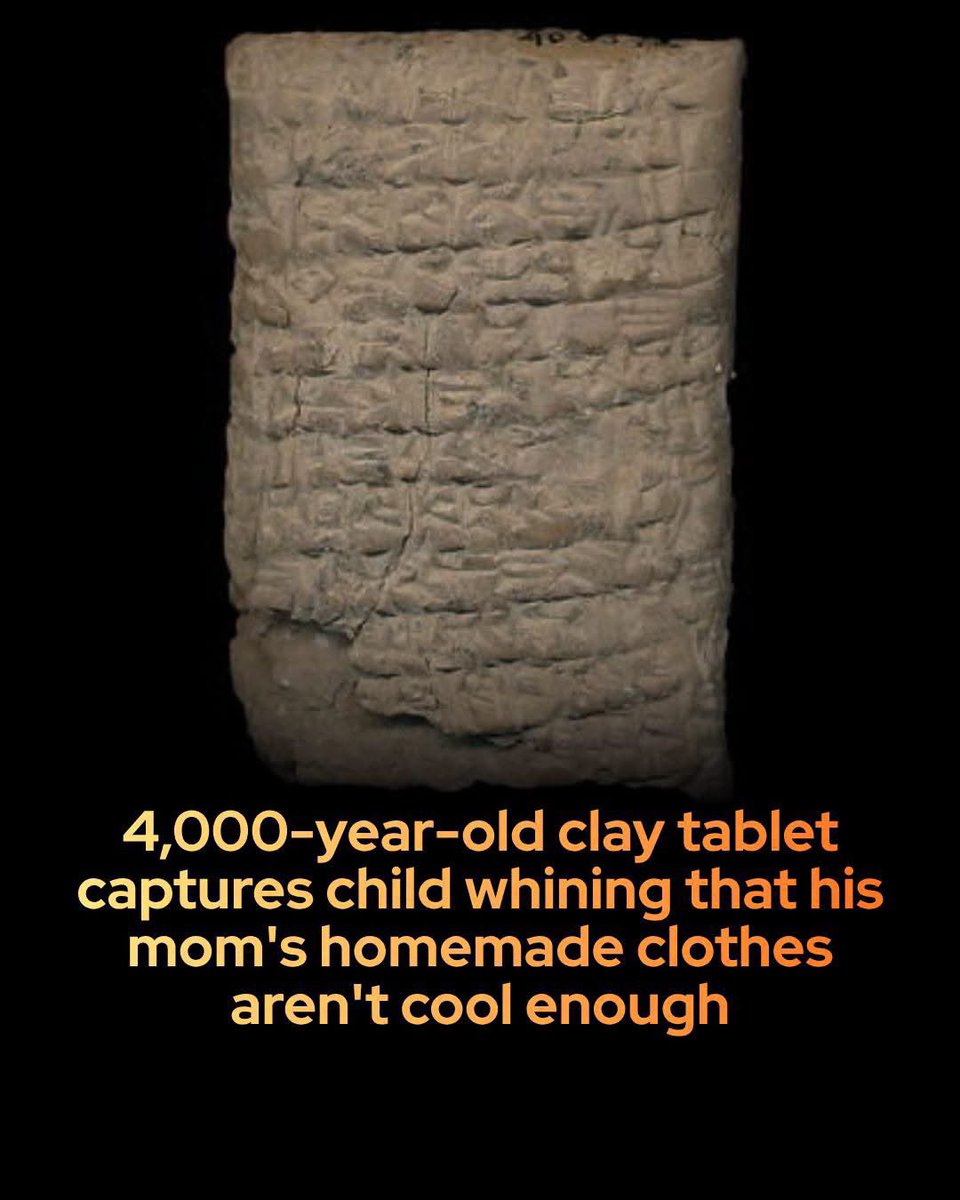
A 4,000-year-old Babylonian clay tablet records a teenager complaining about uncool clothing.
Around 1800 BC, an Old Babylonian student named Iddin-Sin penned a cuneiform letter to his mother, Zinu, that reads remarkably like a modern, overly dramatic text message.
Writing from the ancient Mesopotamian city of Larsa, the young man was outraged by the quality of the homemade garments she sent him. Rather than opening with warm pleasantries or asking about her well-being, Iddin-Sin immediately complained that the other young gentlemen's clothing was improving every year, while his mother insisted on making his 'poorer and more scanty' despite the household having plenty of wool.
His indignation perfectly captures the timeless teenage horror of not fitting in with peers.
To twist the knife, the ancient teenager compared his wardrobe to that of his father’s assistant’s son, who proudly boasted two brand-new outfits. Iddin-Sin then delivered the ultimate ancient guilt trip, writing: 'In spite of the fact that you bore me and his mother only adopted him, his mother loves him, while you, you do not love me!'
Preserved for millennia on clay, this dramatic message serves as a comforting reminder that schoolyard peer pressure, status anxiety, and dramatic parent-child dynamics are not modern inventions of the social media age, but have been deeply hardwired into human nature for thousands of years.
source: Oppenheim, A. L. (1967). Letters from Mesopotamia: Official, Business, and Private Letters on Clay Tablets from Two Millennia. University of Chicago Press.
Breaking: Another banker suicide.
Simon Andriesz, a British banker, who outed Howard Lutnick’s ties to Jeffrey Epstein is dead.👇#HowardLutnick#SimonAndriesz#JeffreyEpstein
https://t.co/pkWHFlaR0a
A follow-up to last Friday's post.
Last weekend, a few friends came back to me with similar questions, mostly boiling down to this:
Why would Washington keep leaning on the banks to fund this buildout, with long yields at their highest since the early 2000s and AI bubble talk everywhere?
I suspect some of you might be wondering the same thing. The short answer is that there's a much larger game at play here. Let me explain…
The game is called the Red Queen.
In Lewis Carroll's Through the Looking-Glass, the Red Queen tells Alice that in her world you have to run as fast as you can just to stay in the same place. Evolutionary biologists borrowed the idea to describe species locked in an arms race, where nobody gets ahead for long, but whoever stops adapting doesn't survive.
What sent me down this rabbit hole was a paper published in January by two researchers at the Chinese University of Hong Kong and the University of Macau, called The Economics of Digital Intelligence Capital.
Their insight was that AI capital doesn't lose value the same way a factory or a truck does. It loses value every time a competitor pushes the frontier forward. Stop spending for a quarter and everything you've already built is suddenly worth less, just because the other guy didn't stop.
Think of it as two Formula 1 teams. Every race weekend, each team brings new upgrades that make the car a little faster. As long as both keep developing, the race stays close. But if one decides the upgrades are too expensive and skips a few, the gap opens... and skip enough and it's a gap that's almost impossible to close, because the other team is compounding the advantage every single race.
That's Microsoft and Google, OpenAI and Anthropic. Now zoom out and swap the two teams for the US and China. The US was happy to let China become the world's largest factory, because cheap goods made the US consumer economy work.
Letting China become the world's source of intelligence is a completely different proposition, because whoever leads there leads everything downstream of it: productivity, military capability and eventually financial power. Every great power rivalry before this one was fought over land, oil or arsenals. This time the prize is intelligence itself.
That's why the leverage rules were rewritten and why the banks are being positioned to finance the buildout alongside the hyperscalers' own cash flow. And it's why nobody in Washington is going to tighten the taps significantly because asset prices look stretched, not while Beijing is backing its own race just as hard.
When both sides are funding a race neither can quit, liquidity stops being a policy choice and becomes a strategic necessity. Think of it as the defense budget of the 21st century. Win the intelligence race and national security comes with it.
The pushback I hear most often is that every great infrastructure boom ends in a bust, usually with the railroads and the dot-com fiber buildout as exhibit A.
I wrote a much longer piece on exactly this back in May, but here's the short version...
Look at why those busts happened. Both built capacity for demand that didn't exist yet. The track was laid long before there was enough traffic to pay for it, and the fiber went in when only a few hundred million people were online, mostly on dial-up. When demand arrived more slowly than the debt came due, the bet broke.
AI is the inverse. The distribution already exists, with more than 5 billion people carrying a connected device that can reach these models the day they go live. The demand is already here too, with more than $2 trillion of contracted backlog across the big cloud providers and capacity expected to stay tight through 2027. And that's before the largest wave of immigration in all recorded history, except none of the new arrivals are human.
As agents come online, the biggest users of compute won't even be people. They'll be software working on our behalf, consuming compute long after we've put our phones down at night. This isn't capacity in search of customers. It's customers waiting on capacity. There will be a speculative bubble eventually, there always is... but it comes at the end of the cycle, not here.
When people ask what slows this race down, my answer is nothing. That doesn't mean there are no speed bumps. Higher rates make it more expensive. Power shortages delay projects. Financing problems will take out individual players... but even then, the compute doesn't disappear.
If one of the big names went under tomorrow, every rival would be fighting over its data centers, because that's capacity you simply can't buy anywhere else. None of it removes the incentive for everyone else to keep going.
Eventually, I think the two sides reach some kind of truce over compute, because their supply chains are still too intertwined: the US designs most of the leading chips, Taiwan makes them and China processes most of the critical minerals that the whole buildout depends on. Each side holds something the other can't do without. But not yet. Right now, neither side is anywhere near ready to back down.
Just look at Tuesday's White House meeting. Dario Amodei, whose company has been one of the loudest voices calling for the industry to slow down, stood next to Trump and told reporters: "As the president said, whoever wins AI wins." His only caveat was that the US should win safely. Even the people who want to slow AI down aren't prepared to lose the race.
So back to Gundlach's dilemma. Hike or cut is the wrong question, because it assumes someone gets to ease off.
Nobody does. Washington, Beijing, the hyperscalers, the banks... every major player in this race has the same job right now. Keep upgrading the car.
Micron Q4: five takeaways
1) Korea called it, again. Three weeks ago the first-ten-day export data set a record while everyone was busy calling the peak in AI. Micron just printed $54.2bn of revenue, +379% year-on-year, beat consensus by $3bn, and guided the next quarter to $61.5bn against a street at $57bn. And note that Q4 was a 14-week quarter, so the Q1 guide on a normal 13-week quarter is an even bigger sequential step than the headline suggests. The earnings cycle is not slowing. It is accelerating into a market that has spent the summer compressing multiples.
2) The cyclicality debate is over, for now. This is the argument we have had for many months: is memory still a boom-bust commodity? Gross margin at 87% and roughly $100bn of remaining performance obligations across the strategic customer agreements say the business has changed. Contracts do not remove the cycle, they stretch it. And $33bn of free cash flow in the quarter, $73bn of cash on the balance sheet: they fund the Idaho buildout and return the excess without touching the debt markets. That is the one thing the neoclouds cannot say.
3) Valuation is still absurd. On the new Q1 guide, run-rate EPS is about $153. At $1,070 that is roughly 7x. The S&P is on 22x. CrowdStrike is near 200x. The market is still pricing memory profits as if they end next year; the guidance says they rise into 2027, when HBM4 volume lands. Way, way too cheap remains the verdict.
4) It confirms the book. Quality of earnings is the factor in a hiking cycle, and Micron is the definition of it. Memory is the all-weather asset in the frontier-slows debate: training wants bandwidth, inference wants capacity, and both showed up in this print. US memory over Korea into the licence decision. We hold. We do not add after a 290% run.
5) The number to watch is capex. FY26 capex was $27bn against $62bn of free cash flow. If all three memory makers raise capex sharply at once, that is the first 2027-28 warning sign. Management already flagged that the rate of price increases is moderating, which means volume and contracts are now doing the work rather than price. That is exactly what you want if you own it for durability rather than for the spike. We do.
🇺🇸🇱🇧🇮🇱 Journalist Courtney Bonneau, reporting from Lebanon:
"In recent days, the Israeli army killed 20 medical staff.
Americans, your taxes are being used to kill unarmed men, women, and children."
Imagine working from dawn to dusk only to have your taxes end up killing children in the Middle East...
Writer: Samuel
⚡️This actually makes sense.
McDonald’s has quietly become a duration asset.
The market sees a huge, mature, highly predictable cash-flow stream with a dividend and relatively modest organic growth. That starts behaving more like a bond substitute than a high-growth equity when the 10-year is moving violently.
So when Treasury yields rise from roughly 4% toward 5%+, three things hit MCD at once.
First, the discount rate rises. A slow-growing stream of future cash flows is worth less today.
Second, Treasuries suddenly offer a compelling alternative. Investors who owned defensive dividend stocks for income can get 5% from the government without equity risk.
Third, McDonald’s franchise system is capital-intensive beneath the surface. Franchisees finance stores, remodels, equipment and real estate. Higher long rates increase the cost of expanding and maintaining the system.
That is why the mirror image is so clean right now.
There is also a consumer layer. Rising yields are increasingly associated with expensive mortgages, auto credit, rents, insurance and general household pressure. McDonald’s normally benefits when consumers trade down, but once lower-income consumers themselves get squeezed hard enough, traffic can weaken too.
So MCD is getting hit from both ends:
higher discount rate + weaker marginal consumer.
That is a nasty combination for a mature defensive stock.
The part that really matters is broader than McDonald’s.
If MCD is trading almost mechanically against the 10-year, it tells you the bond market has become the dominant pricing engine for ordinary equities.
Every company with slow growth, high dividend sensitivity, leverage, or bond-like cash flows is being repriced against a 5% sovereign alternative.
That is why this chart is more important than it looks.
The bond market is no longer merely influencing stocks. It is becoming the hurdle rate that decides which business models deserve capital at all.
And MCD is a very clean example of what happens when a stock built for the cheap-duration era suddenly has to compete with a 5% Treasury.
One of the most brutal scenes in human history has been leaked.
The moment the tents of displaced people were bombed in the southern Gaza Strip, in the Mawasi area of Khan Yunis, killing more than 500 civilians.
A video that the world must never forget.