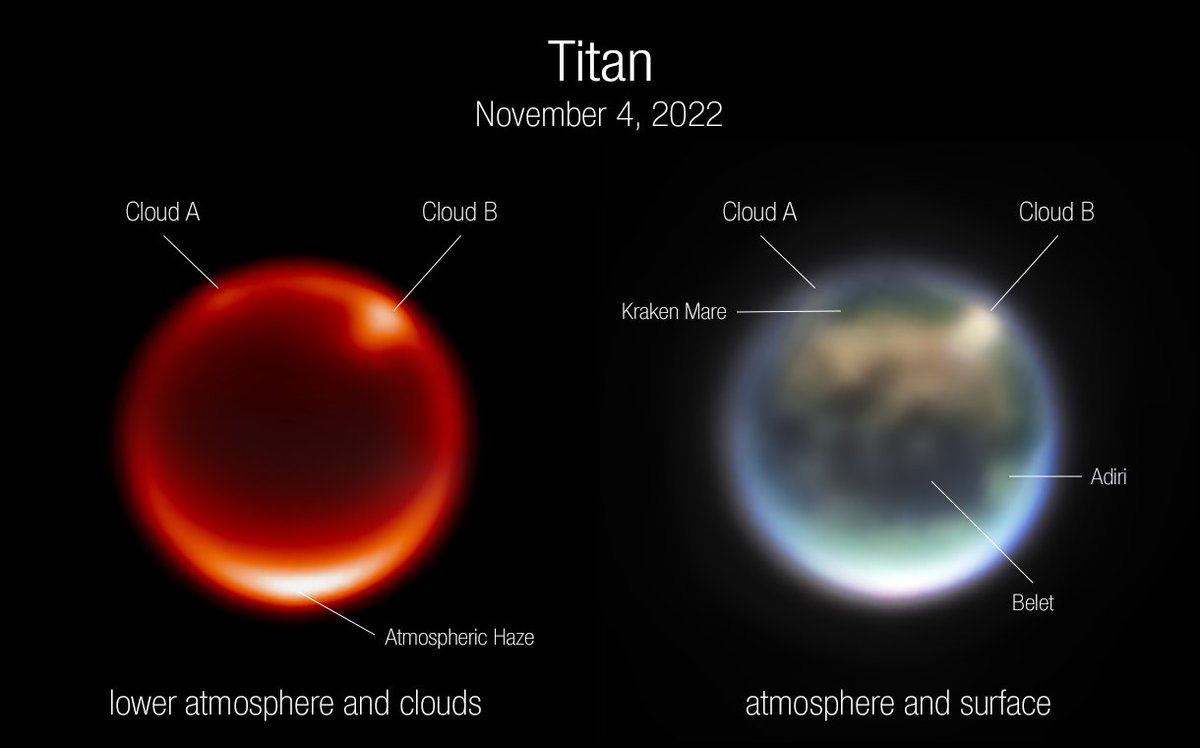
A Titan-ic success!
Here is Webb’s first look at Saturn’s largest moon, Titan. Because Titan has a dense atmosphere, its surface is hidden in visible light. Enter Webb’s infrared eye, which captured clouds as well as bright & dark patches on its surface: https://t.co/zQsSN9Py4H
Countdown to a new star ⏳
Hidden in the neck of this “hourglass” of light are the very beginnings of a new star — a protostar. The clouds of dust and gas within this region are only visible in infrared light, the wavelengths that Webb specializes in: https://t.co/DtazblATMW
You can’t escape its clutches.
Just in time for #Halloween, the Pillars of Creation reach back out like a ghostly hand. The eerie landscape, captured this time by Webb’s mid-infrared instrument (MIRI), spotlights ancient curtains of dust in new detail: https://t.co/Y9QQBf9nYM
@arthur_vlt@NSFVoyager2 *I am currently 18 hrs 10 mins 35 secs of light-travel time from Earth, or 19,617,000,000 km / 12,189,000,000 miles / 131.13 AU (2022:270:000000:2L)
La personne qui filme sauve un gars qui a perdu connaissance en heurtant un autre parachutiste...c'est le truc le plus hollywood que j'ai jamais vu dans le monde réel😳
📷 This NASA/ESA @HUBBLE_space Telescope image shows galaxy CGCG 396-2, an unusual multi-armed galaxy merger, around 520 million light-years from Earth 👉 https://t.co/zQ9aqYiEJg