I’m excited to share our new @Nature paper 📝, which provides strong evidence that the walkability of our built environment matters a great deal to our physical activity and health.
Details in thread.🧵
https://t.co/omO3YcHrvG
Finding clinical signals in large-scale health sensing data streams is quite challenging. We introduce a biomarker discovery framework that pairs hypothesis generation with adversarial validation to discover rigorous digital biomarkers alongside human experts. Read more: https://t.co/w1vKjAA5kw
Sense of community is the "glue" that holds online communities together! But what factors affect sense of community online? Come to my talk @icwsm tomorrow morning at 8:30 to learn more! 🧵
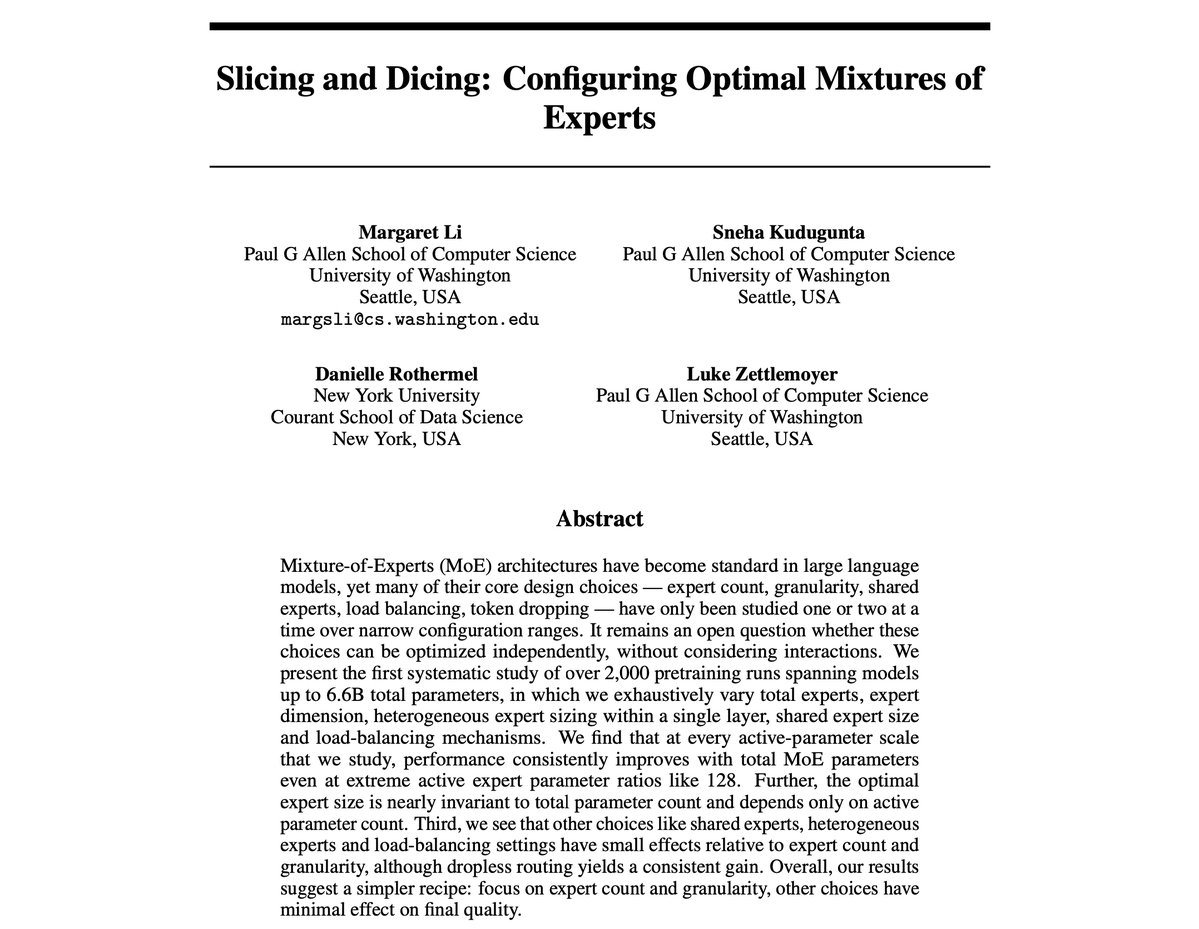
MoEs are everywhere, but the design space is confusing: total vs active experts? expert size? shared experts? routing? token dropping?
We train >2000 MoE LMs 🫠 to investigate and bring you:
📄🔪🍰 Slicing and Dicing MoEs
Tl;dr: it's all about expert size and count
[1/9]
📢 New Paper 📢 Self-Improving VLM Judges Without Human Annotations
Reward models & judges are critical for evaluating output quality and alignment with human preferences for VLM training.
Current training approaches typically rely on:
💸 Costly human preference annotations
🔒 Distillation from large closed-source models GPT/Claude (which also use human labels)
😤 Labels that may become obsolete as models advance
We show you can skip all of this with self-generated synthetic data! ✨👀
We're still accepting postdoc applications starting as early as January'26. Focus areas include psychosocial AI simulation and safety, Human-AI collaboration.
Details: https://t.co/WFlwxVY2gY
Large Language Models (LLMs) are increasingly used to simulate human users in interactive settings. However, they often drift from their assigned personas, contradict earlier statements, or abandon role-appropriate behavior. We introduce a framework for evaluating and improving persona consistency in LLM-generated dialogue with multi-turn RL, defining three automatic metrics and validating each against human annotations. More below 👇
Our ability to meaningfully evaluate language models is critical, but challenged in many ways.
Check out @kenqgu's work that finally helps us disentangle "reasoning ability" from "parametric/world knowledge", while allowing for scalable, automated evaluation.
True intelligence = reasoning about new information, not memorized facts.
How can we scalably create benchmarks that are completely novel yet have known answers?
Meet SynthWorlds, an eval & data-gen framework to disentangle reasoning and knowledge⬇️🧵
📄https://t.co/ITwP4YdtDG
True intelligence = reasoning about new information, not memorized facts.
How can we scalably create benchmarks that are completely novel yet have known answers?
Meet SynthWorlds, an eval & data-gen framework to disentangle reasoning and knowledge⬇️🧵
📄https://t.co/ITwP4YdtDG
(please reshare) I'm recruiting multiple PhD students and Postdocs @uwcse@uwnlp
(https://t.co/I5wQsFnCLL). Focus areas incl. psychosocial AI simulation and safety, Human-AI collaboration.
PhD: https://t.co/ku40wCrpYh
Postdocs: https://t.co/K9HUIPJ5h6
If you're at @ACM_CSCW 🇳🇴, come check out our 🏆honorable mention paper today on Reddit community governance (w/@amyxzh@timalthoff). 4pm in Dovregubben-2! More in thread... 🧵
Some nice coverage of our paper (and award) from ICWSM back in June. Big congrats to Leon his successful first author paper, and big things to @timalthoff and @amyxzh for their support as always!
Congrats again to ugrad student Leon Leibmann and co-authors @galenweld and @timalthoff on best paper award (awarded to a single paper) at @icwsm this year!
ICYMI - our recent @Nature paper leverages a large dataset to show that a city's walkability influences our physical activity and health.
https://t.co/HVn4bKMsXU
Crunching away on a paper for #CHI2026 about online communities, moderation, or sociolinguistics?
You may be want to check out recent work led by @galenweld on predicting SOVC within subreddits based on the style and structure of conversations.
https://t.co/rpGUAiQeJe
Do walkable cities prompt people to take more steps, or do people who want to walk tend to live in more pedestrian-friendly cities?
New research from @timalthoff@uwcse found that highly walkable areas lead to significantly more walking.
More: https://t.co/GRprdsMMwI