We live with the limitations of our memory, but don’t really know where they come from. Our new paper (https://t.co/DYiL0IfxvF) studies "swap errors", which we argue arise during memory manipulation – see thread for more! @timbuschman, @MattPanichello, @wjeffjohnston
New preprint! @tafazolisina shows the brain builds complex tasks by compositionally combining simpler sub-task representations. By dynamically reusing neural subspaces for sensory inputs and motor actions, the brain can flexibly perform multiple tasks. 🧵 https://t.co/PpMhFiO5YP
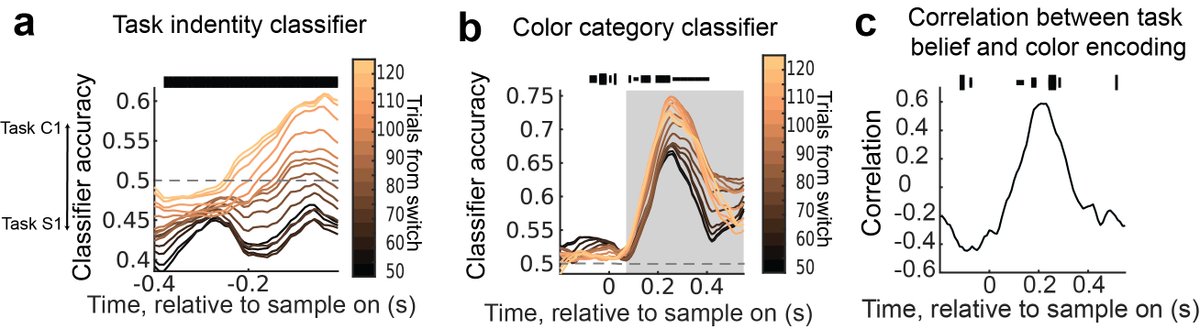
6/7: Finally, monkeys had to discover the task in effect, updating their internal belief based on feedback. As they learned which task was in effect, we found the task-relevant shared subspaces were gradually engaged and task-irrelevant information was compressed.
New @CurrentBiology paper with @CamdenMacDowell relating individual differences in behavior to neural dynamics! Individuals differently expressed ‘motifs’ of cortex-wide neural activity, which explained variability in functional connectivity and behavior🧵 https://t.co/0XVM7Fh4Dk
In sum, this supports a ‘sampling hypothesis’ that suggests differences in behavior are due to differences in the top-down control mechanisms that govern the moment-to-moment selection of specific interactions between brain regions.
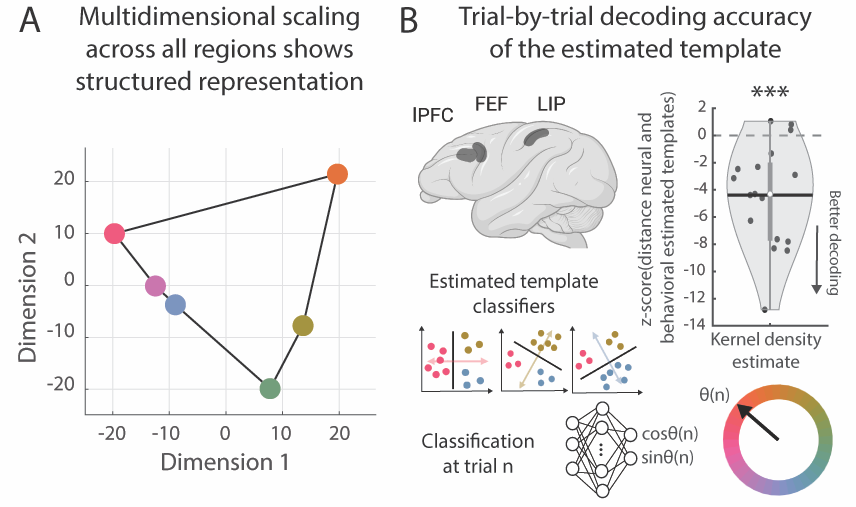
3/5: Recordings in prefrontal and parietal cortex found attentional templates were semantically structured: templates for perceptually similar stimuli had similar neural representations. Such structured geometry could allow for generalization to new templates.
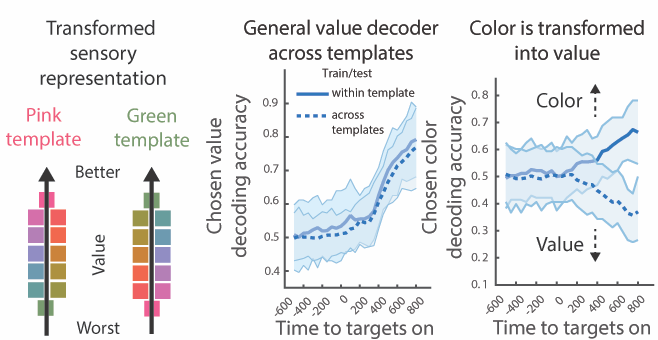
5/5: Finally, attention re-mapped sensory stimuli into a common ‘value’ space which generalized across templates. This could allow the brain to use the same decision-making circuitry to decide which stimulus to select, regardless of changes in the template or environment.
2/5: To understand how the brain does this, we trained animals to do a visual search task that required them to learn new attentional templates on each block of trials. Behavioral modelling enabled us to track the animal’s estimate of the attentional template across learning.