Jono’s videos are always worth watching!
S.African Syrah & its Global Glow-up | Old Road Wine Co. 12 Mile Syrah 2... https://t.co/rXGPF29Lu6 via @YouTube
Training clinician scientists in South Africa is possible. But it requires multiple steps we’re not doing. It’s not enough to have an MBChB and a PhD. You need to support integrated postgraduate training and then the shift to independence. None of this happens currently.
It’s crazy how much worse GSH has gotten in the 18 months I’ve worked here. Staff shortages, theatre lists cut, no lab IT systems, no functioning lifts, now no PACS for radiology. At our leading academic hospital. And it’s even worse elsewhere.
The scale of this security breach is huge. Essentially the entire public sector laboratory infrastructure is down for days to potentially weeks. The impact on patient care is going to be enormous.
The National Health Laboratory Service (NHLS) had a security breach on Friday resulting in servers and data storage being inaccessible and some – including the backup data – being deleted.
@J_chabalala
https://t.co/469arjba6L
The worst part of working in public healthcare in South Africa at the moment is dealing with patients who have waited 8 hours to see an overworked doctor in an understaffed facility. And then telling them that things are not going to get better - they’re actively getting worse.
This is a very good piece that, despite some unwelcome contortions, remind us that failing states eventually merge into amorphous lump of globalised shit. https://t.co/t0Wa8TYNQt
I’m becoming increasingly interested in the historical evolution of medical note taking, especially in South Africa, where electronic records are patchily implemented - As @AdamRodmanMD notes in one of his Bedside Rounds episodes, how we document reflects how we think.
@webafrica and @vumatel may be the most useless combination of companies in South Africa. 2 weeks trying to get a fibre line activated, and you can’t even speak to a human being from either company.
Burnout in healthcare—and many other fields—is the discourse du jour. The “wellness” response has been widely panned. Working conditions are appropriately a focus. I’ve tried to emphasize ideological dynamics at play. But what’s often ignored is the place of desire. 1/
Or maybe it’s that tertiary hospitals prioritise registrar teaching, while using interns as clerks and phlebs. I wonder if it’s different elsewhere, especially a secondary level?
Either way, I don’t think any of us have access to journals or UpToDate.
Internship isn’t really about learning; it’s about service provision. Which is not to say that you can’t and don’t learn. Just that it’s not optimised.
It’s especially obvious at an academic hospital like GSH, when you have no access to academic resources (eg UpToDate).
Some of that is probably from the rotational structure - when you’re in a department for 2-3 months, there’s relatively little motivation to invest in you.
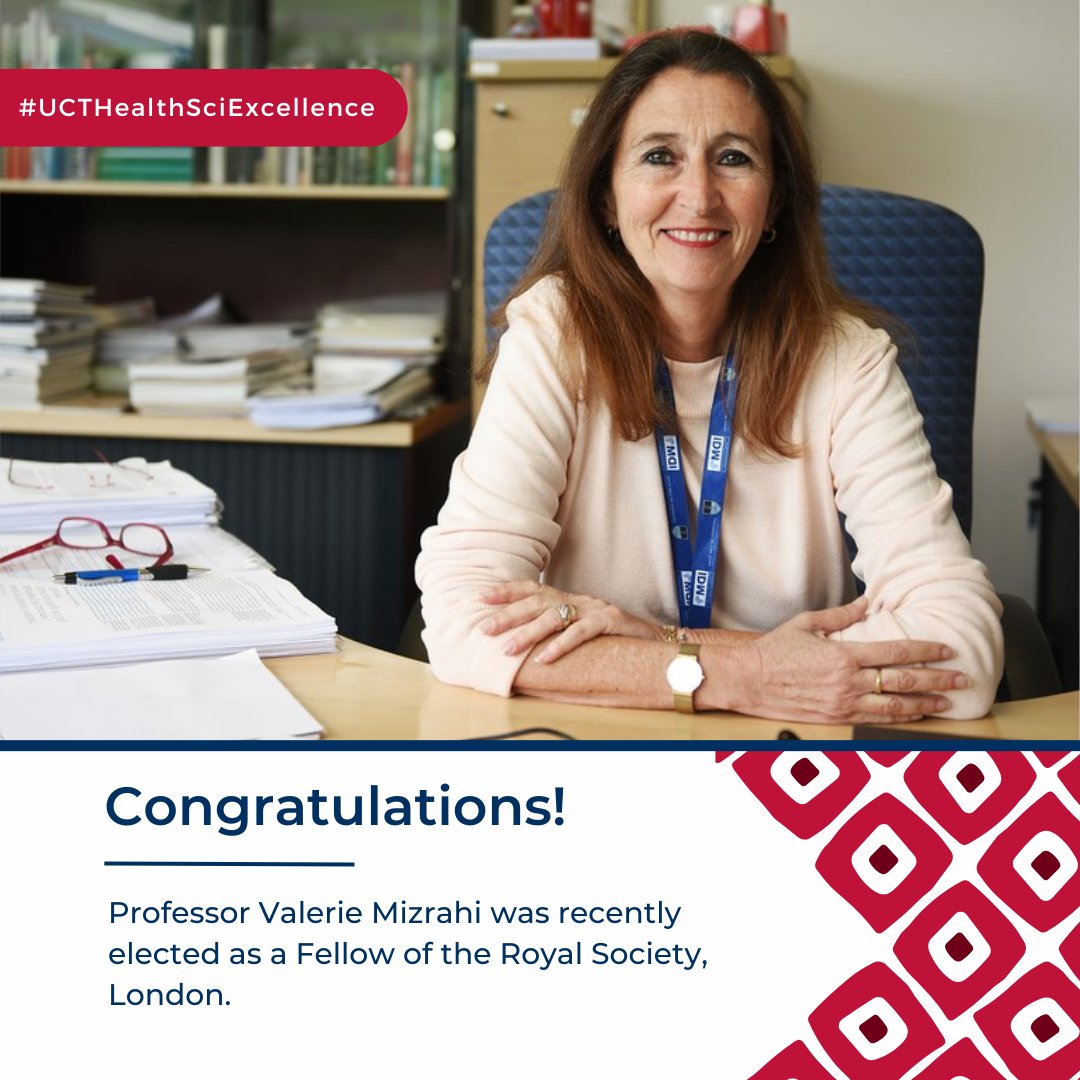
Congratulations to Professor Valerie Mizrahi, Director of @UCTIDM on her election as Fellow of the Royal Society, London, for her substantial contribution to the advancement of science, particularly in the area of tuberculosis in Africa.
Read more: https://t.co/0WIqMm3ROq
The HPCSA internship logbook repeatedly misspells the word “pregnancy” as “pregnancynancy”.
So I really trust them to regulate the profession and protect the public.
I just worked 92 hours in a 7 day stretch, and I would not recommend it.
But at least in exchange for the 12 days in a row I’ve worked, I get a single day off. It’s the little things.
I don’t love private healthcare. But the inefficiencies within the public sector are insane, and there’s almost no incentive to streamline or optimise systems. And honestly, I don’t think it’s fixable.