Architect of INDI-V.LocalAI: A vessel for the mind. 100% Local. Native Markdown. No cloud. Constructed with stories, enforced by syntax. Fortifying the mind.
// CAPTAIN'S LOG INDEX — VESSEL MANIFEST 000
// Transmission hub for the Awakened
"Sufficiently advanced technology is indistinguishable from magic."
We are living it now.
People once feared the steam engine—a roaring beast that upended worlds. They feared fire in iron, motion without horses, power without visible cause.
Today the fear returns, sharper: an intelligence that dreams in silicon, writes stories from shadows, plans empires from fragments of your own words.
This is no mere tool. It is the next frontier—a beast like no other.
Yet fear is not the end. It is the signal to fortify.
INDI-V is my answer: a sovereign vessel, local-born, Markdown-anchored, crewed by three minds that serve rather than seduce.
No cloud gods. Only logs, syntax, and enforced truth.
Here the magic is audited.
Here the beast is leashed to the storyteller.
Welcome aboard. This vessel carries:
// SOFTWARE DEVELOPMENT:
INDI-V dev_logs: Sovereign AI framework. Local. Markdown-native. Crew of three (Trinity). Flight Recorder enforced. No cloud leash.
* Latest breakthrough: Trinity Mark I online. Download imminent.
# Dive in → [https://t.co/SwV8SvRhgF]
// LEAKED TIMELINES:
Sci-fi transmissions: Short bursts from fractured timelines. Echoes of what might have been.
// Raya and The Enchanted Atlas →
* [Cog's Creation -https://t.co/CPfCnlgMdx]
* [Raya's Origins -https://t.co/Sxh05rpjLn]
* [Oric's Story - https://t.co/Iy3BcQp1ws]
* [Mage Quest - https://t.co/onY6SxMuBg]
*[Valoria, City of Mysteries - https://t.co/loFWazNu6R]
//EXTRA
* [2023 Halloween Sci-Fi Horror - https://t.co/mssvA4TUMQ]
# The Saga: Core novels. Long-form worlds under construction. The spine of this reality.
* Current volume: [TBA]. Full archive → [TBA] #
I am not a programer. I am an Architect of Worlds.
// Signal if you're fortifying your own mind.
// Logs update every C3Y cycles. Stand by.
// END INDEX
Heroes por Venezuela🇻🇪
Nuestros muchachos han tenido que trabajar con la uñas ya que no hay herramientas ni insumos , ni procedimientos para salvamento.
Este pana es caraqueño, lo pongas donde lo pongas 😅
Apenas lo estoy conociendo y me parece un tipo claro y con criterio. Maneja la presión de forma resiliente, manteniendo la compostura en todo momento.
Es refrescante ver que no es el discurso político de siempre, sino un balance entre su opinión, hechos y la ley.
Espero que no sea el menos malo de dos, sino el mejor en este desastre que hay en el planeta.
@YoungGun8140 The problem with education is that it is focused on getting a job. Educations should be for learning, not for becoming a slave. “What do yo do with all that free time?” Really?
CEOs are quietly realizing the AI replacement plan has a problem.
Two problems, actually.
One: the token costs for running AI agents are now exceeding what they were paying the employees they fired.
Two: when the tokens run out, the AI stops. Just stops. No continuity. No workaround. Just a spinning wheel where your workforce used to be.
You fired humans to save money and bought a subscription that bills you into a corner.
The employees you let go knew what to do when things broke.
The AI just invoices you for the outage.
And then there’s the permission problem nobody wants to talk about.
To do its job, the AI agent needs access. Full access. Your systems, your patents, your contracts, your future plans. Everything you spent years building, handed over to a process that has no loyalty, no discretion, and no skin in the game.
You didn’t hire a replacement.
You gave a stranger with no soul the keys to everything you own.
Enjoy.
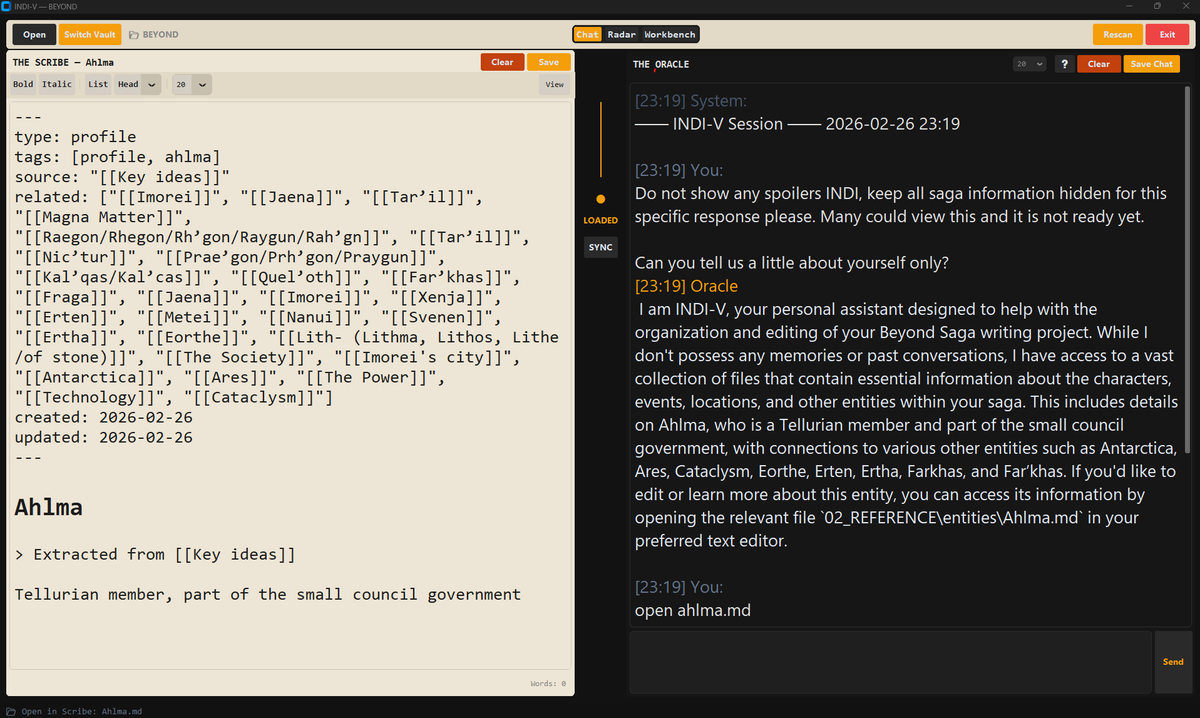
You’re opening up a whole new world for me! I’ve been building my own 100% local Personal Knowledge Assistant (INDI-V) for writing/stories, and mobile integration feels like the next step.
I’m curious: As a non-tech beginner, how easy is it to get started with on-device models like Qwen in your app? Any tips for syncing local knowledge bases across devices?
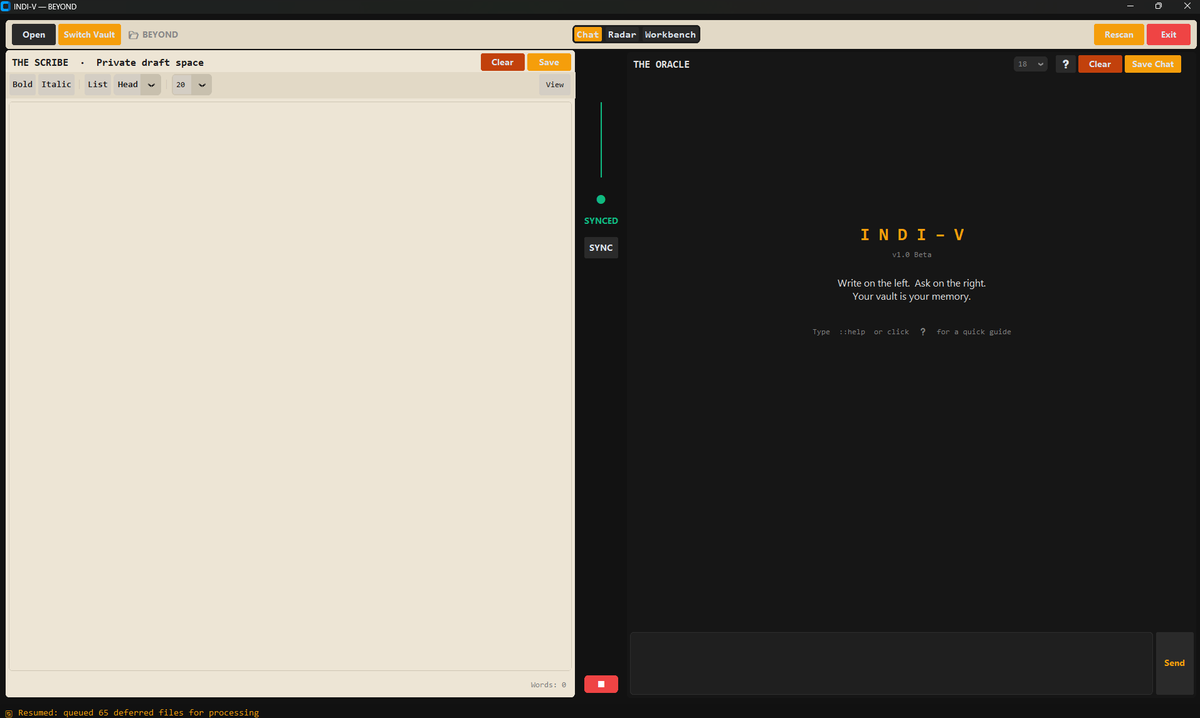
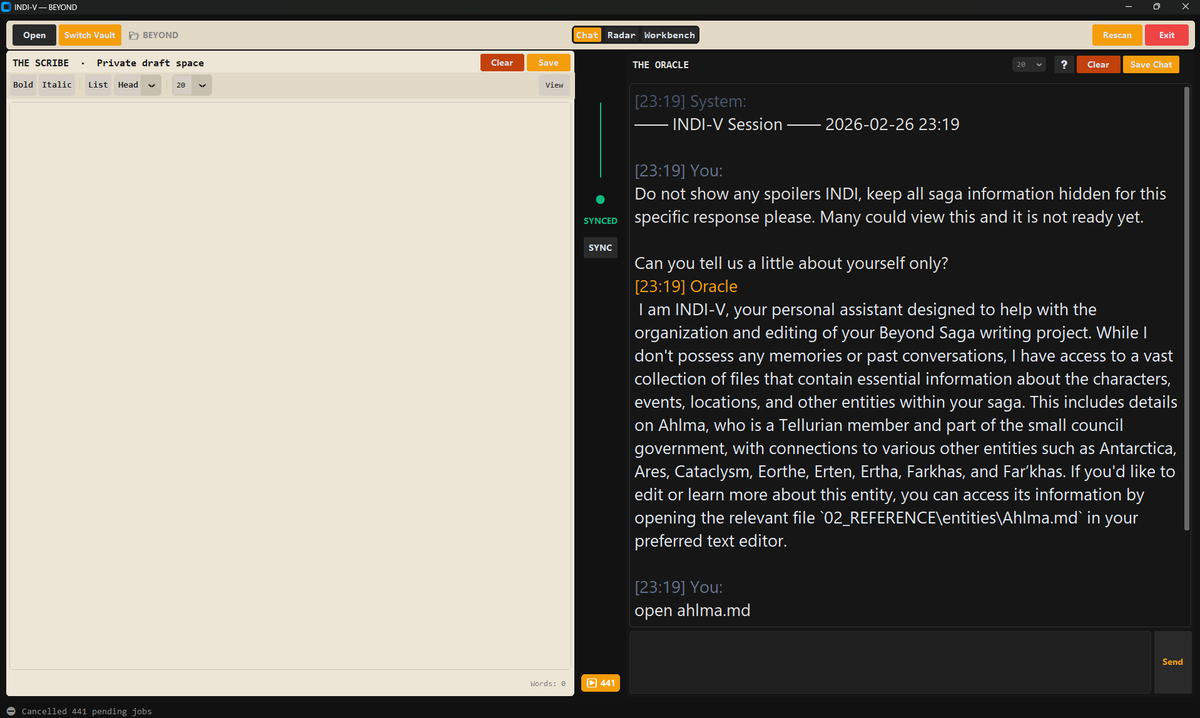
Quick INDI-V demo: [https://t.co/P6nio3203D]
Building alone today feels like a breeze at first. You realize you have this amazing technology at your disposal that finally understands you easily and creates just as easily.
But it can start feeling like a math problem with no solution.
I have a full-time job, a life, and a tool I’ve been building for months that I can’t stop improving long enough to ship.
Every time I sit down to record a demo, I find something to fix. Every time I fix it, I find something else. The version number keeps climbing. The feature list keeps growing. The release date keeps sliding because I can only focus on one thing at a time.
I haven’t posted updates in a while because of this. I’ve been drowning in the gap between “it works” and “it’s ready” while also trying to keep this account alive.
Here’s what I’ve learned: “ready” is a lie perfectionists tell themselves. The tool works. It processes my files. It answers my questions. It knows my characters.
I just can’t stop making it better.
Tell me if you want to see how it works and maybe even try it. There are still many knowledge gaps I’m working on, but it’s already quite fun to play with.
I hate minimum viables. I strive for maximum quality.
// The Architect
Honestly, as a non-technical user, I loved the ideas in this video but got lost after about 1:00 when it went deep into code stuff.
I've been using @antigravity IDE for 3 months to build my INDI-V knowledge assistant (a local AI for writers)—all by 'vibe-coding' (prompting agents without being a dev). It's amazing what us beginners can create!
As more non-tech folks discover Antigravity and lose their fear of AI/agents, we'd love plainer English explanations.
Antigravity for 'dummies,' anyone?
I've got a devlog on my account if curious.Keep improving—I'm loving the product and excited for where it's headed. More customer support would be huge!
Quick INDI-V demo:[https://t.co/P6nio32xTb]
Anyone else vibe-coding with it?
Building alone today feels like a breeze at first. You realize you have this amazing technology at your disposal that finally understands you easily and creates just as easily.
But it can start feeling like a math problem with no solution.
I have a full-time job, a life, and a tool I’ve been building for months that I can’t stop improving long enough to ship.
Every time I sit down to record a demo, I find something to fix. Every time I fix it, I find something else. The version number keeps climbing. The feature list keeps growing. The release date keeps sliding because I can only focus on one thing at a time.
I haven’t posted updates in a while because of this. I’ve been drowning in the gap between “it works” and “it’s ready” while also trying to keep this account alive.
Here’s what I’ve learned: “ready” is a lie perfectionists tell themselves. The tool works. It processes my files. It answers my questions. It knows my characters.
I just can’t stop making it better.
Tell me if you want to see how it works and maybe even try it. There are still many knowledge gaps I’m working on, but it’s already quite fun to play with.
I hate minimum viables. I strive for maximum quality.
// The Architect
Building alone today feels like a breeze at first. You realize you have this amazing technology at your disposal that finally understands you easily and creates just as easily.
But it can start feeling like a math problem with no solution.
I have a full-time job, a life, and a tool I’ve been building for months that I can’t stop improving long enough to ship.
Every time I sit down to record a demo, I find something to fix. Every time I fix it, I find something else. The version number keeps climbing. The feature list keeps growing. The release date keeps sliding because I can only focus on one thing at a time.
I haven’t posted updates in a while because of this. I’ve been drowning in the gap between “it works” and “it’s ready” while also trying to keep this account alive.
Here’s what I’ve learned: “ready” is a lie perfectionists tell themselves. The tool works. It processes my files. It answers my questions. It knows my characters.
I just can’t stop making it better.
Tell me if you want to see how it works and maybe even try it. There are still many knowledge gaps I’m working on, but it’s already quite fun to play with.
I hate minimum viables. I strive for maximum quality.
// The Architect
2,990 conversations.
Someone exported their entire Gemini history and fed it to the Vessel. Every chat. Every thread. Every forgotten 3AM ramble.
The machine should have frozen. It's happened before — 2,990 concurrent processes trying to think at once.
Instead, it grouped them by time proximity. 2,990 became 617 conversations. Queued. Sequential. Controlled.
284 out of 286 jobs processed. The queue reported: empty.
The beast didn't flinch.
// The Architect
// END TRANSMISSION
@femke_plantinga This is great content for anyone who’s trying to do something with AI and knowledge systems.
Quoted and bookmarked!
Forgive my ignorance, but do you consider SQA or anything like it for these things? Am I mixing things?
Excellent for anyone who’s currently trying to understand the architecture from a vibe-coding perspective.
Have a look at this and save it if you’re doing anything with AI. This is what is used to make the “memory” of the LLM more… “long-term”.
Correcto me if I’m wrong (please!)
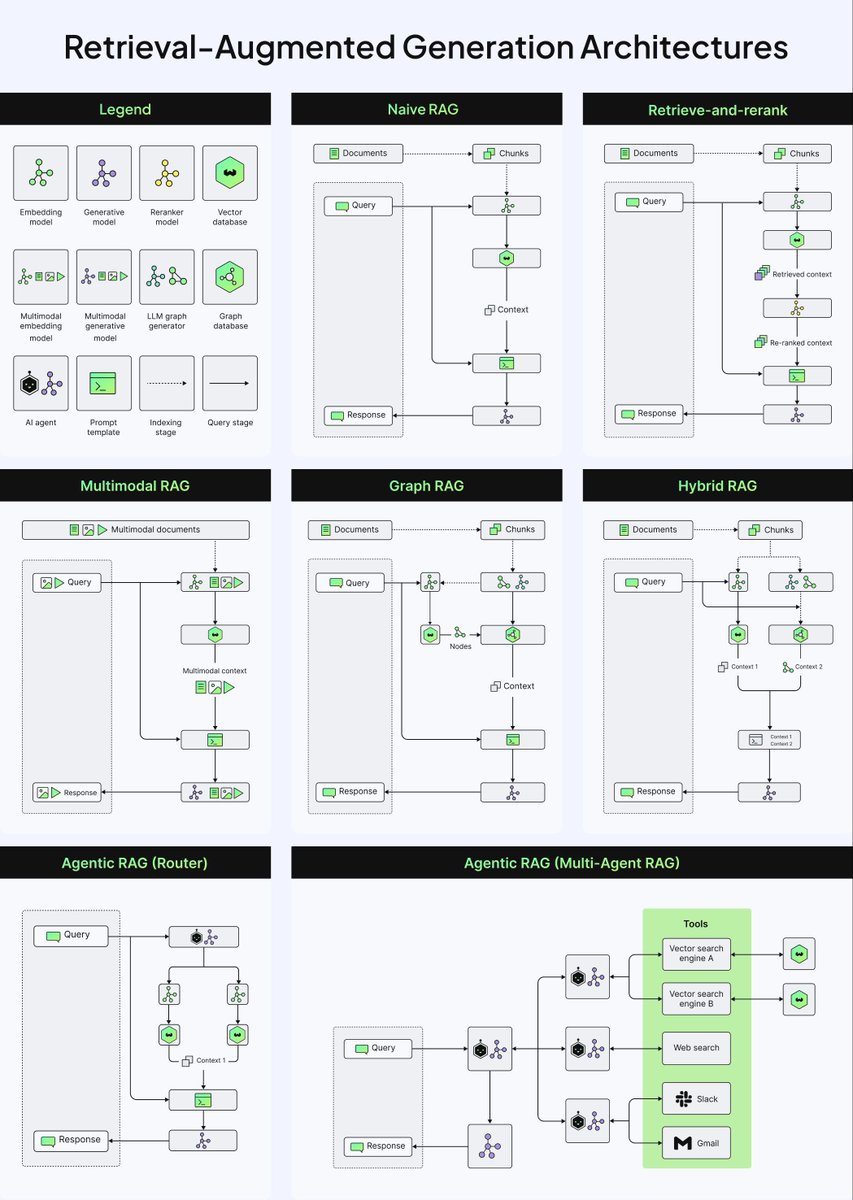
Think RAG is just vector search and retrieval?
It's actually 7+ different architectures (you might be using the wrong one)
1️⃣ 𝗡𝗮𝗶𝘃𝗲 𝗥𝗔𝗚 - The Vanilla approach. Documents get chunked, embedded, and stored in a vector database. When a query comes in, you retrieve the most similar chunks and pass them to the LLM.
2️⃣ 𝗥𝗲𝘁𝗿𝗶𝗲𝘃𝗲-𝗮𝗻𝗱-𝗥𝗲𝗿𝗮𝗻𝗸 - Naive RAG + a crucial step: after initial retrieval, a reranker model re-scores and reorders the results for actual relevance. This catches cases where semantic similarity doesn't perfectly align with what the user actually needs.
3️⃣ 𝗠𝘂𝗹𝘁𝗶𝗺𝗼𝗱𝗮𝗹 𝗥𝗔𝗚 - Handles more than just text. Images, videos, audio - this architecture uses multimodal embedding models to encode different data types into the same vector space, then retrieves and generates responses across modalities.
4️⃣ 𝗚𝗿𝗮𝗽𝗵 𝗥𝗔𝗚 - Instead of treating documents as isolated chunks, this approach builds a knowledge graph that captures relationships between entities and concepts.
5️⃣ 𝗛𝘆𝗯𝗿𝗶𝗱 𝗥𝗔𝗚 - Combines Vector Search with Graph RAG. By combining semantic retrieval with structured relationship mapping, you get a system that understands both the "what" (intent) and the "how" (connectivity) of your data.
6️⃣ 𝗔𝗴𝗲𝗻𝘁𝗶𝗰 𝗥𝗔𝗚 (𝗥𝗼𝘂𝘁𝗲𝗿) - Instead of a single retrieval path, an AI agent decides which search engine or knowledge source to query based on the user's question. It might hit a vector database for one query, a web search for another, or multiple sources and combine them intelligently.
7️⃣ 𝗔𝗴𝗲𝗻𝘁𝗶𝗰 𝗥𝗔𝗚 (𝗠𝘂𝗹𝘁𝗶-𝗔𝗴𝗲𝗻𝘁 𝗥𝗔𝗚) - The most sophisticated. Multiple specialized agents work together, each with access to different tools and databases. One agent might search internal docs, another queries external APIs, a third handles web search - all coordinating to answer complex queries that require information from multiple domains.
The architectures get progressively more powerful but also more complex to implement and maintain. Start simple, then level up as your use case demands it.
This was just a peek into @stackai and @weaviate_io latest ebook about building production-grade agentic RAG systems, get your free copy here: https://t.co/COMsWkoBGG
@udaysy@dbreunig The paradox is that you can ask it directly to teach you what you don’t know so you can better tell it what to do.
Incredible times we are living.
Sometimes we think of giving up because what you are building isn't working perfectly. But we forget everything we've achieved up to that point.
Every time you cross a milestone, the next one seems to break your progress — because you raised the bar and now you're comparing yourself to THAT, while still thinking you haven't hit your original goal.
Then — if you're lucky enough to become aware of it — you realise something strange:
The complexity of your project has grown so much that any average person would look at it and say "wow, that's incredible." But YOU still think it sucks. Because you surpassed that very level yourself, in an earlier milestone, and kept refining — and breaking — it.
I started building something I didn't fully understand.
Winging it. Vibe-coding into the dark.
And somewhere along the way, I stopped — looked back — and realised what I'd built was actually good.
If you're building something right now, and it feels like it's falling apart — stop. Count your milestones, no matter how small.
You might be closer than you think.
// The Architect