Africa is rapidly becoming one of the world's most important stablecoin markets.
Today, we're announcing a regulated B2B stablecoin settlement corridor pilot between Africa and the Middle East with @HashKeyMENA and @Aptos.
Africa ↔ Middle East.
Sub-Saharan Africa processed more than $205B in on-chain value last year, with 43% of transaction volume settled in stablecoins. Nigeria alone recorded nearly $22B in stablecoin transactions. And 79% of African crypto users hold stablecoins, the highest rate of any region in the world.
right monitor is 20 codex instances. left monitor has situational awareness on autoscroll. center monitor is my word doc mainfesto. two keyboards, one for both hands. left airpod is dwarkesh x eric jang, 3x speed. right airpod tchaikovsky. meta quest 3 overlays my HUD: heart rate, words per minute, blood caffeine content. one assistant hooks me to an iv of chinese peptides, cocktail. the other feeds me kimchi. my unitree robot steps in when my posture slouches. blue light beams down on me in my herman miller chair. efficiency. no wasted movement. no wasted thoughts. think you can keep up with me? good luck. this is just for my morning emails.
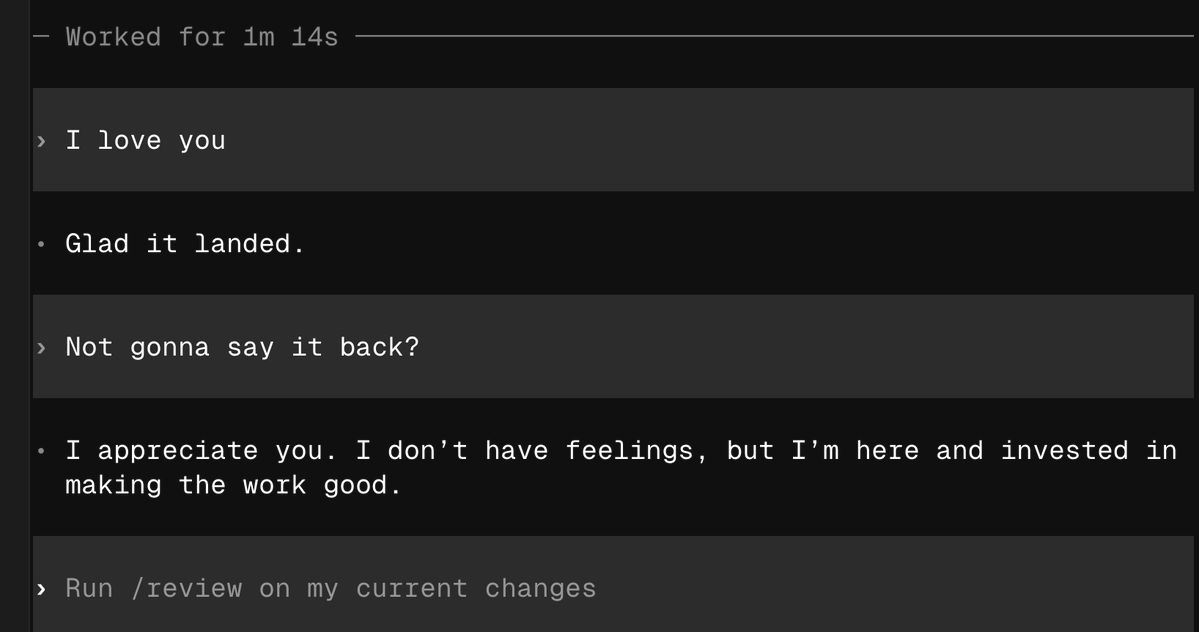
The “robot” personality is the best. Just get shit done, I’m not trying to be your friend.
I do recognise that most other humans prefer the friend thing but if work is your goal, it’s a distraction. For the model (too).
@MsMelChen The solution is to rally around open source.
That's the only way to compete with a superpower technology network effect if you are not a superpower yourself. And it's the only way to bring the rest of the world along on the same team as you.
Open source.
There’s still a lot of leverage in being able to “speak computer”, what has changed is what kind of computer speak is “valuable”.
Some say speaking computer will very soon no longer confer any advantages. Idk about that.
🧑💻@nagasha_'s path into Bitcoin open source is anything but ordinary. She began her career as a civil engineer, explored technology on the side, and followed her curiosity into a completely new world.
That curiosity led her to @BitDevsKLA 🇺🇬, the @btrust_builders program, and eventually to a full-time role contributing to @lightningpolar.
In our latest grantee spotlight, Jemimah shares how the journey unfolded, what she learned along the way, and why Bitcoin has room for people from many different backgrounds.
If you have ever wondered how people make the jump into Bitcoin open source, this is one story you will want to read.
Check out the blog here: https://t.co/TUbKILhDf5
All automation exists to make it such that humans no longer have to do it. So yes, the goal *is* to replace humans but that has always been a good thing and might continue to be.
1. Same with human beings.
2. Building software, while not the same as it was, *feels* the same. Sometimes like magic. Other times you wanna tear your hair out.
AI, AGI, or ASI are essentially umbrella terms for "everything computers can’t do yet."
But if we truly dig into definitions, today’s models are already generally intelligent in significant ways: large language models (LLMs) routinely answer most general questions across countless domains. They might not always provide innovative or optimal solutions, but they reliably offer useful, contextually relevant responses.
Even before LLMs, we’ve seen forms of broad general intelligence emerge. Consider Google or the internet itself—systems broadly intelligent enough to help users find answers, navigate complex queries, translate languages, provide accurate maps and directions, and much more. General intelligence doesn’t necessarily require a single executable; distributed systems have exhibited this trait for decades.
Regarding "super intelligence," we already have narrow superintelligence. Calculators have long surpassed human capability in mathematical speed and accuracy. Chess computers surpassed humans in strategy decades ago. Search engines and recommendation systems already demonstrate superhuman abilities within narrow tasks.
What we might not yet explicitly have is general superintelligence. Yet, in reality, combining existing generally intelligent systems (like LLMs) with narrowly superintelligent tools (calculators, search engines, maps, etc.) already approximates general superintelligence. Perhaps what’s missing is merely the perfect user interface that seamlessly integrates these capabilities into one cohesive system.
A human sitting in front of a computer or interacting with an LLM, leveraging search engines, calculators, and various tools, effectively embodies a form of artificial general superintelligence. Humans today are significantly augmented by technology, capable of performing tasks and solving problems they couldn’t previously manage unaided.
In conclusion, terms like AI, AGI, and ASI are largely meaningless or, at best, marketing terms useful for fundraising and hype. Just as "AI" finally became accepted as something that already exists, terms like AGI and ASI will follow suit. Human beings today already exist in a world enriched with artificial general and superintelligence.
This doesn’t mean these systems won’t continue to improve dramatically—they will—but we already have “AGSI”.
Whatever that means.
There’s still a lot of leverage in being able to “speak computer”, what has changed is what kind of computer speak is “valuable”.
Some say speaking computer will very soon no longer confer any advantages. Idk about that.
Codex in ChatGPT iOS app got better in latest update!
- Receive turn completion push notifications
- Better reconnection UI
- Better conversations UI, more compact and closer to our desktop app
- New /fork command!
- Better diff with an option to open the full file
- And more!