Try to develop a practice of prioritizing curiosity over status, meaning it's better to be learning than to try to appear to be the smartest [person] in the room ~
Brandon cardwel
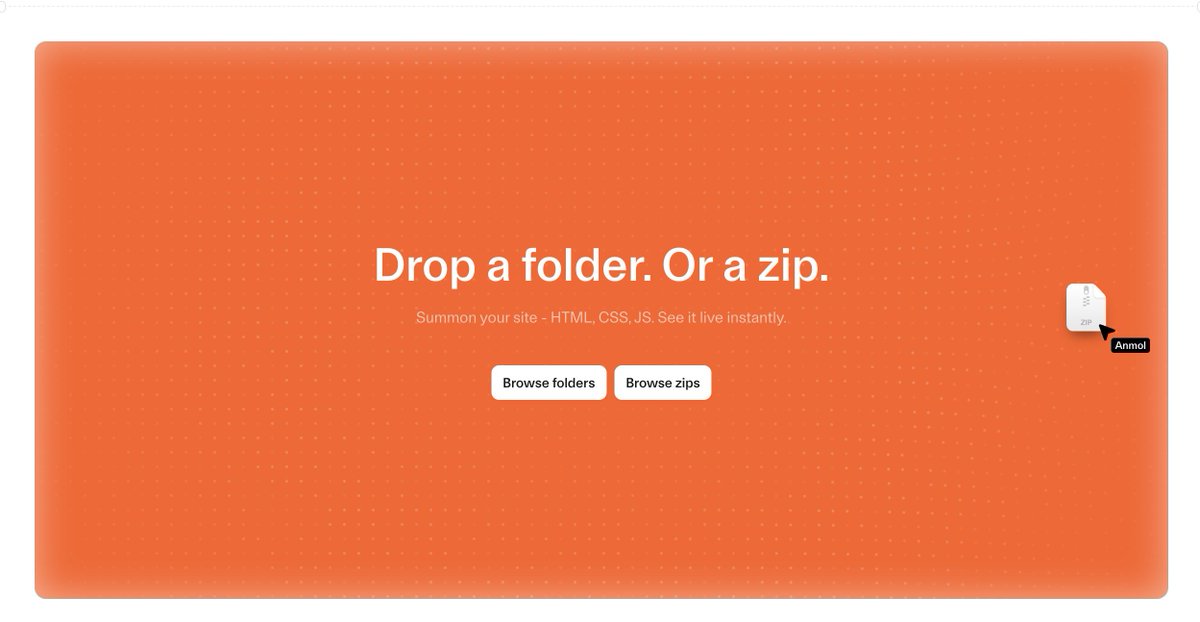
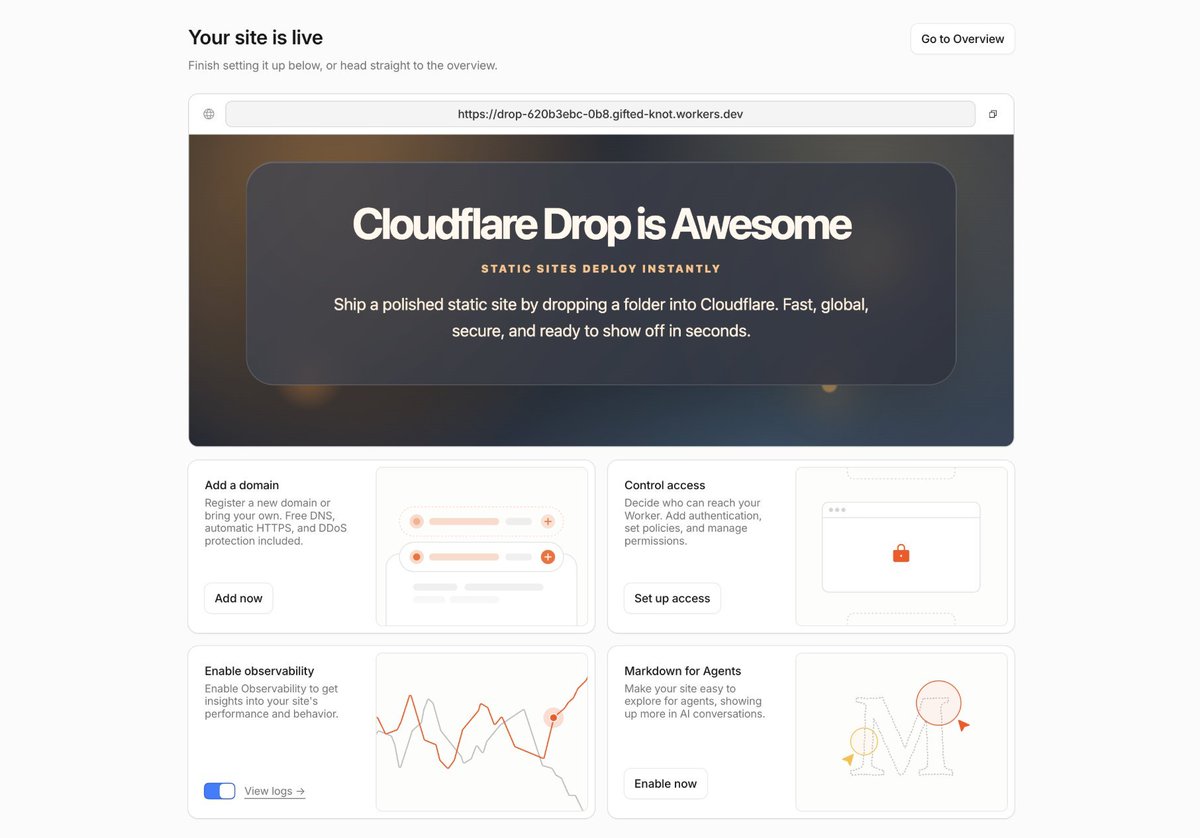
Introducing Cloudflare Drop
Drop your folder in the browser and deploy it instantly on Cloudflare. Your website... milliseconds away from users on region: earth
No account needed. Deployment is active for 60 minutes, then expires unless you claim it.
https://t.co/Dn6b1mggqs
do everything that you can to increase the surface area of luck
a job, a startup, a relationship
whatever it is - do everything, shoot the wildest of shots, be shameless and do things with intent
"First do it, then do it right, then do it better."
Just start. The journey to success often begins with a single step, but that first step can be the hardest to take. It's easy to get caught up in the fear of failure or the desire for perfection, but I hope this quote I first shared in 2013 can be a reminder of the importance of simply getting started as we go into 2024.
Just Start Somewhere
"Start slow if you have to. Start small if you have to. Start privately if you have to. Just start." - James Clear
Taking that first step doesn't require perfection or immediate mastery. The key is to overcome inertia and take action, as this action will lead to progress, learning, and (if you’re lucky and consistent) ultimately success.
When you start, you allow yourself the opportunity to grow, adapt, and move forward.
The Power of Starting
Beginning a new project or habit often feels daunting. According to psychologists, we tend to overestimate the pain of starting and underestimate our ability to persist.
However, studies show that "small starts" predict eventual success better than initial enthusiasm or early progress. This phenomenon is known as the fresh start effect - taking the first step energizes us and bolsters motivation.
So focus on starting without putting pressure on perfection. Progress and course corrections will follow.
First, Do It: Embrace the MVP Mindset
Doing it = get the simplest MVP out.
A Minimum Viable Product (MVP) represents the simplest version of a product or idea that allows you to test, gather feedback, and iterate.
By embracing this mindset (just get something done - it's OK if rough, a prototype, a draft), you focus on progress over perfection, understanding that getting something out into the world is far more valuable than waiting for the perfect moment.
Expand Your Comfort Zone
Venturing outside one's comfort zone can elicit fears of failure. Leaning into discomfort not only builds confidence and skills, but research shows it makes us more receptive to learning. Recognize that fear is often the mind's way of urging us to grow. Don't let it stop you from progressing.
Then, Do It Right: Refine and Correct
Doing it right = fix correctness issues.
Once you've taken that first step and put your MVP out into the world, it's time to refine and correct. This stage is about learning from feedback, identifying areas of improvement, and making adjustments accordingly.
It's a chance to iterate on your idea, ensuring that it meets the needs of your audience or customers while aligning with your vision.
Cultivate Curiosity and Resilience
Meeting new challenges with curiosity and resilience makes venturing outside our comfort zone more sustainable and enjoyable. Cultivate curiosity about growth opportunities and your capacity to rise to them. Set mini-challenges to incrementally expand your horizons.
When facing inevitable setbacks, avoid self-criticism and tap into resilience - the ability to recover, learn and continue progressing.
Self-compassion, adaptability and maintaining perspective are key here. With consistent effort, you build confidence in your ability to start, stumble, learn and work toward mastery.
Finally, Do It Better: Strive for Continuous Improvement
"Doing it better = iterate towards an ideal end-state (e.g., make it fast)."
The journey doesn't end with merely doing it right.
The final step is to continuously improve, striving for excellence and growth.
By iterating towards an ideal end-state, you demonstrate a commitment to progress, ensuring that your product, idea, or project remains relevant, innovative, and successful.
Set New Goalposts
As you improve, have a clear idea of when you are “done” or update your goalposts. Elite athletes turn small gains into competitive edges via the aggregation of marginal gains. Identify areas of potential improvement and set measurable stretch goals, from increasing efficiency to enhancing user delight.
Overcoming the Greatest Barrier to Progress
"The greatest barrier to progress is not lack of resources or talent, but fear of failure."
Recognizing that fear of failure is the most significant obstacle in the pursuit of success allows you to confront it head-on.
By acknowledging this fear, you can focus on taking that first step, knowing that once the ball starts rolling, it becomes much easier to keep it in motion.
Remember that starting is more than half the battle. Don't wait until you feel ready, because the perfect moment may never come.
The Bottom Line
Rather than striving for perfect execution, embrace the power of starting - put forth an MVP, soft launch an initiative, or set a milestone. Progress begets motivation. By simply starting, you open the door to growth and innovation. The rest will follow.
Embrace the power of starting and then iterating until you're happy.
I often joke that I have only ever had one job. What I rarely mention is that, in my early thirties, I was building two businesses simultaneously. Not long after the Unipetrol acquisition, a small group of us saw the opportunity to apply for a GSM license. From 8:00am to 8:00pm, I focused on growing the energy business.
The nights, starting from 8:00pm, belonged to telecoms. Seven of us worked until 2:00am daily, refining the bid, aligning partners, and preparing for an outcome that was far from guaranteed.
We won that license, launched, and later exited. Today, that telecom company is known as Airtel.
What's the lesson? Youth is an execution advantage. At that stage of life, sustaining 18-hour workdays repeatedly was possible. Not only because of motivation, but because of capacity.
There is a surplus of energy and tolerance for uncertainty at that stage. Over time, that edge diminishes.
If you are early in your career, this is the period to use that advantage. Take the risk. Endeavour.
#jatnotes #winning
Thanks for all the responses. It turns out that my view of cybersecurity’s future is unpopular. But here it is:
- New doesn’t replace old. All the stuff that exists keeps existing. BUT it will be effectively “legacy”. Everything below is about the new.
- AI detection everywhere. Audit logs, endpoint, appsec, etc. We embrace non-deterministic vibe hunting.
- The whole “use stupid rules to trigger alerts that we then hand to humans” flow (SOC) disappears because that was built for a world where intelligence was expensive.
- Detection, investigation, and response become one thing.
- AI agent security will be super hot and attract a lot of people not in cyber today (engineering and IT).
- Attacks are way less homogenous, and orgs experience way higher volume of sophisticated and targeted attacks.
- GRC keeps being GRC.
- A lot of existing CISOs won’t make it. Most new CISOs won’t come from traditional cyber roles.