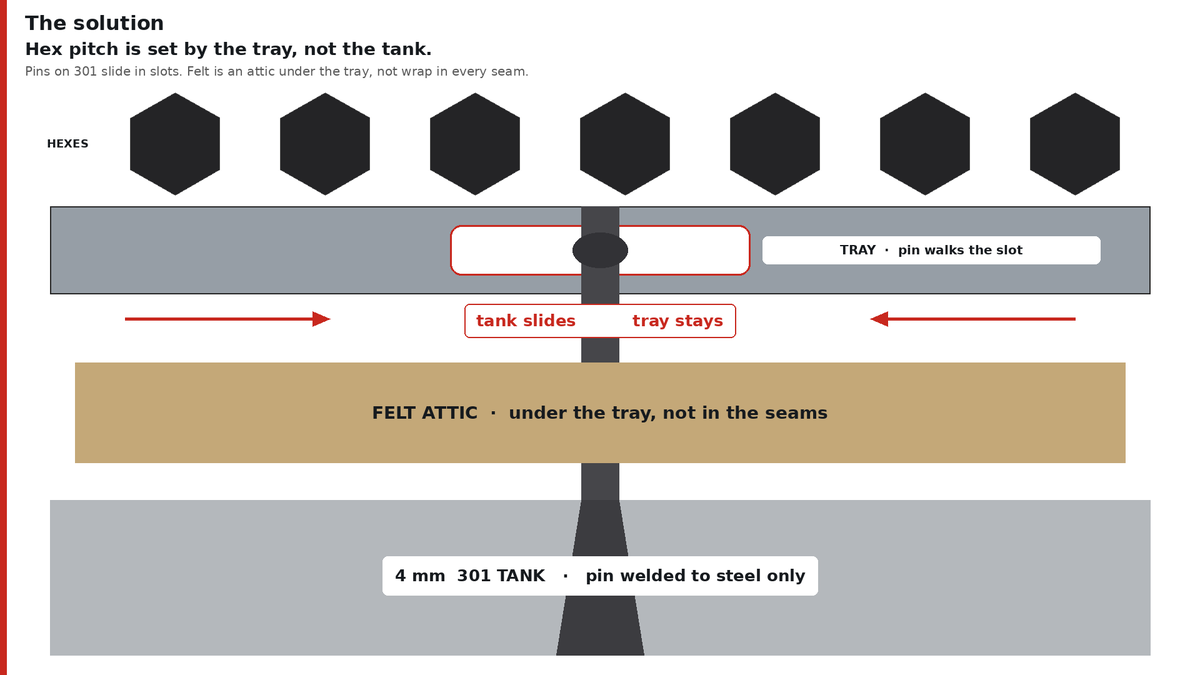
A testable solution to Starship’s heat-shield problem that does not treat wrap as a forever part.
Proposal: hex pitch on a tray. 301 crawls in the slots. Felt is an attic, not 18,000 gaskets.
Hexes stay put on a tray. Trays walk a few mm.
Trays get tiled in the factory.
@elonmusk@SpaceX
@metabolicnurse Typically, the benefits of weight loss and reduction of all of the above would greatly outweigh the low risk of NAION. But when it comes to losing eyesight... Seems like a much more complicated risk-reward calculation.
With the rise of GLP-1 use, I have seen more and more workups for non-arteric anterior ischemic optic neuropathy (NAION) considering this as the cause.
To all the Opthalmologists out there, what are your thoughts?
Patients are suing GLP-1 drugmakers over the risk of sudden vision loss. The little-discussed potential risk of popular diabetes and weight-loss drugs is on warning labels outside of the U.S. https://t.co/wnsPPG5L4o
@metabolicnurse Yes does seem multifactorial. Unfortunately, many people taking them have metabolic syndrome and inherently have all of the above so there must be some signal if we are seeing higher rates of NAION above the baseline in this group.
I want to live in a future where you can casually take your family to the spaceport and fly anywhere in the world in under 60 minutes.
Made with @imagine
@elonmusk I can't help but wonder if there will be a horrible twist of fate where the skynet/terminator scenario is created in an honest attempt to avoid it...
A testable solution to Starship’s heat-shield problem that does not treat wrap as a forever part.
Proposal: hex pitch on a tray. 301 crawls in the slots. Felt is an attic, not 18,000 gaskets.
Hexes stay put on a tray. Trays walk a few mm.
Trays get tiled in the factory.
@elonmusk@SpaceX
Amazing views of the heat shield! Will be doing a series of posts analyzing the current design, why they chose what they did, and why they are falling into the same trap as the Space Shuttle. But love seeing these engineers tackling the hardest problems in space flight, respect!
A fully and rapidly reusable rocket will fundamentally change how humanity accesses outer space. “The Holy Grail of Rocketry” continues the ongoing Starship series with a look back at the scrappy days of SpaceX engineers proving reuse was possible and takes you onboard a high-seas race to recover a floating Starship
A fully and rapidly reusable rocket will fundamentally change how humanity accesses outer space. “The Holy Grail of Rocketry” continues the ongoing Starship series with a look back at the scrappy days of SpaceX engineers proving reuse was possible and takes you onboard a high-seas race to recover a floating Starship
A testable solution to Starship’s heat-shield problem that does not treat wrap as a forever part.
Proposal: hex pitch on a tray. 301 crawls in the slots. Felt is an attic, not 18,000 gaskets.
Hexes stay put on a tray. Trays walk a few mm.
Trays get tiled in the factory.
@elonmusk@SpaceX
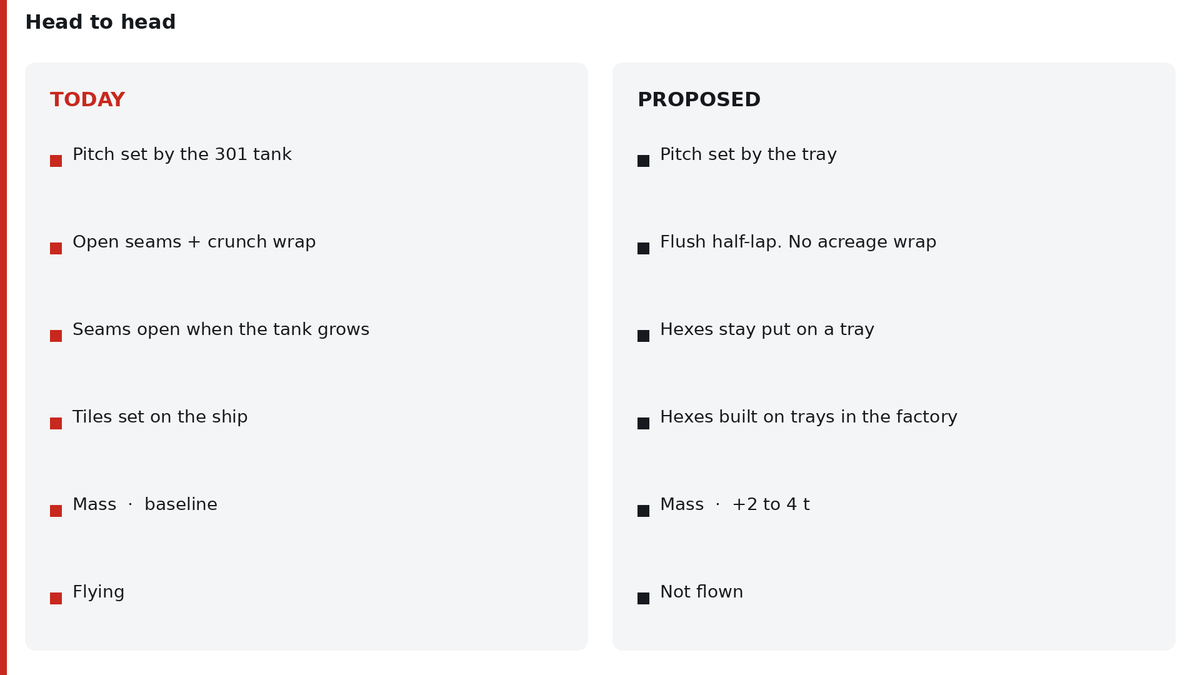
One question on this floating tray heat shield design is: How much of a weight penalty and expense would this add?
Not as much as you'd think.
Weight +2 to 4t which is about %3 of the ~100t dry mass.
Price would depend if you used Titanium versus a ceramic composite but likely in the low millions.
If the ship can truly be refilled and re-flown in hours instead of sitting for days needing refurbishment: priceless.
For sure, might be THE hardest to solve in all of spaceflight. What worries me (as Elon has attested to) is that there have been brilliant people working on this stuff going back to at least the 50s. The space shuttle heat shield is a miracle of engineering all fighting the same problems today. Only ceramic tiles seem to be able to withstand the heat, they expand at a lower rate than the ship they're attached to, and thus need gaps which plasma will interface with.
You can change what's in the gaps but this will always require refurbishment unless the gaps are eliminated and the only way to do that is address the expansion issue. Mine is one solution, sure there are others (Space-X has already tested metallic tiles and they oxidized, not good).
If I were to guess, priority right now is to get the ship flying even if it requires refurbishment. The current design is a temporary solution that can be improved to decrease refurbishment time and one much improved from the shuttle. But to achieve an airplane like reusability will require a major design change and I think we all want to live in that future 😀
A testable solution to Starship’s heat-shield problem that does not treat wrap as a forever part.
Proposal: hex pitch on a tray. 301 crawls in the slots. Felt is an attic, not 18,000 gaskets.
Hexes stay put on a tray. Trays walk a few mm.
Trays get tiled in the factory.
@elonmusk@SpaceX
😂 I am a @grok man, we spent many intimate hours together iterating and there are receipts. But I was at the helm the whole time and the tiles isolated from tank expansion on a scaffolding was mine. I am too verbose for short X threads that need to fit within a character count so Grok helped make them succinct but I admit I still expanded threads against Grok's advice and they were not impressed.
Not as much as you'd think, estimated at +2 to 4t which is about %3 of the ~100t dry mass. Price would depend if you use Titanium or a ceramic composite but likely on the low millions side which can translate to a lot of savings if the ship can truly be refilled and re-flown in hours instead of sitting for days needing refurbishment.
A testable solution to Starship’s heat-shield problem that does not treat wrap as a forever part.
Proposal: hex pitch on a tray. 301 crawls in the slots. Felt is an attic, not 18,000 gaskets.
Hexes stay put on a tray. Trays walk a few mm.
Trays get tiled in the factory.
@elonmusk@SpaceX
A few text typos (images ok), *tray* on post 4 and *2* instrumented trays flown on the ship on post 7. Please forgive, stayed up all night putting this together 😂
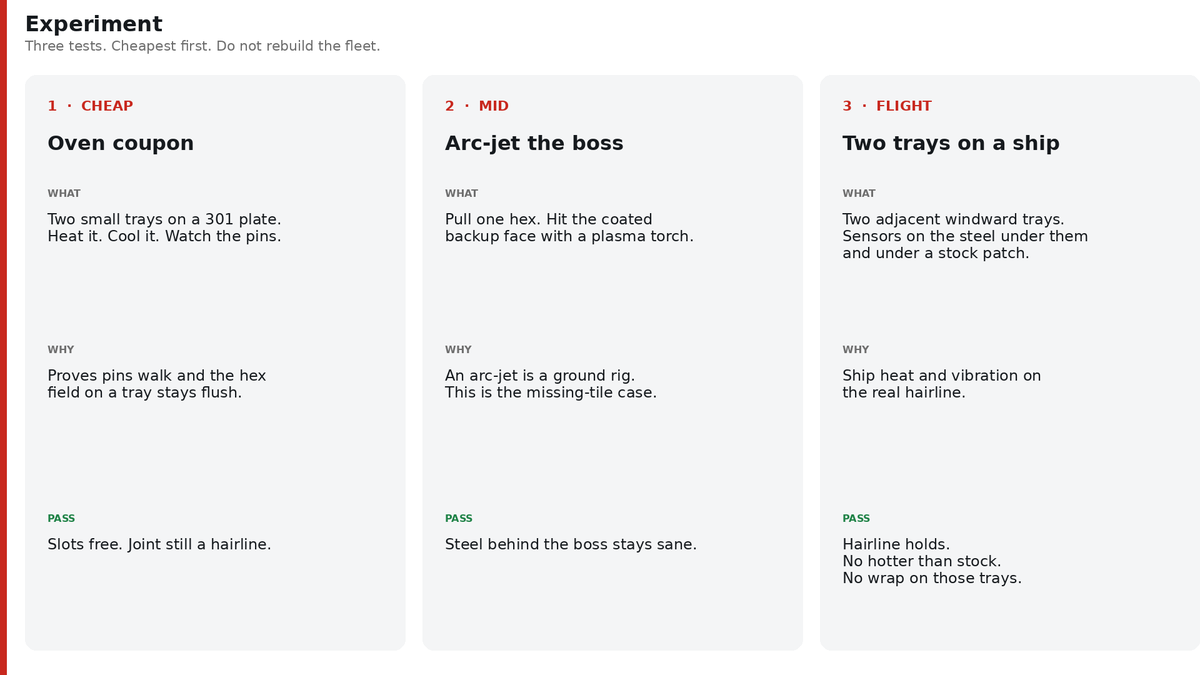
Testable idea without having to rebuild the fleet:
Oven coupon, then arc-jet the boss, then fly one instrumented tray on a ship.
Pass: slots free, hairline holds, steel no hotter than stock, proves wrap-free design.
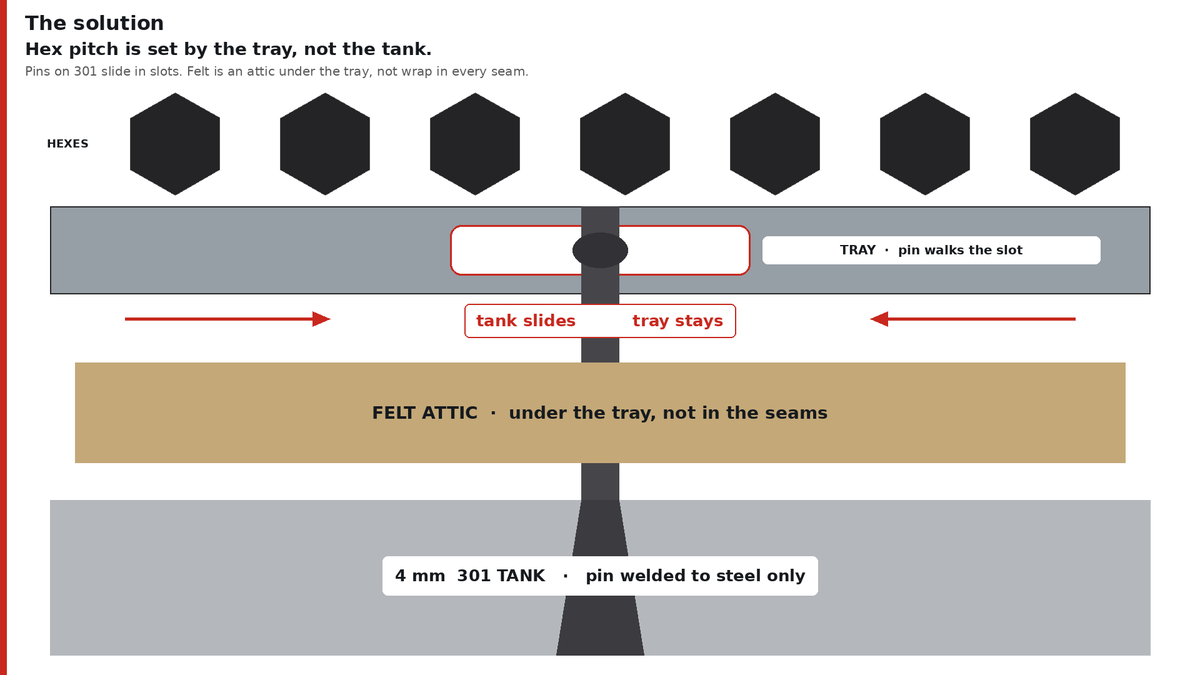
@SpaceX A real testable solution to the problem:
Hexes attached to a titanium tray that allows for steel expansion, eliminating need for tile gaps and hex seals.
Bonus effect is improved tile mounting efficiency.
Full solution walkthrough pinned in profile! :)
Starship’s current heat shield design has a massive problem. As long as there are exposed seams, you’ll never have a fully and rapidly reusable space ship. Even if you fill the gaps with a crunch-wrap or other filler, it will be exposed to the flow and degrade. Every flight will need a complete heat-shield inspection (could be automated) but like all consumables, this filler will need to be repaired/replaced at a suboptimal rate.
Other than having an actively cooled heat shield which seems impractical for the size of Starship, the long-term solution to achieve rapid re-usability HAS to include sealing these gaps. To make matters worse, Starship’s metal skin expands at a greater rate than the tiles, meaning during reentry, the skin of the ship and thus the pins the tiles are attach to expand and make the gaps BIGGER.
So what you need is a passive system that seals these seams as the skin of the ship expands and what better way than to take advantage of the natural expansion that’ll occur during heating? This could be attacked in several different ways:
-Fish-scale tile design with slight overlap +/- pillowed leading edges. The tiles sit on a special sloped keyhole pin design where, as the ship’s skin expands aft, the pin rides down the ramp pulls the tiles tighter into the overlap.
-Some other clever pin/tile design that decouples the ship’s skin expansion from the tiles. Perhaps the tiles can be optimized without gaps at the expected skin’s expanded diameter during peak heating with pins that allow for skin movement down to cryogenic temperatures with a pliable padding layer in-between.
Would love to help solve this problem lol.