Chrome now has native PDF document signing capabilities.
Just click the squiggly "annotate" button and download "with your changes"
No more downloading/uploading Adobe, Docusign, etc.
Someone open-sourced a PDF parser that converts 100 pages per second to Markdown.
100% free. on a CPU. no GPU. no cloud. no API key.
→ 100 pages per second.
→ handles tables, nested layouts, complex docs.
→ built-in OCR for 80+ languages via hybrid mode.
→ official LangChain integration.
It's called OpenDataLoader and it just took the #1 spot in every PDF-to-Markdown benchmark.
The wildest part is that docling scores 0.86 and is 15x slower. marker needs a GPU and is 1,000x slower. Pymupdf4llm is fast but scores 0.40 on tables.
This thing beats every one of them. on a CPU.
Built with the PDF Association and the veraPDF team the people who literally write the PDF standards.
8.6k stars. Apache 2.0. zero proprietary dependencies.
founders: why does marketing suck in crypto?
also founders: hires 1 person to do social media management, marketing strategy, write content, design, community management, partnerships, video editing, manage partnerships, event management.
@ProofofIntern Oh its far worse than that.
Most crypto marketers are so ridiculously, uniquely underbudgeted and understaffed, and micro'd to the point they'll never advance beyond a year 2 Web2 marketer's knowledge.
I still don't think people understand what just leaked on Reddit.
A senior dev just shared how to get Claude Code to brief you on the internet every morning. While you sleep.
The full system:
→ Use Claude Code's /schedule command to run persistent cloud tasks
→ Connect Brave Search MCP for real-time intel
→ Connect your Obsidian vault via filesystem MCP
→ Write a CLAUDE .md research context with focus areas and "do NOT want" filters
→ Tell Claude: "6am every weekday, search developments, save brief to vault"
Claude converts plain English into a cron job. No N8N. No server. Your machine doesn't even need to be on.
Most builders are still manually scrolling X and HackerNews for AI news.
The smart ones just made Claude Code their personal analyst.
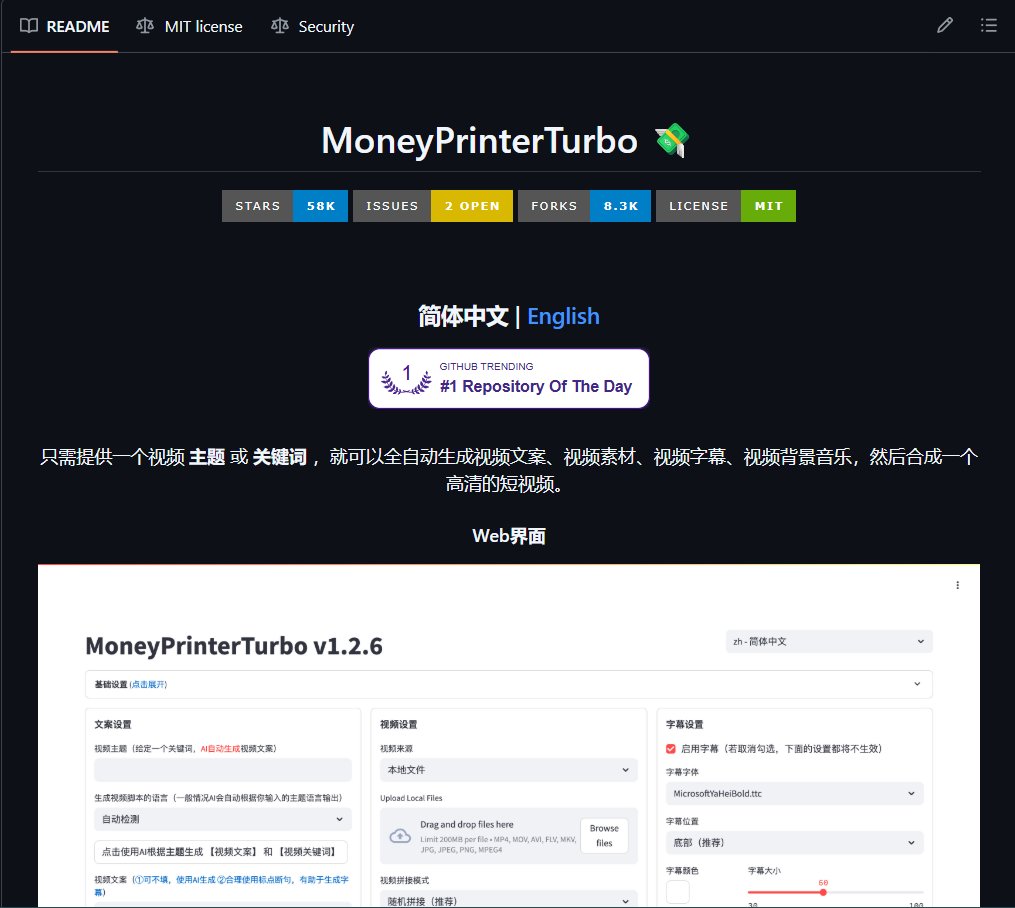
A Chinese developer built a free money printer. Literally named it MoneyPrinterTurbo. 13,000+ stars on GitHub.
You type a topic or keyword. It generates the script, finds HD copyright-free footage, adds subtitles, background music, and voiceover - then outputs a finished short video.
This is the exact pipeline TikTok Shop and YouTube faceless channel creators use to scale to $6,000-10,000/month. The difference: they paid for tools. This is free.
> What's inside:
Script generation via Claude, DeepSeek, Gemini, GPT, or any LLM you already have access to.
Batch video generation - create multiple versions at once, pick the best one. 9:16 vertical for TikTok and Reels, 16:9 horizontal for YouTube.
Voice synthesis with real-time preview.
Custom subtitles - font, size, color, position, outline. Background music from built-in library or your own files.
> Runs locally on your machine. Web UI and API both included. Docker supported. Google Colab supported if you don't want to install anything.
No subscriptions. No watermarks. No usage limits.
The repo is actively maintained - last commit was 44 minutes ago.
https://t.co/W4mlxu2jml
THE INTERNET JUST OPEN-SOURCED A $1,380/MONTH AI STACK.
And 99% of people still pay for the tools these repos replace.
No subscriptions.
No “pro” plan.
No monthly burn.
Just insane open-source projects hiding on GitHub:
1. [9router by decolua](https://t.co/Rm9f71Y62p)
replaces Claude Code + Cursor + Copilot
40+ AI models. auto-fallback. cheaper tokens
⭐ 6.2K stars
2. [agentmemory by rohitg00](https://t.co/58QhSdc0kH)
persistent memory for AI agents
runs locally with zero API keys
⭐ 3.1K stars
3. [agent-skills by Addy Osmani](https://t.co/Pxwwo42xnN)
production-grade workflows for coding agents
⭐ 36.9K stars
4. [UI-TARS-desktop by ByteDance](https://t.co/ML7RhFDlTo)
AI that sees your screen and uses your computer
clicks, types, fills forms, automates workflows
⭐ 31.1K stars
5. [dive-into-llms by Lordog](https://t.co/mxFTCpNTgn)
full hands-on roadmap for mastering LLMs
⭐ 36.4K stars
6. [hello-agents by DatawhaleChina](https://t.co/ioI2Z5qYpX)
build AI agents from scratch to deployment
⭐ 45.4K stars
7. [financial-services by Anthropic](https://t.co/OnE3iict9S)
official AI agent templates for finance apps
⭐ 16.7K stars
Old world:
pay subscriptions forever.
New world:
clone repos.
Total before: $1,380/month
Total now: $0
Bookmark this before someone repackages these repos into another “AI SaaS” and charges you monthly again.
Harvard Business Review research reveals that excessive interaction with AI is causing a specific type of mental exhaustion ( or "AI brain fry"), which is particularly hitting high performers who use AI to push past their normal limits.
A survey of 1,500 workers reveals that AI is intensifying workloads rather than reducing them, leading to a new form of mental fog.
While AI is generally supposed to lighten the load, it often forces users into constant task-switching and intense oversight that actually clutters the mind.
This mental static happens because you aren't just doing your job anymore; you are managing multiple digital agents and double-checking their work, which creates a massive cognitive burden.
The study found that 14% of full-time workers already feel this fog, with the highest impact seen in technical fields like software development, IT, and finance.
High oversight is the biggest culprit, as supervising multiple AI outputs leads to a 12% increase in mental fatigue and a 33% jump in decision fatigue.
This isn't just a personal health issue; it directly impacts companies because exhausted employees are 10% more likely to quit.
For massive firms worth many B, this decision paralysis can lead to millions of dollars in lost value due to poor choices or total inaction.
Essentially, we are working harder to manage our tools than we are to solve the actual problems they were meant to fix.
---
hbr .org/2026/03/when-using-ai-leads-to-brain-fry
How to Make Viral Posts on X Using Claude Code
an agency hit 100M+ views for tech startups in 6 months — moda, durable, hockeystack, all #1 trending.
mitcheIl broke down their system. turns out you can run most of it yourself, solo, with claude code.
here's the whole thing, including the prompts they used:
—
step 1 — find your hidden outcome
you're posting about a feature. "i built x." nobody cares about the what.
durable didn't launch as an AI website builder. it launched as "replace your 9-5 income." same product. different sentence.
drop your feature list into claude code:
"here's a list of features for [thing]. for each one, ask 'so what?' recursively until you reach an emotional outcome. return the single strongest emotional positioning statement."
that sentence is your hook.
—
step 2 — score every line before you post
don't post a draft you haven't pressure-tested.
paste your thread into claude code, run each line through this:
"score this line on two dimensions: invention novelty (does it feel like a genuine breakthrough?) and copy intensity (does it make someone feel something, not just understand something?). both 1-10. if either is below 10, rewrite it and tell me what was weak."
under 10 gets rewritten. filler gets cut. that's it.
—
step 3 — let your category's haters distribute it
the most counter-intuitive part.
moda launched an AI design tool to designers — people who hate ai design tools. instead of dodging the hate, they named it: "anti-slop. by design."
every designer who disagreed quote-tweeted it. quote-tweets = the algo shows it wider. the critics did the distribution.
find the criticism of your niche. say it out loud before anyone else can. make your post the answer to it.
—
step 4 — borrow a frame that already went viral
before writing, ask: what does this actually help someone do?
then go find a proven viral format built on that same idea. search youtube, sort by all-time, then last 12 months, then last 30 days. the top video per keyword is your ceiling. the title pattern is what you steal.
you're not copying content. you're borrowing a structure that's already proven to work, and pouring your thing into it.
—
step 5 — post for the algo's real signals
x doesn't reward "engagement." it rewards two specific things:
→ retweets decide if your post gets shown at all
→ reply chains (where you reply back) decide how high it ranks
so when you post:
→ reply to every single comment.
→ keep every chain going. do it for 48 hours, not 48 minutes.
stuck on what to reply? claude code:
"here's my post [paste]. write 25 replies to people commenting on it — keep the conversation going, add value, sound like a real human, under 280 characters each."
—
step 6 — roll it out slow, not all at once
the mistake: blasting every link and friend the second you post. a spike with no organic base reads as fake, post dies in an hour.
instead:
→ first 60 min, let it breathe, organic only
→ reply to everything that comes in
→ only once it has real velocity, share it wider
→ next few days, keep feeding it — follow-up posts while the algo's still warm
—
that's the system. six steps, four of them run through claude code: positioning, scoring, research, replies.
most people spend months on the thing and 30 minutes on the post.
flip that.
Anthropic just automated 99% of legal roles.
Claude for Legal is live now - and it's a marketplace with DOZENS of agents trained on legal roles.
Review agents, policy drafters, NDA agents & much more.
Can't believe this is public.
https://t.co/EyPkD2wMWv
For me ~ deployed roughly 900K into 179 angel investments across the past two cycles.
• 72 profitable (40%)
• 22 breakeven (12%)
• 15 token-lost (8%)
• 70 rugged or no news (40%)
52% hit rate sounds good but I lost 40% of my capital. However, thankfully some moonshots returned 10-100x. Those outlier wins covered the losses and more.
Looking back, I wouldn't have done it though. That $900K could have been better deployed into 3-5 conviction liquid thesis bets and gotten better returns with way less drama and effort.
Angel investing is a hit-or-miss. In retrospect, here's what I would have told my past self to look at.
1) Founder integrity (Are they a serial entrepreneur? Run as far as you can.)
2) Founder time commitment (Are they crypto-native? Are they working on side projects or are they all in? Do you see them "networking" at conferences and parties? Run!)
3) Product-market fit (Do they have real users? Or are they just paying VCs/KOLs/shillers to talk about it?)
4) Ability to scale and build community (Can they handle growth? Do people naturally gravitate towards them?)
Angel investing is not for the weak. You might hit some wins, but more likely you're just funding some rando who thinks he's the goat and will disappear once the market turns.
startup idea for you
use OpenHands (75k+ github stars) + 131 free subagents to sell a "done-for-you AI engineering team" to SMBs that need custom software
what's OpenHands? open-source agent runtime that runs Claude/GPT as actual software engineers. they read your codebase, edit files, run tests, open PRs
idea:
1. self-host OpenHands on a $20/mo VPS. claude code walks you through setup in an afternoon
2. pick one niche. real estate brokerages, dental practices, law firms, marketing agencies. SMBs that need custom software but can't afford a developer
3. wrap it in their language. "your AI engineering team for dental practices" not "an OpenHands instance with 131 subagents."
4. install the relevant subagents from VoltAgent. crm-specialist for real estate, hipaa-auditor for healthcare, document-automation for law firms
5. plug in MCP servers from the 14k+ available. GitHub, Stripe, Twilio, Postgres, Calendly. now your AI team can ship, deploy, integrate, and notify
6. charge $2,000-5,000/month per client. nothing compared to a $15k/mo dev shop or a $25k/mo junior hire. you're 5x cheaper and the work doesn't stop overnight
7. build one landing page. one onboarding call. record the AGENTS.md setup once. the rest is supervision
8. become the "AI engineering team for [niche]" person on X, LinkedIn, YouTube. share what your agents shipped this week. case studies sell themselves
9. reinvest profits into vertical-specific agents. a "patient-intake-automator" for dental. a "lease-document-generator" for real estate. now you own the vertical
these businesses KNOW they need custom software. they hate hiring developers. they will never find OpenHands on github. they will google "outsource my software development." that's you
open source is the new wholesale. the code is free. the orchestration is where the margin lives
one person can do this. two-person team scales to $50k/mo. you don't need funding. you don't need an office. you need a laptop, a niche, and the willingness to start
someone is going to do this. might as well be you
p.s. repo into the article below








![exploraX_'s tweet photo. How to Make Viral Posts on X Using Claude Code
an agency hit 100M+ views for tech startups in 6 months — moda, durable, hockeystack, all #1 trending.
mitcheIl broke down their system. turns out you can run most of it yourself, solo, with claude code.
here's the whole thing, including the prompts they used:
—
step 1 — find your hidden outcome
you're posting about a feature. "i built x." nobody cares about the what.
durable didn't launch as an AI website builder. it launched as "replace your 9-5 income." same product. different sentence.
drop your feature list into claude code:
"here's a list of features for [thing]. for each one, ask 'so what?' recursively until you reach an emotional outcome. return the single strongest emotional positioning statement."
that sentence is your hook.
—
step 2 — score every line before you post
don't post a draft you haven't pressure-tested.
paste your thread into claude code, run each line through this:
"score this line on two dimensions: invention novelty (does it feel like a genuine breakthrough?) and copy intensity (does it make someone feel something, not just understand something?). both 1-10. if either is below 10, rewrite it and tell me what was weak."
under 10 gets rewritten. filler gets cut. that's it.
—
step 3 — let your category's haters distribute it
the most counter-intuitive part.
moda launched an AI design tool to designers — people who hate ai design tools. instead of dodging the hate, they named it: "anti-slop. by design."
every designer who disagreed quote-tweeted it. quote-tweets = the algo shows it wider. the critics did the distribution.
find the criticism of your niche. say it out loud before anyone else can. make your post the answer to it.
—
step 4 — borrow a frame that already went viral
before writing, ask: what does this actually help someone do?
then go find a proven viral format built on that same idea. search youtube, sort by all-time, then last 12 months, then last 30 days. the top video per keyword is your ceiling. the title pattern is what you steal.
you're not copying content. you're borrowing a structure that's already proven to work, and pouring your thing into it.
—
step 5 — post for the algo's real signals
x doesn't reward "engagement." it rewards two specific things:
→ retweets decide if your post gets shown at all
→ reply chains (where you reply back) decide how high it ranks
so when you post:
→ reply to every single comment.
→ keep every chain going. do it for 48 hours, not 48 minutes.
stuck on what to reply? claude code:
"here's my post [paste]. write 25 replies to people commenting on it — keep the conversation going, add value, sound like a real human, under 280 characters each."
—
step 6 — roll it out slow, not all at once
the mistake: blasting every link and friend the second you post. a spike with no organic base reads as fake, post dies in an hour.
instead:
→ first 60 min, let it breathe, organic only
→ reply to everything that comes in
→ only once it has real velocity, share it wider
→ next few days, keep feeding it — follow-up posts while the algo's still warm
—
that's the system. six steps, four of them run through claude code: positioning, scoring, research, replies.
most people spend months on the thing and 30 minutes on the post.
flip that.](https://pbs.twimg.com/media/HISN8urWIAEybRg.jpg)
![DeRonin_'s tweet photo. startup idea for you
use OpenHands (75k+ github stars) + 131 free subagents to sell a "done-for-you AI engineering team" to SMBs that need custom software
what's OpenHands? open-source agent runtime that runs Claude/GPT as actual software engineers. they read your codebase, edit files, run tests, open PRs
idea:
1. self-host OpenHands on a $20/mo VPS. claude code walks you through setup in an afternoon
2. pick one niche. real estate brokerages, dental practices, law firms, marketing agencies. SMBs that need custom software but can't afford a developer
3. wrap it in their language. "your AI engineering team for dental practices" not "an OpenHands instance with 131 subagents."
4. install the relevant subagents from VoltAgent. crm-specialist for real estate, hipaa-auditor for healthcare, document-automation for law firms
5. plug in MCP servers from the 14k+ available. GitHub, Stripe, Twilio, Postgres, Calendly. now your AI team can ship, deploy, integrate, and notify
6. charge $2,000-5,000/month per client. nothing compared to a $15k/mo dev shop or a $25k/mo junior hire. you're 5x cheaper and the work doesn't stop overnight
7. build one landing page. one onboarding call. record the AGENTS.md setup once. the rest is supervision
8. become the "AI engineering team for [niche]" person on X, LinkedIn, YouTube. share what your agents shipped this week. case studies sell themselves
9. reinvest profits into vertical-specific agents. a "patient-intake-automator" for dental. a "lease-document-generator" for real estate. now you own the vertical
these businesses KNOW they need custom software. they hate hiring developers. they will never find OpenHands on github. they will google "outsource my software development." that's you
open source is the new wholesale. the code is free. the orchestration is where the margin lives
one person can do this. two-person team scales to $50k/mo. you don't need funding. you don't need an office. you need a laptop, a niche, and the willingness to start
someone is going to do this. might as well be you
p.s. repo into the article below](https://pbs.twimg.com/media/HIRvOy1XAAAy99-.jpg)





