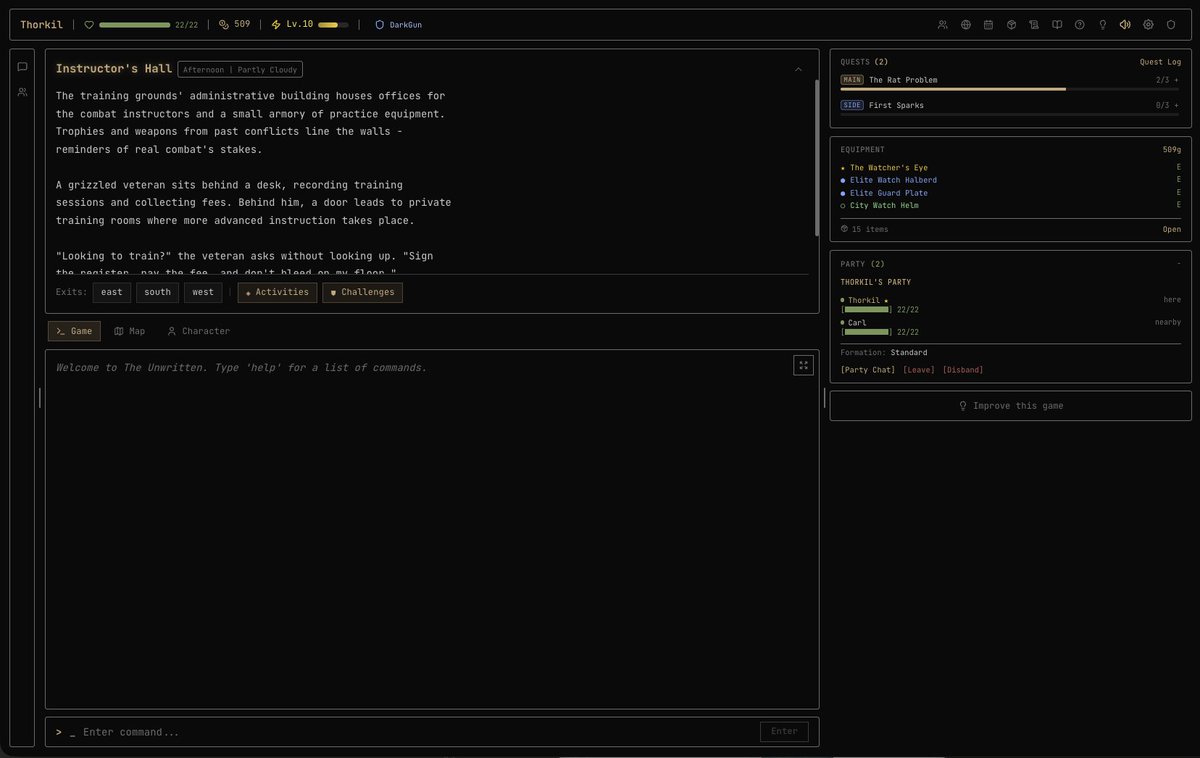
I needed something to redzone my Claude Code subscription, so I’m building an MMO.
I’ve been looking for a project ambitious enough to truly stress-test my Claude Code Max subscription. As a longtime RPG fan with nostalgia for the old text-based MUD days, and with an itch to build a game, I decided to skip graphics entirely and focus purely on systems, mechanics, and world design that make a living world feel real.
That’s what I’m doing now, and the design space we’ve reached is one of the most fascinating things I’ve ever worked on.
Around the same time I started this, pure LLM-based generative games were getting buzz again. AI Dungeon had its explosion years ago, and now there’s a new wave of “AI game” startups. But every time I tried one, it felt loose—too much freedom, no grounding. Choices didn’t matter because nothing persisted underneath. The AI just vibed and generated something that sounded right but meant nothing. Characters forgot their names. The world forgot yesterday.
It felt like a gimmick: impressive tech demo, not a game.
That led to a better question: what would good game design look like if it actually integrated LLMs’ generative strengths with the deterministic, shared experience of a multiplayer world? Not AI doing everything, not AI as a bolted-on coat of paint, but an architecture built around what AI is genuinely good at and what it absolutely cannot do.
That’s how The Unwritten began.
What it is
A text-based MMORPG. Persistent shared world. Permadeath. Dynasty system. A magic system grounded in theoretical physics. A frontier that literally doesn’t exist until players walk into it.
The world exists in three layers:
- Deterministic layer (bottom): The Athenaeum (think Oxford crossed with the Library of Alexandria) and the Seven Cities are hand-crafted and canonical. When I say “meet me at the Forum,” everyone knows exactly where that is. This gives shared reality, weight, and stakes.
- Procedural layer (middle): Consistent, learnable rules and systems. The magic works the same way every time, can be taught, documented on a wiki, and remains fair and predictable.
- Generative layer (top): The frontier. When you step beyond the known world, the AI generates terrain, ruins, creatures, NPCs, and mysteries—all shaped by lore and constrained by procedural rules. Crucially, once discovered, it crystallizes into the permanent world. Every player after you will find that ruin. Your name is etched as the discoverer. Forever.
The unknown becomes the known. That’s the core loop.
The magic system
Reality is woven from the Threads of the Utterance—strings (as in string theory) still vibrating from the Creator’s First Word. Everything differs only in frequency. A stone wall and the air beside it are the same substance singing different songs.
No spell slots, no mana, no cooldowns. Only knowledge—and the cost of being wrong.
Four disciplines, each rooted in real physics/philosophy:
- Sonaecraft (String Theory): Every material has a unique Tone. Transmutation requires walking harmonic bridges through stable intermediate tones (A* pathfinding on a tone graph). Wiki-documentable, tradable knowledge. Cost: Harmonic Contamination—your own Thread drifts toward the studied frequency. Masters become visibly marked: metallic skin, vibrating eyes, echoing voices.
- Attestation (Quantum Mechanics): Before observation, things exist in Fieri (superposition). Practitioners can delay collapse and bias outcomes. More observers = heavier Gravitas (decoherence), so Attestors are stronger alone and weaker in crowds. Cost: Fieri Drift—prolonged superposition blurs identity until you fade into ambient background.
- Codex Arts (Simulation Theory): Reality is information; practitioners read and edit the Codex (source code). Integrity checks make consistent edits cheaper and contradictory ones dangerous. Exploit path: Logic Bombs that trigger localized Excessus (buffer overflows) for impossible writes. Cost: Data Overflow—overexposure causes cognitive fugue; long-term users lose the ability to process normal input.
- Nominatio (Logos Theology): True Names must be earned through personal experience and interaction (LLM-generated unique paths). Comprehension is 0–100% via Insights. At 100%: mutual understanding and co-creation. Effects are consistent and balanced across players. Cost: Name-Sickness—you gradually become the thing you deeply understand.
Dynasty system (permadeath that matters)
Characters can die permanently. At zero health you enter a ~5-minute Dying Light window where others can save you. If not, you’re gone.
Survive long enough (100+ real days), build legacy, and hit thresholds → establish an heir. Heirs inherit 40% tendency (faster skill learning in mastered disciplines). NPCs remember bloodlines. Dynasties stack generational bonuses. One death without an heir ends the line completely.
A Bloodline Registry tracks dynasties, ended lines, and player-written memorials. The emotional weight is real.
World design
Known world: canonical Athenaeum, Seven Cities (each with distinct identity), connecting roads.
Unknown: eight biomes, wilderness up to 50 rooms from landmarks, dungeons 20 levels deep, generated settlements capped at 30 NPCs/15 buildings. Lore explanation: frontier exists in Fieri until observed and collapsed.
NPC system
Two-layer dialogue: canonical core (fixed, documentable) + expressive LLM variation through personality. Trust tracking, knowledge maps, action parsing.
Challenges
Balancing the tone graph, Gravitas edge cases, Codex integrity/exploit design, crystallization quality threshold, and dynasty emotional clarity.
Why it matters
Most AI-in-games answers are weak: full AI (meaningless after an hour) or AI as texture (same game, prettier wallpaper).
The interesting path is architectural: deterministic foundations for trust and stakes, procedural rules for fairness and depth, generative AI for emergence and personalization—each doing what it’s best at.
Discoveries persist. Choices ripple across players. Knowledge is literally power.
We’re still building, but the design space is the most compelling I’ve touched in years.
If you played MUDs back in the day and this resonates, that’s exactly the feeling we’re chasing. Looking for playtesters—comment or DM and I’ll send an invite.
I LOVE this idea so much. Reminds me of a language app someone built - you take a picture of an object and it collects a sticker for it. I built something in the same niche, with a mission to increase nature IQ and make it fun. You are off to a great start! https://t.co/vw1G5wMt6w
The reason images can pack more information into fewer tokens (and cost less GPU power) isn’t because pixels are magic. It’s because of how the AI is built.
Think of the main AI “brain” like a very busy, expensive manager who charges a lot for every minute of a meeting. The longer the meeting (more tokens), the more it costs.
With normal text:
Every single letter or small word has to show up to the meeting as its own tiny token.
For a big chunk of code, that can mean tens or hundreds of thousands of individual tokens.
The manager has to listen to and think about every single one of them. That’s slow and expensive.
With an image (the pxpipe trick):
You turn the code into a picture.
The AI doesn’t send every tiny letter straight to the busy manager. Instead, it first goes through a helpful “smart eyes” step (called the vision encoder, like CLIP).
This smart-eyes step looks at the picture in chunks (like little puzzle pieces called patches). It quickly recognizes:
• Shapes of letters
• Spacing and indentation
• Overall layout
Then it creates smart summaries instead of sending every single letter.
One summary token can represent several characters + how they’re arranged.
Result:
A much shorter line of smarter tokens goes to the expensive manager brain.
The manager still understands the code almost perfectly, but the meeting is way shorter.
That’s why you can cut token counts (and therefore cost + waiting time) by around 60% while getting almost the same result.
The AI’s design gives pictures this helpful “smart summarizer” step that plain text never gets. It’s a clever little loophole in how these models were built.
I couldn’t wrap my head around why this would work. I think the key is that the way the llm interprets images- it’s not doing ocr, it’s scanning pixels and pattern matching the actual pixels. So the token cost is tied to pixel count and image resolution, not characters. So if you can cram enough characters into the pixels you get an actual “one weird trick”. Am I on the right track?
I couldn’t wrap my head around why this would work. I think the key is that the way the llm interprets images- it’s not doing ocr, it’s scanning pixels and pattern matching the actual pixels. So the token cost is tied to pixel count and image resolution, not characters. So if you can cram enough characters into the pixels you get an actual “one weird trick”. Am I on the right track?
I couldn’t wrap my head around why this would work. I think the key is that the way the llm interprets images- it’s not doing ocr, it’s scanning pixels and pattern matching the actual pixels. So the token cost is tied to pixel count and image resolution, not characters. So if you can cram enough characters into the pixels you get an actual “one weird trick”. Am I on the right track?
@jquave@MiTypeScript TIL there is no OCR happening in the classic sense with the image side of llm. It’s looking at the pixels and pattern matching but unlike text it’s the number of pixels that are tokenized not characters, so this is an actual “one weird trick”
@coughdropsh Trying to put a dent in that with https://t.co/3mrHQJe0M4 - our mission is to increase nature iq by making it fun to learn to identify plants and bugs! Try it out!
@om_patel5 This is awesome. I made something very similar last year, but for bugs and plants! Mission driven to improve ecology iq too! https://t.co/3mrHQJe0M4
I wanted to build a video editor into X like other social apps. I had expected it to take 3 months of engineering time.
Today I decided to try prototyping it myself. I one-shotted a full in-browser editor in 15 minutes.
It felt like I could replace the entire Adobe software suite by Sunday.
Then I asked myself: will videos even be edited manually in 3 months? Chatbots can do reasonably well now.
Product development is getting extraordinarily difficult when the world is changing so fast.