Lending activity in DeFi usually tracks the broader market.
When crypto is bullish, borrowing demand and loan volume go up.
When it’s bearish, they typically shrink as risk appetite drops and collateral values fall.
Maple broke that pattern.
Instead of shrinking during the downturn, the loan book kept expanding.
Their institutional loan portfolio (money actually lent out to borrowers) grew 181% over the past year to $1.91B while bitcoin fell 45%.
@maplefinance growth isn’t coming from crypto speculation or price momentum, it’s coming from institutional demand for their credit product regardless of what the market is doing.
That is a resilience/product-market-fit flex 💪 🥞
Maple just shipped its first new Syrup asset in two years, and it’s a big one.
syrupUSDG, a yield-bearing version of Global Dollar (USDG), built with Paxos.
The returns are real, not incentivized
syrupUSDG isn’t paying yield from token emissions.
It’s backed by @maplefinance institutional lending book over $22B in loans originated since 2022, all overcollateralized.
Borrowers pay interest, holders earn from that.
Same engine behind syrupUSDC and syrupUSDT, now extended to USDG.
It’s landing on Robinhood Chain.
This is Maple first real push into fintech distribution.
Steakhouse Financial (curator) approved syrupUSDG as collateral for the vault behind Robinhood Earn, the first decentralized lending product live inside the Robinhood app.
Morpho provides the vault infrastructure underneath it.
Four players, four clear roles
Maple → credit & yield Steakhouse → vault curation Morpho → vault infrastructure Robinhood → distribution to millions of users.
Everything verifiable onchain through Maple Proof of Reserves.
USDG sits inside the Global Dollar Network. Kraken, OKX, Mastercard, and 130+ other fintech partners.
syrupUSDG gives that entire network a plug-and-play way to offer credit-backed yield without building their own credit desk.
It’s less “one integration” and more a template other platforms can copy.
syrupUSDG is live now on Ethereum and Robinhood Chain, with more chains coming.
Robinhood access is rolling out in phases over the next few weeks.
Institutional credit has always sat behind closed doors.
This is Maple clearest step yet to bring institutional credit to everyday users.
stay syrUP’d 🥞
On July 13, @maplefinance proposed MIP-021: a fixed share of revenue automatically funds SYRUP buybacks each month and that share grows as revenue grows.
10% of monthly revenue under $1.5M
20% from $1.5M–$2M
30% above $2M
$SYRUP holders voted and 99.97% said yes.
First buybacks start in August, with every purchase tracked publicly
First buybacks start in August, and can be tracked publicly on the Transparency Dashboard.
Stay $SYRUP ‘d
🥞 🥞
Six months in, and Maple has already proven why it’s one of the best DeFi protocols.
Q2 alone brought ecosystem growth, fresh partnerships and product updates that most people scrolling their timeline probably missed.
@rektdiomedes put together a thread that covers the whole update from the ecosystem call, plus his own take as someone who is actually paying attention.
If you want the full picture heading into H2, this is where to start.
@maplefinance is about to experience more growth in H2.
GMaple 🥞 🥞
TL;DR of @joe_defi latest piece on Maple:
WHAT $SYRUP HOLDERS ACTUALLY HOLD.
Maple AUM went from $2.55B to $4.6B in the last 12 months. Understandable that people are asking questions about the token now.
No separate equity class.
Every raise since 2019 has gone into SYRUP, not into a private cap table.
VC, team, and someone who bought on an exchange yesterday all hold the same token. No hidden layer with better rights sitting above you.
The structure:
@maplefinance DAO Foundation sits at the top (Cayman Islands, no shareholders). Under it:
→ Operating Subsidiaries generate protocol revenue
→ A Guernsey Trust holds the brand, IP, and tech, with the Foundation as sole beneficiary
→ The Syrup Strategic Fund (SSF) handles strategic growth, liquidity, and reserves
Where revenue goes:
25% of monthly revenue flows to the SSF (voted in via MIP-019).
From there it splits into buybacks (SYRUP bought back and removed from circulation) and reserves (capital held to keep Maple running through a full cycle without emergency raises).
Why buybacks slowed in 2026:
8M SYRUP bought back in 2025. Only 2.5M so far in 2026, a deliberate call to build reserve strength instead, so Maple can keep scaling without selling into weak markets or raising emergency capital.
A new proposal (MIP-021) that ties buybacks to revenue growth through a set formula.
An onchain dashboard showing SSF balance, allocation and buybacks.
Plus a real reporting cadence, monthly Maple Memo, monthly AMA, quarterly Ecosystem Update Call.
One token, one structure, no equity class sitting above SYRUP holders. The growth flows back to the people who hold it.
Full details here 🔻
https://t.co/LCc39BgJOs
stay syrUP’d 🥞 🥞
Most people chasing yield onchain don’t stop to ask where it’s actually coming from.
That question matters a lot.
Tokenization is pulling serious capital onchain but capital needs a yield layer beneath it and not all yield layers are equal.
→ Incentive yield is borrowed time.
It is funded by token emissions and the moment that pool shrinks or dries up, so does your return.
It was never a business model, just a growth tactic.
→ Treasury yield is real but limited. You’re essentially lending to a protocol’s reserves, stable and predictable, but capped by definition. There is no mechanism for it to scale with demand.
→ Credit yield is different in structure. The return comes from borrower interest, real institutions paying to access real capital.
When credit demand grows, yield potential grows with it.
Nothing is being diluted.
Nothing is artificially inflated.
That is the yield layer Maple is building on.
Over $3.9B in loans originated, connecting lenders to vetted institutional borrowers through underwritten, overcollateralized credit.
The yield isn’t manufactured, it is earned from actual lending activity.
As tokenization scales, the platforms with durable yield infrastructure win.
@maplefinance is already there.
Pivot to Maple 🥞
$HYPE is now accepted collateral on Maple.
Institutions can borrow against their position without selling.
Overcollateralized, structured terms handled by the @maplefinance credit team.
You keep your $HYPE. You get liquidity.
Hold the asset. Access the capital.
Good tek indeed 🥞 🥞
Fintechs hold stablecoin balances every day.
They stay idle with zero yield, just sitting there.
@maplefinance just changed that.
Maple is now live on @tempo bringing institutional-grade yield to fintechs building payments and payouts on their network.
Instead of stablecoin balances doing nothing while transactions settle, fintechs can now plug into Maple and put that float to work.
No credit desk or custom code needed.
Just managed yield, ready to integrate.
Every loan behind it is underwritten and actively managed by Maple credit team, so the risk work is already done.
Fintechs get an earn product.
Their users get yield, Maple handles the rest.
🥞 🥞
Most institutional borrowers still prefer TradFi not because onchain credit is inferior but because the experience hasn’t matched the standard they’re used to.
@maplefinance added three tools that make onchain borrowing feel like what institutional finance actually demands.
The Borrower Hub already centralised the entire borrowing experience in one place.
#1. Transactions
Every interest accrual and principal movement logged and exportable to CSV. The kind of clean record-keeping that compliance teams actually need.
#2. Statements
Pull a report of your loan activity for any time period you choose. One click, ready for your accountant or auditor.
#3. LTV Calculator
This one stands out. Before a market move catches you off guard, you can simulate it.
Adjust price, collateral, or paydown figures and see exactly how your position responds. That’s risk management, built into the interface.
Institutions don’t just need access to capital, they need visibility and control over it.
That’s what these tools deliver.
Great tek. Kudos to Maple🥞 🥞
Trading crypto isn’t just about buying low and selling high.
There is a layer most people never see, leverage trading.
When you trade with leverage, you’re not putting up the full amount.
You deposit a fraction and the platform lets you control a larger position.
Put in $100 with 10x leverage, you’re trading as if you have $1,000.
Profits are bigger, so are losses.
Get it wrong, and your position gets liquidated.
This has existed on centralized exchanges for years.
The problem is that you don’t control your funds, the exchange does.
@XBITDEX built a different idea entirely.
XBIT is a fully decentralized exchange that allows you connect your wallet, trade and your funds never leave your custody.
No middlemen, Everything settles on-chain.
Most DEXs offering leverage just borrow the same mechanics used for crypto price trading, a system called funding rates, where periodic payments between traders keep contract prices aligned with the real market.
It works fine for Bitcoin or Ethereum, where prices move continuously.
XBIT supports leverage on prediction markets too, markets where the outcome is binary.
- Either a team wins or it doesn’t.
- Either an event happens or it doesn’t.
Prices don’t drift gradually, they collapse to zero or surge to full value at settlement.
Funding rates have nothing to anchor to in that environment.
So XBIT says Instead of funding rates, use a borrowing interest model where the cost of holding a leveraged position adjusts in real time based on actual market demand.
Every order routes through real external order flow, not artificial liquidity.
They also built liquidation mechanics specifically for the volatility spike that happens as an event approaches its outcome because that’s exactly when things get dangerous and most platforms fall apart.
The result is a platform where a regular person can trade real-world outcomes, sports matches, market events with proper leverage tools, on-chain, without handing their funds to anyone.
That’s a whole new primitive.
Check it out: https://t.co/nCXZKOPOrH
@XBITDEX_ZH
#XBIT
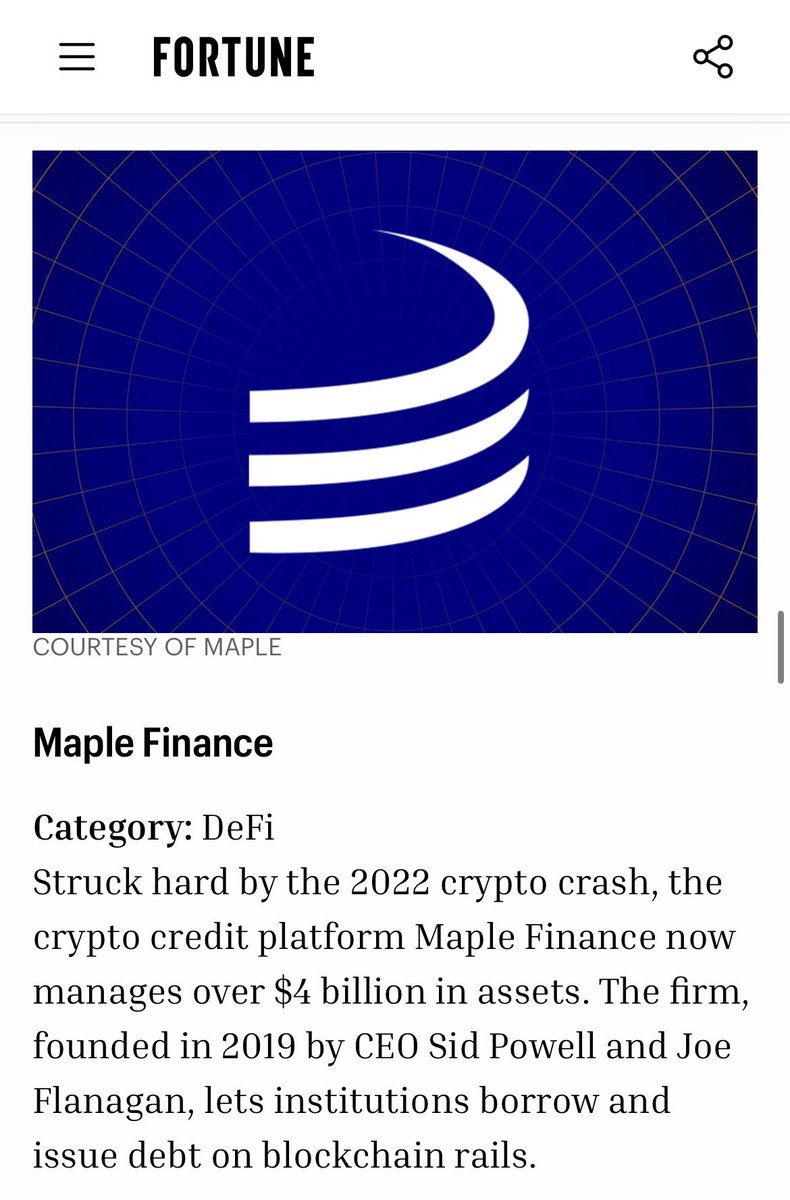
Fortune is one of the biggest names in global business journalism, the magazine behind the Fortune 500. They don’t chase crypto hype, so when they cover this space, it means something.
@maplefinance is the only onchain credit platform on their 2026 Crypto Innovators list 30 companies across the US, Europe and Asia recognized for actually moving the digital asset space forward.
Everyone else on that list is exchanges, infra, custody.
Maple is the one bringing institutional credit onchain, real lending markets, real underwriting, just without the legacy rails.
Recognition like this is top notch 🥞
@syrupsid view of competition isn’t other crypto protocols, it’s Ares, KKR, Blackstone, the actual giants of private credit.
His reasoning is that those firms aren’t built to lend in stablecoins or accept tokenized collateral and that’s not something they patch with an update, their entire infrastructure was built for a different era.
Meanwhile RWAs are accelerating fast, funds, real estate, mortgage-backed bonds, tokenized stocks, HELOCs and Maple is already configured to lend against all of it as it comes onchain.
He also makes the point that regulation had basically frozen innovation in TradFi, more capture, not better products and blockchain is now forcing real competition back into finance, trading oil futures on Hyperliquid on a Sunday being a good example of that shift.
His closing thought is that real widespread adoption won’t be obvious until it actually disrupts the hedge fund and asset manager business model itself, not before that.
Go through the thread below by @rektdiomedes
stay syrUP’d 🥞 🥞
X is not the only platform built for Web3 creators.
I made a video breaking down what Binance Square is and why it deserves a spot in your content strategy.
@cz_binance@heyibinance#BinanceSquare#Web3
6/ Loans & Liquidity
Total outstanding loans now near $1.5B, with loan counts also up from around 25 to over 40.
Pool collateral has grown alongside this, moving from around $1B to consistently above $1.5B since May.
Collateral coverage has trended down slightly, from above 180% to around 140-150% now, still comfortably overcollateralized.
Liquidity deployed into strategies spiked sharply in early April (close to $890M) before settling into a $300-400M range.
5/ Syrup Pools
Syrup pool liquidity jumped from around $40M to over $300M after late April, a big step up in available capital.
Outstanding loans on Syrup pools have grown from around $600M to close to $1B over the same stretch.
Utilization dipped to 60% briefly in April but has climbed back to near 99% since.
Deposits on syrupUSDC/syrupUSDT dropping from $2.9B to $1B now around $1.5B
4/ Pools
Deposit and borrow flows have been choppy. Some days see outflows close to $370M, other days bring in spikes of $180M+
Gross flows show the real scale, daily activity regularly hits $100-200M in and out, with one outflow day near $400M.
Despite the swings, the protocol keeps absorbing it without issues.
3/ SYRUP Token
Circulating supply now close to 1.2B.
SYRUP sitting on CEXs spiked hard around mid-2025, and has been steady in the 150-200M range.
DEX & DeFi integrations now sitting in low millions.
For holder breakdown, one group holds 61.1% of supply, with the rest split between 17.6%, 13.5%, and smaller portions.
2/ Financials
Protocol revenue has settled from around $45k/day in March-April to about $20k/day now.
Interest accrued for depositors followed the same pattern, dropping from roughly $450k to $200-220k daily.
Interest Margin move from around 1% up to over 3%.
Treasury balance also jumped from about $3M to $9M in late April, and is now sitting around $6-7M.
Revenue’s lower, but margins are healthier and the treasury is still solid.
1/ Overview
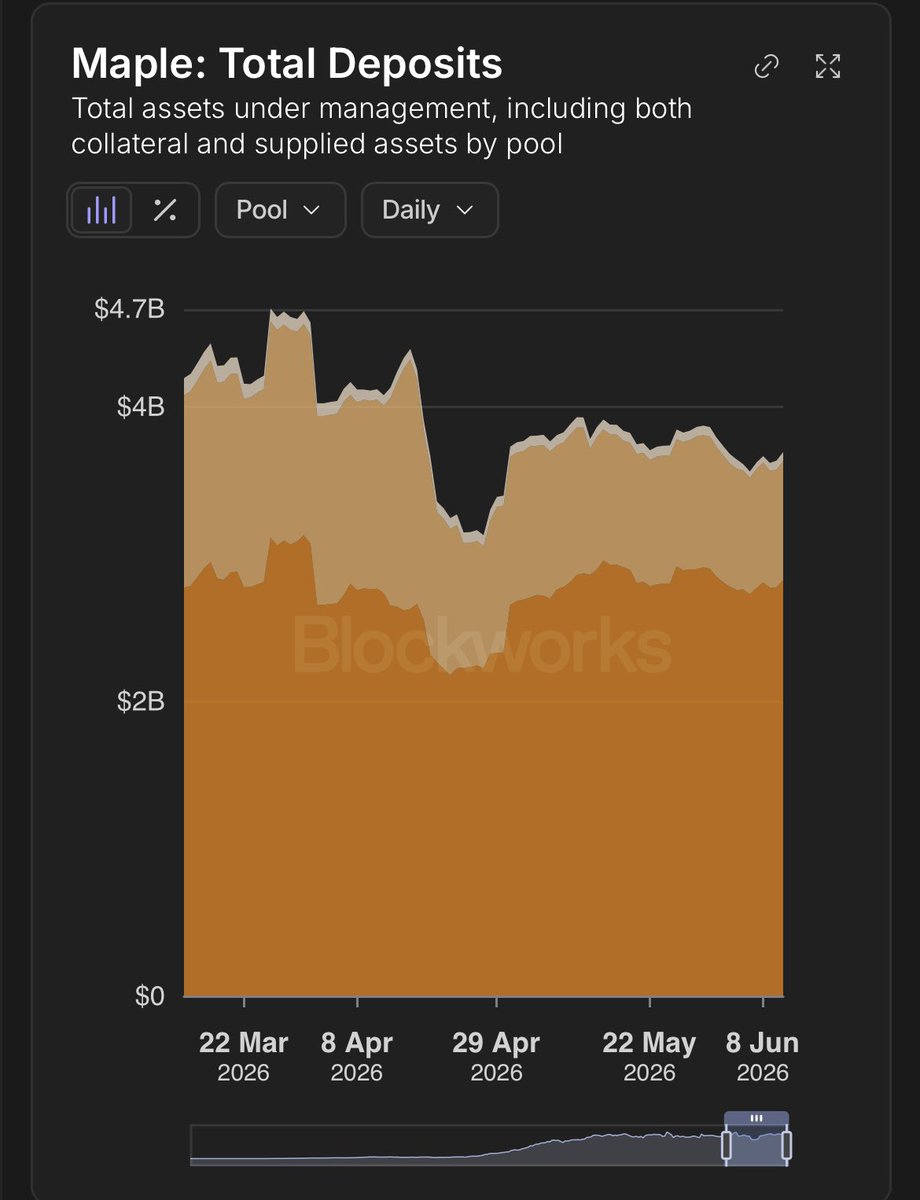
@maplefinance AUM has been moving between $3.5B - $4.7B over the last 3 months, sitting at $3.69B right now.
Outstanding loans went from about $700M in March to almost $1.4B now, nearly doubled in 3 months.
Pool utilization is also sitting near 99% across the board. Most of the capital deposited are actively lent out.
Yields now settling around 4-6% but more stable.
Growth on the lending side, stability everywhere else.
A few weeks ago, Maple introduced Proof of Reserves for syrupUSDC & syrupUSDT, independent third-party verification through @The_NetworkFirm confirming the collateral backing every active loan on the protocol.
@Blockworks just launched a dedicated public dashboard fo @maplefinance tracking the protocol across six categories.
- Overview
- Financial
- SYRUP Token
- Pools
- Syrup Pools
- Loans & Liquidity
Protocols that operate with this level of accountability are rare, Everything is onchain and visible.
I’m going through every tab and breaking it all down, thread incoming.
https://t.co/naDM6MYvGe