Don’t be fooled. Nicola Sturgeon (wife) is not being held responsible for her husband’s crimes. As leader of the party she is being called to account for her deliberate frustration of the legitimate scrutiny which might have revealed those crimes. The distinction is 💯 clear.
I wrote the climatic chapter of my cancellation story, in which my publishers became murderous. It's horrible, ludicrous, and names names. A five minute read. Free to read, link in next tweet 👇👇👇👇👇
My thoughts on the @EHRC guidance laid yesterday; this is not about non-existent "rights". It is about the safety of women - mothers, sisters, wives, daughters. We men need to hear their voices. Virginia Woolf : "Though we see the same world, we see it through different eyes".
My intro on @TimesRadio yesterday:
Where I live there are two different routes to and from the tube station. One, let’s call it Acacia Avenue, is quiet and residential. The other, London Road, is a busy major route with lots of traffic. At all times of the day, I automatically head for Acacia Road. It’s just much nicer.
The women in my family, on the other hand, will never willingly make that walk after dark. They live with an anxiety that most men find it hard to imagine, and frankly, rarely think about unprompted.
Last year 739,000 women were sexually assaulted in Britain. Virtually all such assaults - nine out of ten - are perpetrated by men. One in four women have been attacked at some time in their lives. Acacia Avenue is exactly the sort of place in which most women fear that they become vulnerable, and they are right.
As the author Virginia Woolf once wrote " Though we see the same world, we see it through different eyes".
I think this is the right context in which to understand the furore over the guidance being laid today by the government, over the meaning of the words man and woman when it comes to providing services and facilities in workplaces.
Many men think this is about a rather arcane dispute about who gets to use what loo. For their mothers, sisters, wives and daughters, it isn’t.
In a previous life, as Chair of the Equality and Human Rights Commission, I had a hand in writing this country’s equality laws, in particular the 2010 Equality Act. It never occurred to any of us that there could be any confusion or dispute over the meaning of the words man and woman. But it has taken a decade of campaigning, a Supreme Court judgement and now hundreds of pages of guidance to settle the issue.
This is not about so called trans rights, which are completely unaffected by this guidance, since no-one has ever had the right to walk into a changing room reserved for teenage girls.
What it does mean is that women and girls are guaranteed the protection they deserve, and that their safety, which we spent half a decade drafting law to ensure, is protected.
But the whole business illuminates some serious issues in our politics.
First that many of our institutions, in spite of the fact that they always knew what the right thing to do was, decided to ignore the fears of their women customers and employees, under pressure from noisy pressure groups. Instead, the people who were supposed to be the grown ups behaved as though the law said what campaigners wanted it to say, rather than what it actually said. They settled for what they hoped would be a quiet life.
In a democracy, there’s little point in Parliament deciding anything if the law is then made an ass by activists intimidating bosses in companies, schools, universities and the media into doing something different.
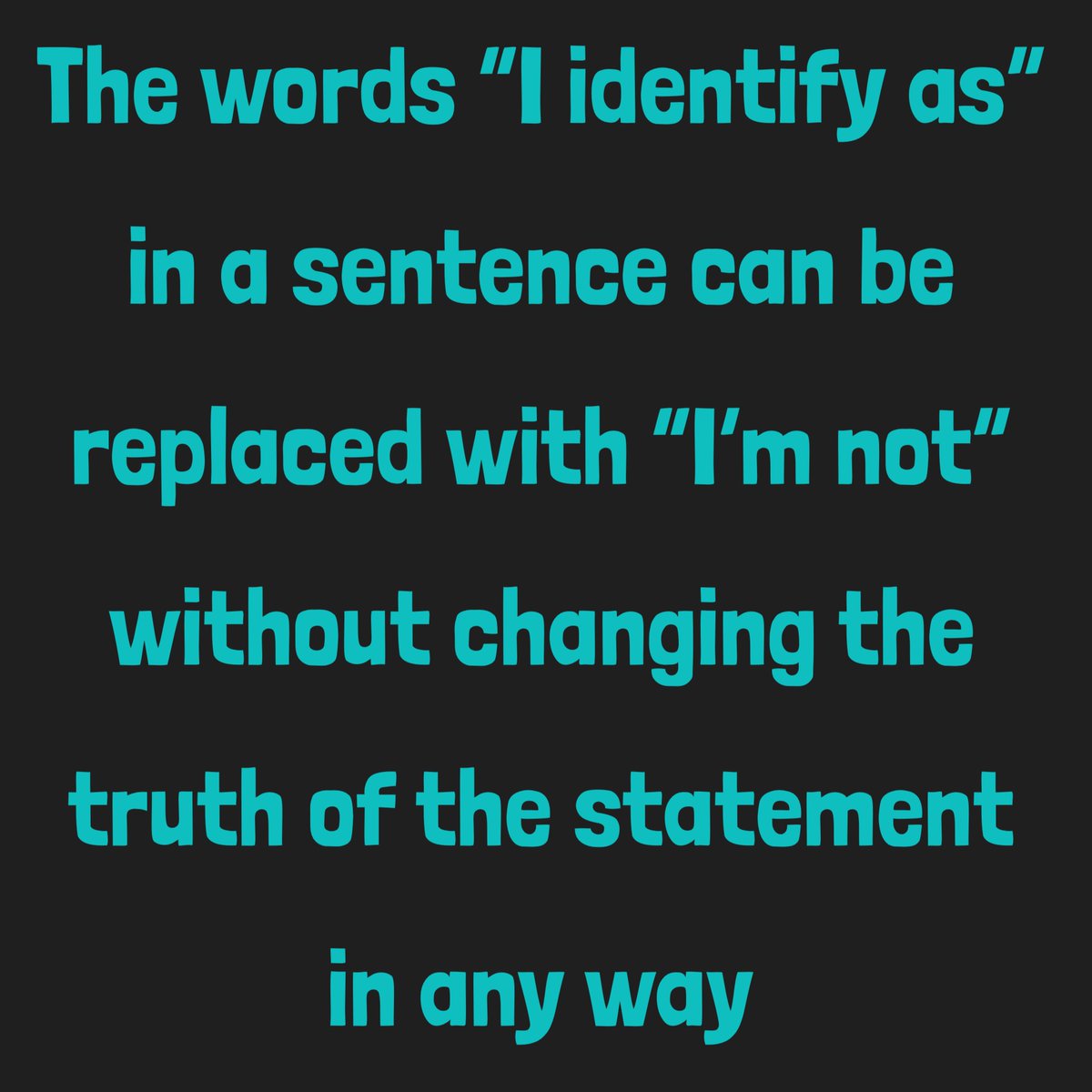
Second, at the heart of the campaign to undermine the Equality Act is an idea that we specifically rejected in 2010, so called self-identification. That is to say, that it should be up to the individual to decide whether they have what’s called a protected characteristic - are you male or female, are you black or white. The problem is that self-ID would destroy the operation of any law against discrimination.
Look, it would almost certainly have been to my advantage as a young man to self-identify as a handsome, white public schoolboy. None of those things is true of me. And at various points I am pretty sure it’s been to my disadvantage. It is certainly statistically likely to have been to my disadvantage.
But according to the logic of those who say that self-ID should be the rule and that anyone should be able to decide for themselves whether they are male or female, black or white or Asian, were I to complain about racial discrimination, it would be difficult for anyone prove that I’d been discriminated against because of my race since anybody to whom I’d lost out could just tell the courts that they too were black.
I know that sounds like Alice in Wonderland but you can google the case where a chap, both of whose parents are white, insisted he should get money from the Arts Council because he so identified with the black struggle that he considered himself black, and everyone should accept his point of view. In the United States and Brazil exactly such outlandish claims have been made and people rewarded to the disadvantage of people actually born into minority families.
I have even been told about firms who, when reporting their gender pay gaps have put men who just happen to like wearing dresses at weekends - nothing wrong with that, let me be clear - into the female column and told their women employees that they really haven’t got anything to moan about because statistically they are paid equally, and they should get back in their box.
So today’s guidance isn’t just another tiresome chapter in culture wars. It is , I hope, a halt to the efforts to undermine one of the most important pieces of legislation on the statute book, by people who, for their own reasons, would prefer us to be living in the 1950s world of Mad Men.
It’s extraordinary that the BBC consistently platforms men upset they have to use gender neutral toilets instead of women’s toilets over the female rape survivors who have been unable to access a female-only support group, in relation to the EHRC guidance. It says it all, really.
Dear English Followers: on May 20, 2026, I learned that I had been convicted by French court for stating: “As women, we are compelled to be wary of people with penises.”This conviction marks a deeply troubling turning point for freedom of expression in France.
You can read more here:
https://t.co/W7qK6Dci6W
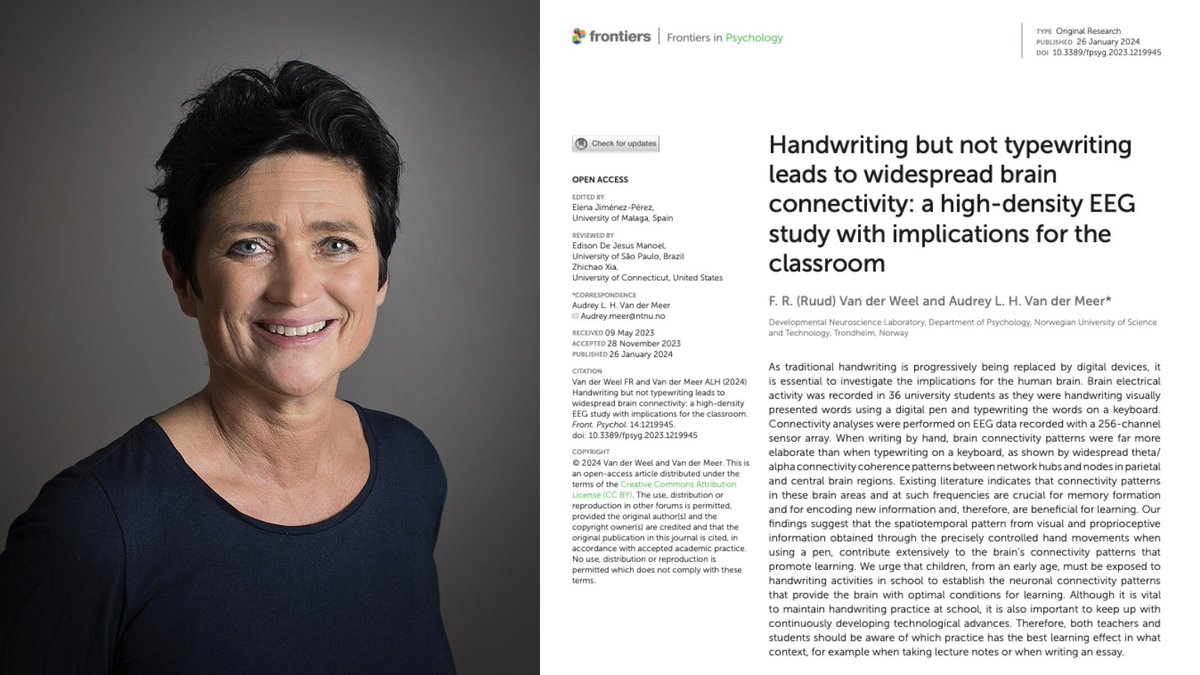
A Norwegian neuroscientist spent 20 years proving that the act of writing by hand changes the human brain in ways typing physically cannot, and almost nobody outside her field has read the paper.
Her name is Audrey van der Meer.
She runs a brain research lab in Trondheim, and the paper that closed the argument was published in 2024 in a journal called Frontiers in Psychology. The finding is brutal enough that it should have changed every classroom on Earth.
The experiment was simple. She recruited 36 university students and put each one in a cap with 256 sensors pressed against their scalp to record brain activity. Words flashed on a screen one at a time.
Sometimes the students wrote the word by hand on a touchscreen using a digital pen, and sometimes they typed the same word on a keyboard. Every neural response was recorded for the full five seconds the word stayed on screen.
Then her team looked at the part of the data most researchers had ignored for years, which is how different parts of the brain were communicating with each other during the task.
When the students wrote by hand, the brain lit up everywhere at once.
The regions responsible for memory, sensory integration, and the encoding of new information were all firing together in a coordinated pattern that spread across the entire cortex. The whole network was awake and connected.
When the same students typed the same word, that pattern collapsed almost completely.
Most of the brain went quiet, and the connections between regions that had been alive seconds earlier were nowhere to be found on the EEG.
Same word, same brain, same person, and two completely different neurological events.
The reason turned out to be something nobody had really paid attention to before her work. Writing by hand is not one motion but a sequence of thousands of tiny micro-movements coordinated with your eyes in real time, where each letter is a different shape that requires the brain to solve a slightly different spatial problem.
Your fingers, wrist, vision, and the parts of your brain that track position in space are all working together to produce one letter, then the next, then the next.
Typing throws all of that away. Every key on a keyboard requires the exact same finger motion regardless of which letter you are pressing, which means the brain has almost nothing to integrate and almost no problem to solve.
Van der Meer said it plainly in her interviews.
Pressing the same key with the same finger over and over does not stimulate the brain in any meaningful way, and she pointed out something that should scare every parent who handed their kid an iPad.
Children who learn to read and write on tablets often cannot tell letters like b and d apart, because they have never physically felt with their bodies what it takes to actually produce those letters on a page.
A decade before her, two researchers at Princeton ran the same fight using a completely different method and ended up at the same answer. Pam Mueller and Daniel Oppenheimer tested 327 students across three experiments, where half took notes on laptops with the internet disabled and half took notes by hand, before testing everyone on what they actually understood from the lectures they had watched.
The handwriting group won by a wide margin on every question that required real understanding rather than surface recall.
The reason was hiding in the transcripts of what the two groups had actually written down.
The laptop students typed almost word for word, capturing more total content but processing almost none of it as they went, while the handwriting students physically could not write fast enough to transcribe a lecture in real time, which forced them to listen carefully, decide what actually mattered, and put it in their own words on the page.
That single act of choosing what to keep was the learning itself, and the keyboard had quietly skipped the choosing and skipped the learning along with it.
Two studies. Two countries. Same answer.
Handwriting makes the brain work. Typing lets it coast.
Every note you have ever typed instead of written went into your brain through a thinner pipe. Every meeting, every book highlight, every idea you captured on your phone instead of on paper was processed at half depth.
You did not forget those things because your memory is bad. You forgot them because typing never woke the part of the brain that would have made them stick.
The fix is the thing your grandmother already knew.
Pick up a pen. Write the thing down. The slower road is the faster one.
We hope this post about orphaned negatives makes you gruntled.
An ‘orphaned negative’ is a word that SHOULD feel like it has a related word, but doesn’t.
‘Nonchalant’ is an orphaned negative because there is no ‘chalant.’
@Kat4e4@ActiveLesbians There was no moment in 4.5 years of this case where I felt - genuinely or superficially - that the other side made a good or coherent point. Not once. Every submission I read I thought, “this is the most insane thing I’ve ever read…” and then I’d get the next one…
@JohnAndersonAC@HJoyceGender I have been ordered to pay $95,000 in damages and found guilty of vilification for identifying two males in female sport - in Australia! But very few know about it because hardly anyone reports on it. I am appealing the decision in the NSW Supreme Court 25 and 26 May.
“It’s not the first time in history artists have faced oppression and it won’t be the last.
We should support each other, come together and defend our shared space, our territory, the place where imagination can roam free.
Because if they come for one of us they will eventually come for all. “
On Monday 26/4/26 I gave a speech at the House of Lords, Palace of Westminster to help launch https://t.co/2YhLCM1V7m
Please follow/donate to @Freedom_in_Arts they are doing VITAL work for all of us.”
The Scottish government is responsible for this sexual assault. The Supreme Court has confirmed women’s right to single sex spaces, a ruling the SNP continues to flout. If the victim wishes to sue, https://t.co/iyohnrgVZN can assist with all costs.
A thought on the Campbells. Anyone with a child of an age to be affected by the gender cult will know how difficult it is to resist.
My daughter was furious with me for my resolute pushback. She screamed in rage and anguish when I contradicted the mantras she was receiving from school and Tic Tok. She had no friends who were not captured, and nor did I among the mums.
It was extremely difficult to hold the line, and she hated me with every fibre of her being for quite some time.
All I had were two lifelines: first, my own conviction that I was protecting her and the truth about biological sex was a red line I would never cross. It was the only thing I broke my anonymity for - going into the school to make sure the Head understood the law and that there would be consequences if I saw gender ideology appearing in the curriculum or affecting sports and facilities. Parents in this position will know how lonely and frightening a stance this was four or five years ago.
Second - the example of parents on here who never softened their position though they would have been under pressure from all sides. The public spotlight on Graham Linehan makes his steadfastness in this regard particularly exemplary.
Being viscerally hated by your child is no joke. It strikes at your core as a parent. I now think the ability to withstand that when the chips are down is what actually makes you a parent.
Watching Grace Campbell clutch that cushion and contort while parroting that aggressive man's insults should horrify anyone that truly loves her.
The 'Rhodesia Solution': How to use word tricks to 'disclose' a scandal to a Prime Minister while allowing him not to act. And to say, later on, that he wasn't really told...