Japanese soccer fans stayed behind to clean up where they were sitting after Japan's draw with the Netherlands on Sunday at Dallas Stadium. This has become a tradition with Japanese fans that extends to the players who are known for always cleaning up locker rooms after their matches. ⚽
WARNING: GRAPHIC CONTENT. A 21-year-old woman died after being launched off a bridge in Brazil without the rope that was supposed to be attached, falling 120 feet to her death. Three men have been arrested in the case. https://t.co/2vFWwbAv1y
oh YES.
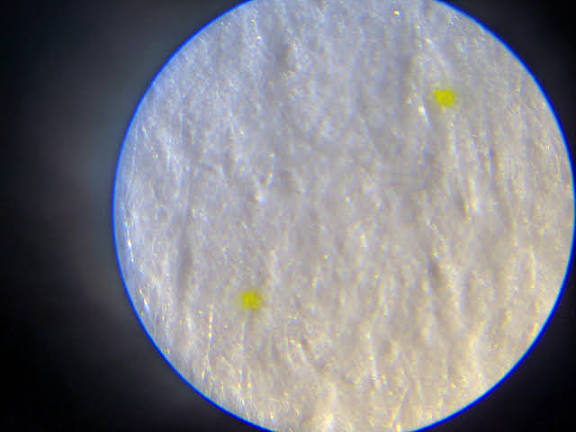
Since the 1980s, Xerox and Canon made a secret deal with the US Secret Service. every color laser printer now embeds invisible yellow dots on every single page it produces. too small to see with the naked eye. they repeat up to 150 times per page so they survive cropping, damage, even shredding.
the dots encode:
— your printer's serial number
— the exact date and time of printing
— the manufacturer
no law requires manufacturers to tell you this. most printer manuals don't mention it. you almost certainly didn't know.
The first use case was counterfeiting. catching people printing fake money. reasonable.
Then, in 2017, Reality Winner printed a classified NSA document and mailed it to journalists. investigators cross-referenced the yellow dots with security footage. she was identified, arrested, and sentenced to 5 years.
because there is no law regulating who can request this information. no warrant requirement. no oversight. the EFF has been saying this since 2004 and nothing has changed.
you can check if your printer does this. the EFF maintains a list: https://t.co/mffS4X92kw
A new Science study shows that bumble bees can position a ball underneath a fake “flower” to reach a reward, suggesting they can exhibit spontaneous problem-solving and challenging the notion that such advanced cognitive abilities are exclusive to large-brained vertebrates.
Learn more: https://t.co/T964qkIQzx
The plastic ring around a duck's beak doesn't kill it fast. It starves it slowly. 2 seconds and a couple cuts fixes this problem.
A duck with a ring stuck on its bill can't open its mouth to eat. It can't fish. It can't preen. It tries to scrape the ring off against rocks, branches, mud, anything, until its bill is raw and it's exhausted from the effort.
Wildlife rehabbers see this constantly in waterfowl: cranes, geese, ducks, pelicans, and herons. The birds in the photo below are three out of millions.
The fix takes about two seconds. Cut every plastic loop you encounter before throwing it away. Six-pack rings, jug seals, the rings around milk caps, dog treat bag tops, mask ear loops. Snip every closed circle into an open line.
You won't see the bird your snip saved, but the ring you cut tonight isn't out there waiting to choke a tern next year. It's already a piece of broken plastic on its way to a landfill, no longer a snare for anything.
You might think your chest holds the only organ keeping you alive, but a tiny biological powerhouse is actively saving your life with every single step you take.
Deep within your lower leg lies the soleus muscle. Making up just 1% of your total body weight, it acts as a literal secondary pump, defying gravity to force deoxygenated blood all the way back up to your lungs.
When this critical system remains inactive for too long, blood begins to pool, drastically increasing your risk of dangerous clots and severe circulatory failure. Regular movement isn't just about general fitness; it is a vital mechanical requirement for your survival.
They didn't kill the cancer. They told it to go home.
A team of Korean scientists at KAIST just pulled off something that sounds like science fiction.
Instead of nuking colon cancer cells with chemo or radiation, they convinced them to turn back into normal, healthy colon cells.
No killing. No collateral damage. Just a quiet U-turn at the cellular level.
Here's how it works.
Led by Professor Kwang-Hyun Cho at the Department of Bio and Brain Engineering, the team built a "digital twin" of the gene network that controls how a normal cell becomes cancerous.
They ran simulations. They hunted for the exact moment a healthy cell flips into a malignant one.
Then they found the switches.
Three master regulator genes — MYB, HDAC2, and FOXA2 — were the keys to the whole transformation.
Flip those switches back, and the cancer cell stops behaving like a cancer cell. It starts looking and acting like a normal enterocyte, the kind of cell that lines a healthy intestine.
No gene editing. No permanent rewiring. Just the body's own natural signals, used in reverse.
The team confirmed it in molecular experiments, cellular experiments, and animal studies. The malignant cells stopped multiplying out of control and went back to doing their actual job.
The research has already been handed off to a company called BioRevert Inc. to develop into real-world treatments.
This isn't a cure tomorrow. But it rewrites the entire playbook for how we think about cancer.
You don't always have to destroy the enemy.
Sometimes you just have to remind it who it used to be.
Source: KAIST / Advanced Science (Gong et al., 2024) via ScienceDaily and OncoDaily
Big news from Australia 🇦🇺
A new study tracked 15 companies that switched to a 4-day work week (100% pay, 80% hours, 100% output).
Results?
• 14 out of 15 companies decided to keep it permanently
• Zero reported a drop in productivity
• 6 companies actually saw productivity increase
Less burnout, same (or better) output.
The 4-day week is no longer just a dream, the data backs it up.