The next great wave of entrepreneurship may not begin with an idea. It may begin with an acquisition.
For the past two decades, we have glorified one version of entrepreneurship:
Start from zero.
Raise venture capital.
Burn cash.
Chase hypergrowth.
Hope the company survives.
But a historic opportunity is emerging in the opposite direction.
McKinsey estimates that by 2035, around six million US small and medium-sized businesses will face an ownership transition as their owners retire. More than one million are viable candidates for sale, representing up to $5 trillion in enterprise value.
Yet in 2022, 92% of SMB exits happened through closure. Only 5% were sales and 3% were ownership transfers.
This is not creative destruction.
It is a succession failure.
Many of these companies already possess what founders spend years trying to build:
Paying customers.
Trained employees.
Supplier relationships.
Cash flow.
Reputation.
Community trust.
Entrepreneurship through acquisition—ETA—offers a different path.
Not zero-to-one.
But one-to-ten.
A capable entrepreneur acquires a viable business, protects what made it successful and builds its next chapter through better leadership, technology, distribution and capital allocation.
Nearly 80% of projected exits are expected to involve businesses valued below $2 million.
These companies are often too small for traditional private equity, but large enough to provide meaningful employment, generate durable cash flow and become platforms for long-term wealth creation.
The AI era makes this opportunity even more powerful.
The biggest ETA opportunity may not be buying software companies.
It may be acquiring manufacturers, logistics companies, healthcare practices, maintenance businesses, construction trades and professional-service firms—and giving them a modern operating system.
AI can improve pricing, sales, scheduling, procurement, reporting, compliance, customer service and decision-making.
A company built over 30 years does not need to lose its identity to become significantly more productive.
And AI does not remove the need for operators.
It increases their leverage.
But ETA must not become private equity in miniature.
The best acquirer is not merely a financial buyer.
The best acquirer is a steward: someone who respects the founder’s legacy, retains the workforce, protects customer trust and grows the company for another generation.
For investors, this could also become an important real-economy asset class.
Family offices, banks and private-credit providers can back talented operators, combine acquisition equity with seller financing, and provide shared technology and operational support across multiple businesses.
To unlock the opportunity, however, we need more than search funds.
We need acquisition education, transparent marketplaces, standardized diligence, flexible financing, properly structured seller participation and real post-acquisition support.
We built an enormous ecosystem to help people start companies.
Now we need an equally strong ecosystem to help good companies survive, transfer and compound.
McKinsey estimates that a functioning ownership-transition market could preserve up to 12 million jobs and protect approximately $250 billion in annual local spending power.
This is bigger than M&A.
It is a new pathway to ownership, financial freedom and economic mobility.
The next great entrepreneur may not start from zero.
They may acquire a great foundation—and build its next chapter.
St. Augustine: “The city of man seeks the praise of men… [It] lifts up its head in its own boasting… Both the rulers themselves and the people they dominate are dominated by the lust for domination; whereas in the City of God all citizens serve one another in charity… [But the other] city loves its leaders as symbols of its own strength” (City of God, Book XIV, Chapter 28)
Pope St. Gregory the Great stands among the most influential figures in Church history. A pope, theologian, missionary leader, and Doctor of the Church, he helped guide both the Church and society through the challenges of the late sixth century. His leadership, writings, and example continue to shape Catholic life more than 14 centuries after his death.
Born in Rome around 540 into a wealthy and respected Christian family, he received a comprehensive education and entered public service. He served as prefect of Rome, one of the city’s highest civil offices. Yet worldly success did not satisfy him. After his father’s death, Gregory distributed much of his wealth, transformed his family home into a monastery, and became a monk.
Gregory’s wisdom and talents soon led the Church to call him to greater responsibilities. He served as a papal ambassador to Constantinople before being elected pope in 590. Although he preferred the quiet life of a monk, he accepted the office out of obedience and reverence for God’s Will.
As pope, Gregory cared deeply for the poor and worked to ensure that Church resources were used to assist those suffering from disease, famine, and war. He organized a structure to produce and deliver food to the people. It is said he would not eat until the people were fed.
He reformed Church administration, strengthened pastoral care, and encouraged bishops to be faithful shepherds of their people. His missionary vision led him to send St. Augustine of Canterbury and his companions to evangelize the Anglo-Saxons in England, a mission that would have a lasting impact on Christianity in the British Isles and beyond.
Gregory was also a prolific writer. His works on pastoral leadership, prayer, Scripture, and the spiritual life became classics of Christian literature. He is credited with giving the Church the Gregorian Chant, and many of his liturgical reforms are used in today’s liturgies. His humility was evident in the title he preferred for himself: “Servant of the Servants of God.”
St. Gregory died in 604 and was later declared a Doctor of the Church. Known as “Gregory the Great,” he remains a model of wise leadership, pastoral charity, and faithful service to Christ.
https://t.co/CBR3L2mO8v
68 years in the making 🇵🇪
Ignacio Buse battles through five-set drama to record his first US Open win, following in the footsteps of his grandfather Eduardo, who last won a match here in 1958! ❤️
Happy 84th Birthday, Merrill Reese!
Entering his 50th season as the distinguished, distinctive radio voice of the Philadelphia #Eagles
2024 Pro Football Hall of Fame Pete Rozelle Radio-Television Award recipient
#FlyEaglesFly
'The earth is a huge wounded creature; she is ill. Bending over her, not as a slave over the clod, but as the physician over a prostrate sufferer, the tiller lovingly showers on her his care. But love, for all that it is so necessary, is not enough.
To know nature, to know, so to speak, the temperament of one's own piece of land, sometimes so different from that of the very next plot; to be able to discover the germs that spoil it, the rodents that would burrow beneath it, the worms that would eat its fruits, the weeds that would infest its crops; to determine what elements it lacks and to choose the successive plantings that will enrich it even while it rests—these and so many other things require wide and varied knowledge and information'
Pope Pius XII
Friends, Jesus so identifies himself with his Church that he can say, “Saul, why are you persecuting me?”
The Church is not just a club of like-minded people, a society of those who love Jesus. It is a mystical body—cells, molecules, organs of the body of Christ.
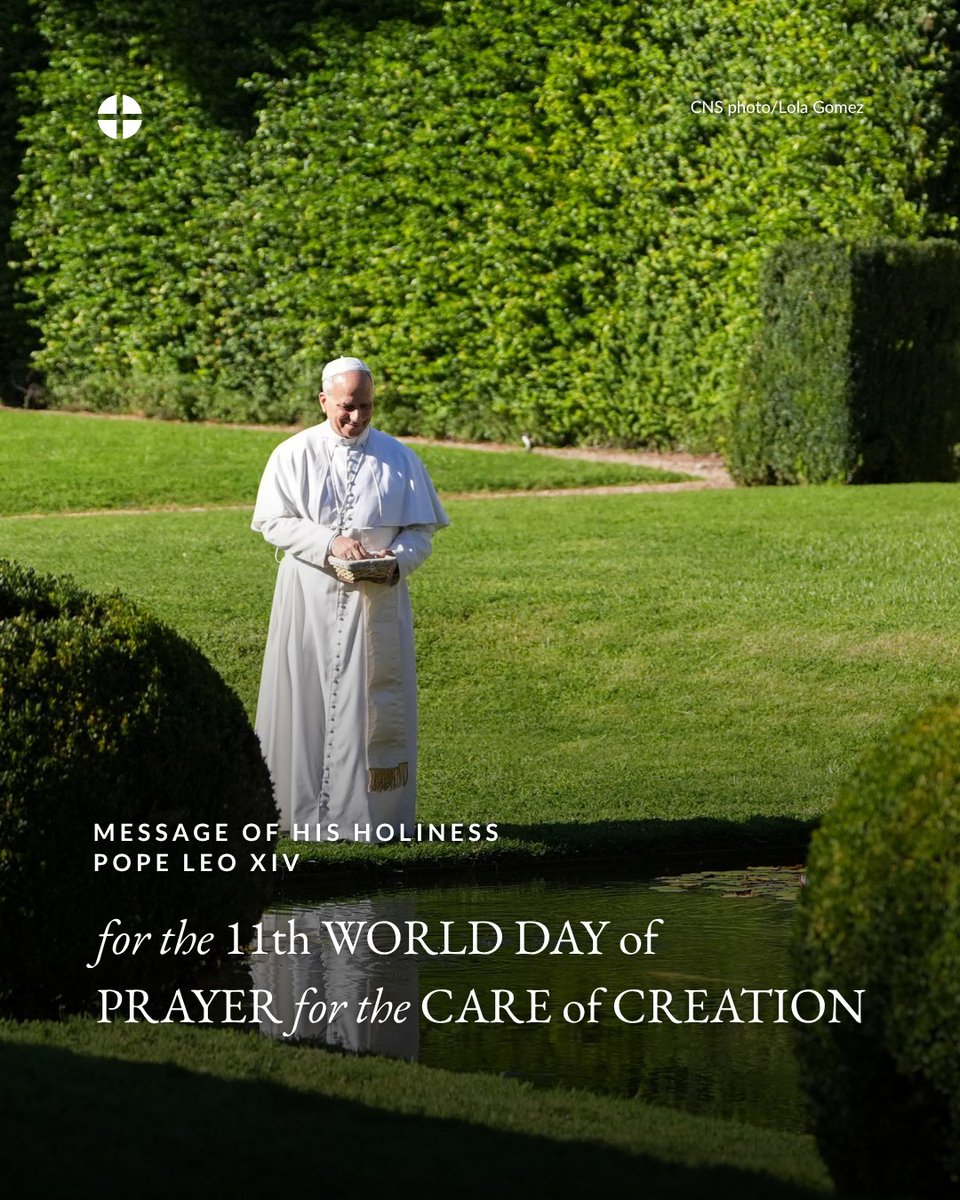
The Season of Creation is an ecumenical initiative celebrated every year from September 1 to October 4, beginning with the World Day of Prayer for the Care for Creation and concluding on the Feast of Saint Francis of Assisi. This season gives Catholics the opportunity to give thanks to God for the creation of the world and of humanity, and to recall and strengthen our responsibility to care for God's creation.
September 2nd
The church celebrates the September Martyrs
These were 191 Bishops, Priests and Religious BRUTALLY martyred in Paris during the French Revolution for REFUSING to renounce allegiance to the pope
Continuing his catechetical series on Vatican II, reflecting now on the Pastoral Constitution on the Church in the Modern World, Gaudium et spes, Pope Leo XIV says:
“This Document focuses on the Church’s pastoral responsibility to engage with the contemporary world, sharing in its joys and sorrows, and calls for a commitment to conversion, bearing witness to Christ’s work, and advocating for the poor and marginalized.
The Church is also to be attentive to the signs of the times, interpreting them in the light of the Gospel, thereby addressing pressing issues such as the technological progress that benefits only some and the persistence of widespread poverty.
In our own day, marked by profound change and much injustice, each of us, then, is called to play our part in welcoming and listening to the deepest questions and longings of the human heart, making present to all the merciful love of Christ our Savior.”
Baker is a bulldog on this issue. You can’t explain away the facts he’s unearthed. I’m convinced based on my own interviews of law enforcement involved, three whistleblowers who’ve come to me, and dozens of videos, that the J6 pipe bombs were orchestrated by agents of government.
Had dinner tonight with some friends from Hong Kong, and they reminded me that Hong Kong taxes are:
-Income tax (2% to 15%)
-Capital Gains (0%)
-Sales Tax (0%)
-Estate Tax (0%)
They can't believe how much Americans pay in tax. Unique circumstances in HK for sure though...
Pope Benedict XVI's words on Saint John the Baptist:
"With love for Christ, for his words and for the Truth, we cannot stoop to compromises.
The Truth is Truth; there are no compromises.
Christian life demands, so to speak, the “martyrdom” of daily fidelity to the Gospel, the courage, that is, to let Christ grow within us and let him be the One who guides our thought and our actions.
However, this can happen in our life only if we have a solid relationship with God.
Prayer is not time wasted, it does not take away time from our activities, even apostolic activities, but exactly the opposite is true: only if we are able to have a faithful, constant and trusting life of prayer will God himself give us the ability and strength to live happily and serenely, to surmount difficulties and to witness courageously to him"


![FeserEdward's tweet photo. St. Augustine: “The city of man seeks the praise of men… [It] lifts up its head in its own boasting… Both the rulers themselves and the people they dominate are dominated by the lust for domination; whereas in the City of God all citizens serve one another in charity… [But the other] city loves its leaders as symbols of its own strength” (City of God, Book XIV, Chapter 28)](https://pbs.twimg.com/media/HRUDvXWaUAAOrmd.jpg)