If you are serious about better mathematics education - be it in a traditional classroom or supported by tech, then ignoring the QAMA really means you are just happy with mediocrity. Sorry. Take a look and if you think they are not worth the time or effort - PLEASE say why. This is one of those times when silence means complicity with the poor substitute for thought that calculators have generally become.
Desirable Difficulties - as discussed by UCLA - Hear from the Bjorks on @mrbartonmaths podcast at 1:06 how the QAMA contributes to thinking. https://t.co/tkCFmft39L The result of their thinking? See more recommendations at https://t.co/XWGG6E4oS9
I really love reading. Always have. Always will. Daily visits to the library when young. Paper or electronic now. Finding new works and revisiting old friends. Why is reading seen as being something that needs AI ‘tailored to my interests’ slop? I have themes I like and what do you know, there are books already written. And I try books I know nothing about. Some I like, some I don’t. Surely that’s all part of being a reader. Not whether you can do some comprehension tests to ‘move you along a path’. Educational proponents of this should be embarrassed.
@C_Hendrick@teachthemx3 I would say it is still a chatbot though. Would you say that such models ‘could’ be of use? I think we agree that out of the box models are problematic.
@C_Hendrick@teachthemx3 How about if it was a chatbot programmed for a school, that is primed to only ask questions that support learning instead of just providing answers?
of course, outside school, anything still goes!
yes, that form of table is what I was talking about. There is still a place for understanding the comment way of learning/practicing, but my theory is that the form of long lists of sums to remember adds difficulty.
Considering the table, and seeing the patterns and so forth , even if a vertical/horizontal column/row is 'isolated' from the neighbours to remember them is (IMO) better. There is no evidence for this, similarly, I don't think there is evidence for using 3(4) being better instead of 3x4 - But I 'think" it is a great idea.
But maybe there could be that research... For me, it was just not accepting that because tables have always been done one way, they should always be done that way.
Now that’s an idea - and not the same as the table chants. In fact… Will post up at some point t about my audio learn any ‘time table’ idea from same time as factsinabox that used similar but on an individual basis. Very short term retrieval practice. Although I reckon it could also end up as an ASMR ‘how to get to sleep quickly’ audio and THAT go viral! 😅
@supertolerant Sharing a Knickerbocker Glory on the few visits to Wimpy because it was too expensive to have any more!
It was something 'posh' mind you!
Lots of sense - thanks for engaging. Yes, I agree remembering facts is good. You can tell how long ago I made these for Maths and Science by 1) the use of the very popular font at the time and 2) a readily available case that everyone knew!
Anyway - what I think gets in the way, is when what is being remembered (and I am not talking here about how the facts are learned) are lists of sums in the form 3x4=12, 4x4=16 and so on... and when the multiplication facts are written and met solely in that fashion, as a sum.
Those facts are often practiced/remebered as rote knowledge (c/f videos of children chanting tables. Watch the children half a beat behind!). So that when met in a different context, or when a different problem such as 3(0.4) is met, they do not have the understanding to relate that to 3(4). I agree that yes, it is not a given that "they MUST have an understanding of this" but IMO the likelihood that they have that understanding is lower when they purely rote remember the lists.
I think that multiplication tables are better ways to learnt multiplication facts, commutativity is easier to see, patterns down and across, and they can be easily extended to negative numbers.
So my gripe is practicing to remember facts with the format 9x6=54 in a list of similar sums - and going back to the impetus for this thread, why there is a disparity with the results for 6x9=54 and 9x6=54
@ToddTruitt76508 I actually think she might not like what I propose and have even developed. After all, it started life as the ‘Four minute tables tests’ !!
WRT multiplication facts. I think automaticity is good - and better than rote memory. But mathematical fluency is better. So you know that 6x8 and 8x6 are mathematically the same and not just parts of different sequences in a set of similar looking sums! And other such aspects. E.g That if you want 15x7 you can add the results of 10x7 and 5x7. But (IMO) if your knowledge of 5x7 consists of their place in a list that stops at 10 or 12, then you’re probably stuck. And need the calculator… wonder what we can do about that?! 😉
@ToddTruitt76508 Take a look at any of my previous posts about tables - Or practice. You do need to practice and I am quite clear about that. A timed element is useful. Little and often. Every day I feel.
@ToddTruitt76508 I have no problem with automaticity - in fact, actively promote automaticity and my other articles are clear about this. I have a problem with the format of how automaticity has traditionally been taught.
Here are a couple of #nationalNumeracyDay freebies - to take you through the year!
1) a free download of the QAMA calculator at https://t.co/02nUmSMNh9 that asks the user to make a reasonable estimate before they get the exact answer. Only free today. So fill your boots before the clock strikes twelve! For anyone who uses maths, not just maths teachers.
2) https://t.co/Y12CzAAZH2 - Numeracy in English classes? English in Maths classes? Surely not! Surely Yes! How many poems will YOUR class make. Here's an example https://t.co/diVLR4LxSI
Q: How many pupils submitted a poem to get this many possible poems?
p.s. this is free forever. 😅
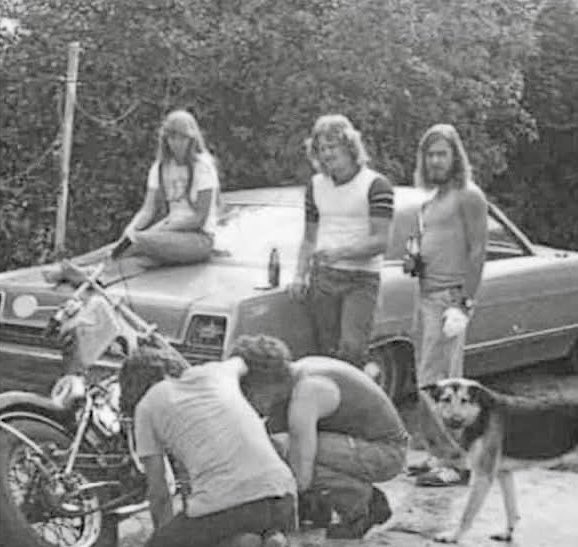
There’s a generation a lot of people forget exists. We were born at the tail end of the Boomers, but we are not culturally the same as people born in the 40s and early 50s. We are Generation Jones.
And honestly, it explains a lot.
We grew up in a world that still felt fundamentally analog, but we were young enough to be dragged headfirst into the digital revolution. We are the bridge generation between rotary phones and smartphones, between slide rules and AI, between Walter Cronkite and algorithm driven media.
We remember when there were only a few television channels and the entire country watched the same thing at the same time. We also adapted to the internet, email, forums, social media, streaming and now artificial intelligence. We lived before and after the technological singularity hit everyday life.
That is not a small thing.
People born in the 40s came of age in a post World War II America that was still industrial, deeply hierarchical and institutionally stable. Their formative years were shaped by the Cold War, Vietnam, the civil rights era and a society where information moved slowly.
Generation Jones came later. We inherited the aftermath of all of that.
We were the kids who watched Watergate destroy blind trust in government. We watched manufacturing begin to collapse. We saw divorce rates explode. We were the first truly latchkey generation in massive numbers. We learned independence early because many of us had to.
We grew up with one foot in old America and one foot in whatever this new thing was becoming.
We played outside until the streetlights came on but we also learned DOS commands. We learned cursive and keyboarding. We had card catalogs and Google searches. We went from vinyl records to cassette tapes to CDs to MP3s to streaming in one lifetime.
We remember maps. We remember memorizing phone numbers. We remember life before GPS and before every human interaction became filtered through a screen.
And because of that, I think Generation Jones developed a very unique perspective. We are adaptable because we had no choice but to adapt. We learned technology as adults instead of being born into it. We remember a slower world but were forced to survive in a rapidly accelerating one.
That creates a very different mindset than either older Boomers or younger Gen X and Millennials.
A lot of us also reject the caricature people now associate with “Boomers.” We were not buying houses for the cost of a sandwich in 1965. The interest rate on my first house was over 14% and that was after buying down a point. Many of us got hit by recessions, outsourcing, pension collapses and economic instability just like younger generations did. We watched promises evaporate in real time.
We understand older generations because we were raised by them. We understand younger generations because we had to evolve alongside them.
That’s why the Jones generation often feels culturally homeless. We are rarely discussed, rarely defined and usually lumped into categories that don’t actually fit us.
But we exist.
We are the human transition point between the industrial age and the digital age.
And frankly, there will probably never be another generation quite like us again.