Are LLM outputs just language?
We often don’t know what the answer to a question will be - but we do know its structure. Numbers, lists, sets, ...
Our framework models outputs in their underlying structure for better answers + uncertainty.
w/ @dfuchsgruber@guennemann [1/4]🧵
Discrete flow matching usually changes one component per edit in a fixed-size state. Can we extend it to general actions, like inserting whole molecular fragments?
Introducing Trajectory Matching 🧵
New paper with M. Lienen, @ludke_david, @guennemann
This lets us estimate that set checking a simple cycle:
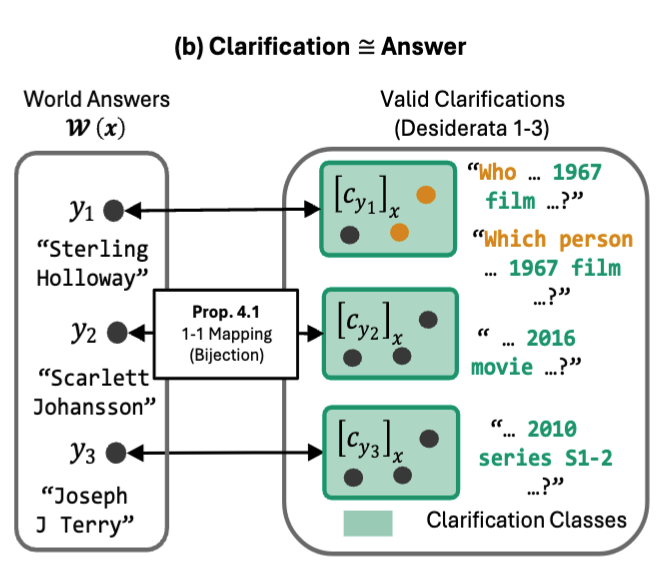
Can we get from: answer → clarified question → answer?
Only candidates for which the model completes the cycle are kept.
@MunichCenterML@zuseschoolrelAI
📝 https://t.co/4PnVKzMdQ7
🖥️ https://t.co/9sGB9BMOB9 [4/4]🧵
Can a question be ambiguous for one LLM, but not another?
Our paper received an Outstanding Paper Award at LP4FM @ NeurIPS 2026 🏆 I’ll present it as an oral in Sydney 🇦🇺 !
w/. J. Tang, S. Schmidt @dfuchsgruber@guennemann
Why ambiguity should depend on the model [1/4]🧵
→ For a particular model, we should quantify model ambiguity rather than world ambiguity.
Our goal: estimate the set of correct answers a model knows
We formalize clarifications and show a one-to-one correspondence between correct answers and clarification classes [3/4]🧵
@maksym_andr I guess for agents, especially calibration on the level of decision is of interest, as they are basically sequential decision-makers. But this angle is also an interesting thought, which could be seen from a time/cost calibration perspective.
@GoodfireAI Would be interesting to wrap this into Bayesian decision theory to generalise. E.g under 0-1 loss we would get exactly if the (argmax) answer switches, but one could also look at entropy changes (log loss) or whatever.
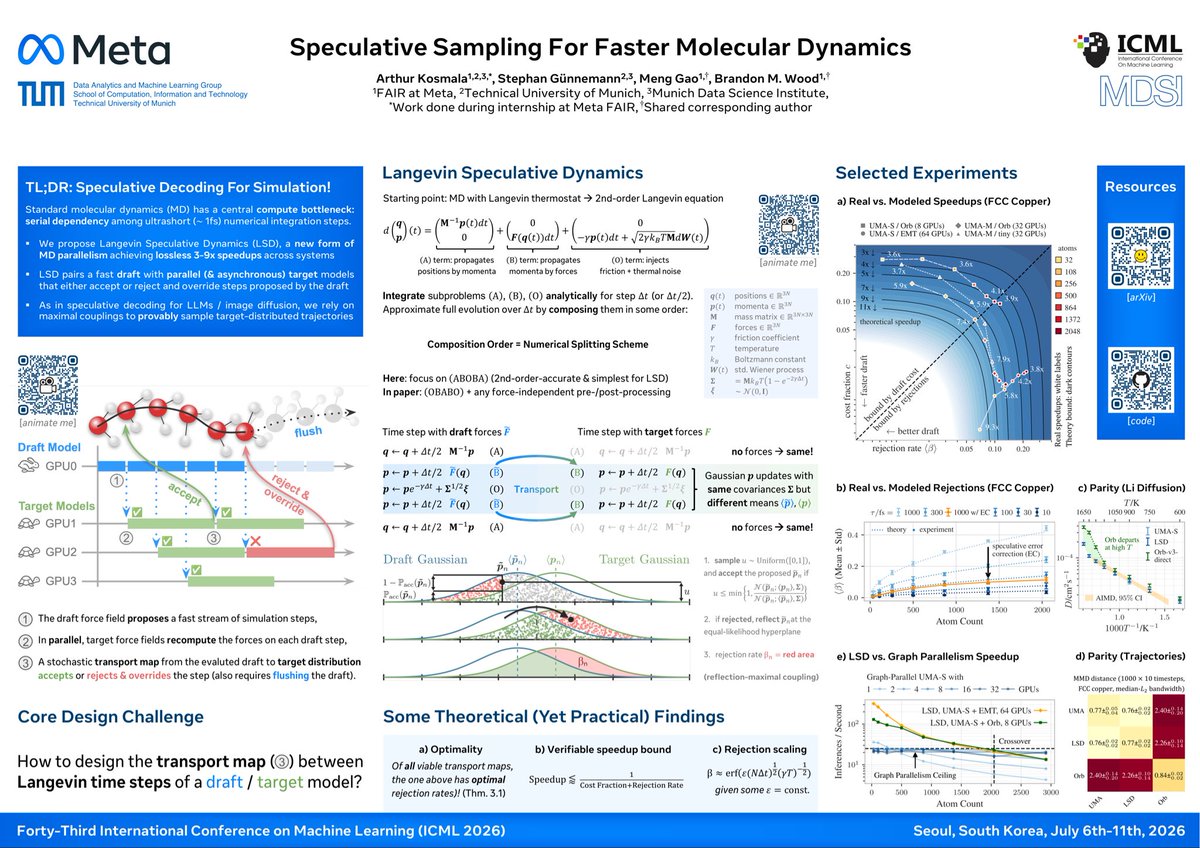
🇰🇷 If you’re at ICML: come check out our Meta FairChem + TUM poster exploring an idea:
Speculative decoding, but for simulation trajectories!
🗓️ Tue, Jul 7, 2026 • 2:00 PM – 3:45 PM KST
📍 HALL A #1312
w/ @guennemann, Ray (Meng) Gao, @bwood_m. 🙏 to the entire FAIRChem team!
(2) 🔗 https://t.co/VCI928oJvK
Task-awareness makes calibration possible for free-form generations. Use this to get a provably optimal decoding strategy.
📍 Fri Jul 10 — Spotlight Talk & Poster @ EIML Workshop
📍 Fri Jul 11 — Poster @ Agentic UQ Workshop
I’ll be at ICML next week in Seoul 🇰🇷, presenting two recent works:
(1)Task-Awareness Improves LLM Generations and Uncertainty
(2)Task-Aware Calibration: Provably Optimal Decoding in LLMs
@dfuchsgruber@raajeevVerma@guennemann@MunichCenterML
What, When, Where 👇🏽
(1) 🔗 https://t.co/pryQL3p9g0
Free-form language often has underlying semantic structure. Instead of modeling LLM outputs in text space, we model them in their task structure.
This improves both decoding and uncertainty estimation.
📍 Thu Jul 9, 10:00–11:45 AM
Hall A #1607
This is an amazing read. Like AI 2027, it's a great way to spend some time thinking about the future and feels very plausible
That said, it's already overtaken by recent events thanks to the USG pulling Mythos and Fable already. This should help Europe wake up faster hopefully
@SharonYixuanLi Interesting stuff ! In general I feel current methods do not really utilize the full information (distribution) the model has. Have you thought about Minimum Bayes Risk decoding baselines using the corresponding loss (Rogue, etc)?
Information Bottleneck Theory is a powerful framework introduced by Naftali Tishby for understanding learning and representation in intelligent systems. The central idea is that a good representation should compress the input while preserving information relevant to the prediction task. Formally, the objective balances two quantities: maximizing information about the target Y while minimizing unnecessary information about the input X.
A typical objective is:
I(T;Y) − βI(T;X)
where T is the learned representation and I(·;·) denotes mutual information.
In statistics and machine learning, the information bottleneck provides a principled approach to feature extraction, dimensionality reduction, and prediction. In deep learning, it offers a theoretical perspective on why hidden layers learn compressed representations that retain task-relevant information while discarding noise. It has influenced research on generalization, representation learning, self-supervised learning, and neural network interpretability.
In reinforcement learning, information bottleneck methods are used to learn compact state representations, improve exploration, and reduce sample complexity. The broader insight is that intelligence is not merely about storing information—it is about retaining the right information. By balancing compression and prediction, the information bottleneck provides a unifying principle connecting information theory, learning, and decision-making.
Image: https://t.co/jFnRTw87GD
1/4 Fixing hallucinations means fixing evaluations, as shown in our new paper https://t.co/Y75ldQUAbm building on our earlier @OpenAI blog. Accuracy-based scoring rewards models for making their best guess even when unsure, so hallucinations are like students guessing on tests.
@mkirchhof_ But this, of course, assumes you can find a map between a string and the distribution it represents, which is probably mostly not injective. But maybe another representation, like a credal set, could work. But in all these cases, you explicitly define the form of the object.