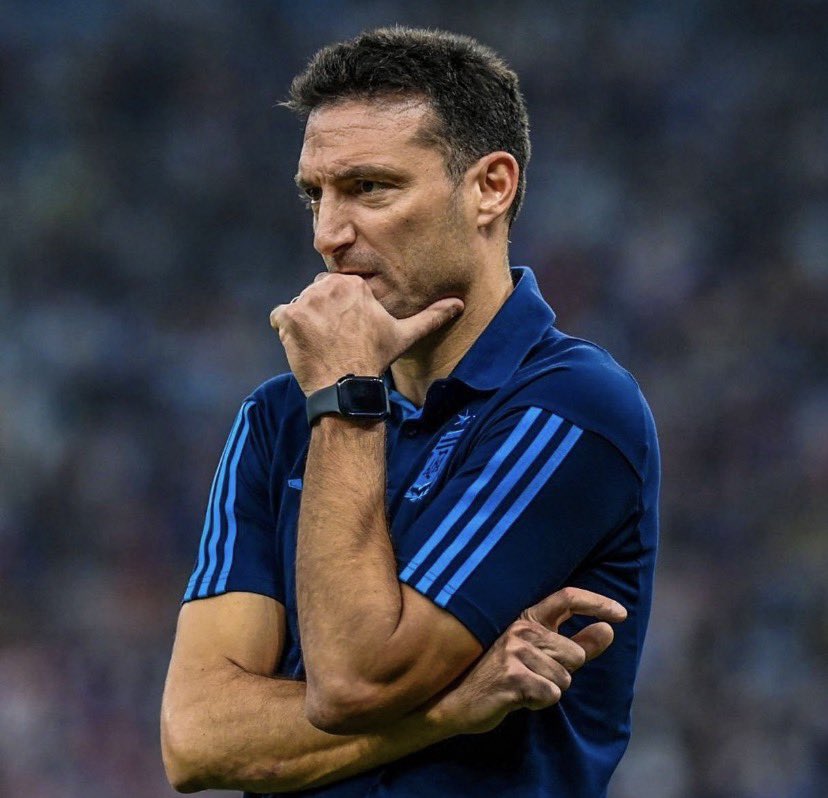
Lionel Scaloni: "We are losing the essence of football. Not only at a professional level, but also with kids."
"My children play in Spain and are overwhelmed with information. They receive the ball, and they're already being told what to do."
"There are fewer dribblers because if they barely get the ball and you say, 'Pass it!'... Imagine if Messi, when he was eight years old, had been constantly told by his coaches to "Pass it!" We wouldn't have him today."
"Football has become such a huge thing, everyone reads, studies, and thinks that with that, they can already manage."
"If you tell a 7 or 8-year-old to make a diagonal run, cover defensively... He's seven years old! Let him play with the ball, make mistakes, and when he's 14 or 15, then we can start correcting."
"It's a message for the future. This is a sport, and the beauty of football should not be lost."
🚨 Jamie Carragher on Chelsea’s performance against Brighton:
“Forget the individual quality for a second, what’s impressed me about Chelsea is how difficult they’ve become to play against.
Brighton are trying to move them around, find spaces between the lines, pull players out of position. Chelsea aren’t really giving them anything. The distances are good, everyone seems to know where the next man is and when they win it back, they’ve got the players to hurt you immediately.
That’s when Chelsea have historically been at their most dangerous. Some of the best Chelsea teams weren’t just full of great footballers, they were horrible teams to play against. You could have the ball for five minutes and feel like you were achieving absolutely nothing.
That’s what I’m beginning to see again. They’ve spent a lot of money on quality, we know that. But quality without structure is just expensive players. This is starting to look like a team.”
@DarthWhiskey@CFCJnR Tyrique George was sold to Everton with a 15% sell-on clause rather than a buy-back clause, in a permanent deal worth £18 million plus £6 million in add-ons
🚨💣 𝗘𝗫𝗣𝗢𝗦𝗘𝗗: Sunday Oliseh, the Nigerian football legend recalls how frustrating and difficult it was playing with Jay-Jay Okocha.
Also how Taribo West almost beat him up for his “useless” dribbles. 😳🇳🇬
This one is really dicey.
FIFA is registered as a non-profit association under Swiss law. Its 211 member associations own it. It pays no corporate tax in Switzerland. And right now, while the ink is barely dry on the 2026 World Cup final, it is in advanced discussions to sell a minority stake in its commercial operations to private investors, with JP Morgan acting as financial adviser and Thrive Capital, whose chief executive is Josh Kushner, expected to lead the investor group.
UEFA is responding. And I see reason with them. Their statement called it a crossing of a line and said the soul and governance of football are not assets to trade.
Let me explain what is actually happening here and why both positions are legally and commercially coherent at the same time.
The legal vehicle at the centre of this is called FIFA Forward Enterprise, or FFE. It is a FIFA-owned company that would consolidate all of FIFA's commercial rights, broadcasting, sponsorship, ticketing, licensing, and the operational delivery of FIFA tournaments, into a single entity.
Based on how things are proposed, FIFA would retain majority control and exclusive authority over governance, competitions, the match calendar, and all regulatory and sporting decisions.
Private investors would then hold a minority, non-controlling stake in the subsidiary, not in FIFA itself. FIFA says the proposal could deliver more than $10 billion in football development funding over the next four years.
Now here is the legal position.
Under Swiss association law, FIFA has broad autonomy over how it manages and commercialises its assets, provided it pursues its statutory purpose of promoting football and follows its internal decision-making rules.
Creating a commercial subsidiary and selling minority stakes in it to private investors is not categorically prohibited under any applicable law. FIFA already commercialises its rights aggressively through sponsorships, media deals, and licensing arrangements worth billions of dollars per cycle.
Placing some of that commercial activity into a valued vehicle and inviting outside capital is structurally an extension of what FIFA already does, not a departure from it. The proposal requires approval from the FIFA Council and the 211 member associations. That approval process is where the real legal constraints sit, not in Swiss corporate law.
What UEFA is objecting to is not the legality of the structure. They are objecting to the incentive architecture it creates once private capital is inside the tent. And again, that objection deserves to be taken seriously.
Even with formal majority control retained, private investors seeking returns will create ongoing pressure. They will request more matches, an expanded calendar. They will make decisions that prioritise revenue over player welfare or competitive balance.
Of course that pressure will not arrive through a boardroom vote. It arrives gradually, through the logic of what a return on investment requires. FIFA can retain exclusive authority over sporting decisions and still find that sporting decisions are shaped by the financial expectations of its commercial partners. Those are not mutually exclusive outcomes.
The legal permissibility of this structure is high if internal approvals are obtained. The binding constraints are member consent, political capital, and the risk that private capital incentives gradually reshape priorities even under retained formal control.
Football has watched that process play out at club level for thirty years. The question being asked right now, with genuine urgency, is whether the same dynamic should be allowed inside the institution that governs the game itself.
My name is Ajoje. I am a FIFA Licensed Agent and International Sports Lawyer. I write on the Law and Business of Football, a lot. Repost and Follow if you want to read more posts like this.