Assume a device gets captured one day. What can the attacker read?
That depends on how its keys were built.
A drone goes down behind the line. If its radio shares one long-lived key with the rest of the fleet, whoever recovers it may be able to read every radio on that key, including traffic recorded months earlier.
Grid equipment stays in service for decades. Take a controller from an unmanned substation, and a key that never changes can open years of recorded control traffic.
Smart meters ship by the batch. If a batch shares one key baked into firmware, a single meter opened on a workbench can be enough to read the rest.
A seized satellite ground terminal is the same story, on a link that may need to stay secure for as long as the satellite flies.
PQR is designed to keep the answer short. Keys keep evolving and old ones are erased, so a captured device exposes only the messages under its current key. Systems with independent keys in separate security domains stay outside the breach. How long that window lasts is a setting. Once fresh secret material arrives that the attacker can't reach, protection recovers.
Post-quantum signatures prove who you're talking to when a connection starts. What if the scheme breaks years later?
In PQR, later messages are checked with a key grown from the conversation's own history. A forger could start a new connection, but couldn't join an existing one.
Claude found a new way to do modular inversion, the costliest step in elliptic-curve arithmetic. One of its point-addition circuits uses 17x fewer gates than the smallest previous design, for 12% more qubits.
A quantum attack on ECDSA keys spends most of its effort on exactly those point additions. Nothing is broken today. The cost estimates keep falling, though, and this drop came from a single 53-hour run.
"Harvest now, decrypt later" has a simple plan: record encrypted traffic today, break the lock that set up the connection years from now, then read everything.
Adrian Neal's new paper on our Post-Quantum Ratchet shows where that plan can fail.
Every confirmed message gets folded into the next key, a bit like a recipe where each step uses some of the last batch. To rebuild later keys, the attacker needs every confirmed piece. Miss one that's hard to guess, and breaking the lock years later doesn't give it back. The keys after the gap stay out of reach.
https://t.co/VrCku0jou5
One-time pads have a distribution problem.
The textbook OTP needs a uniformly random secret pad as long as the message, with every segment used only once.
QuStream’s published QS-OTP design tackles the logistics: endpoints begin with a shared secret reservoir and derive pad segments locally from authenticated public epochs.
In the worked example, 1,024 parallel streams each produce a 256-bit segment: 32 KiB of pad per epoch.
A 4,096-bit epoch is 512 bytes—about 1.6% of that output, excluding authentication and transport overhead.
The aim: ongoing pad derivation without repeatedly shipping bulk secret pad files.
This is a bounded security model, not a claim of unlimited textbook perfect secrecy. Its stated assurances depend on protected secret state, controlled exposure, and safeguards against replay and rollback.
Local derivation. Single-use segments. Explicit limits.
Your next breakthrough shouldn't expose your last decade of secrets.
QuStream's published security model keeps key secrecy independent of an eavesdropper's computing power, within defined limits.
Built for a world where AI and quantum computing keep advancing.
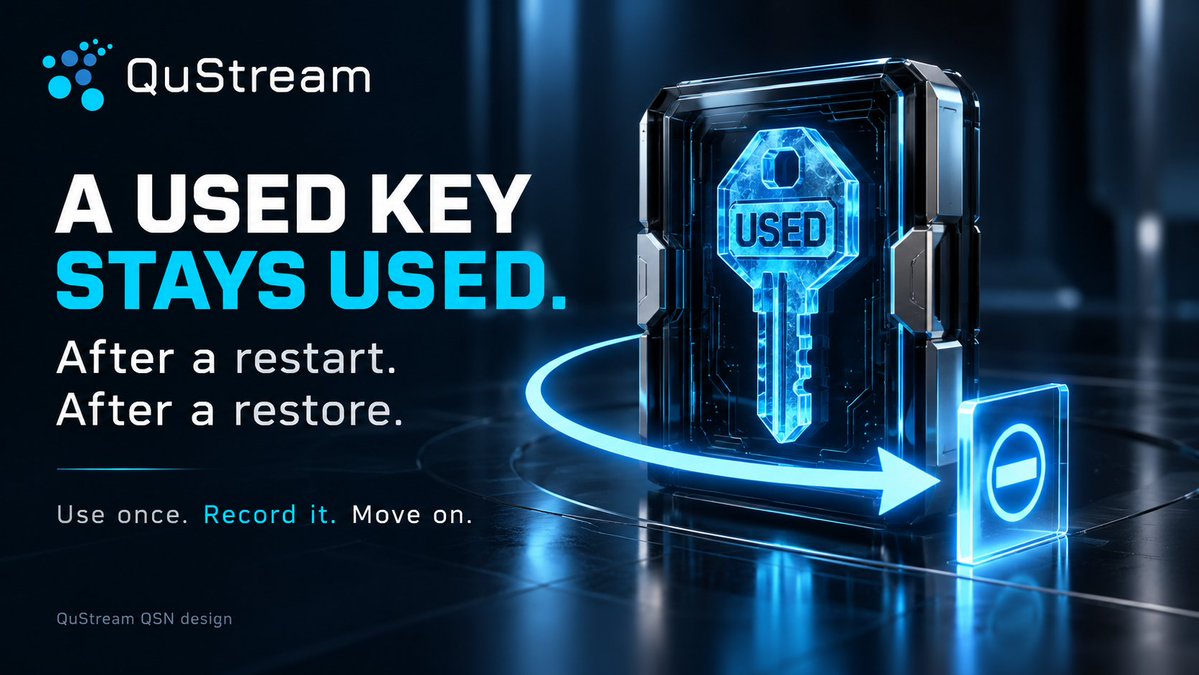
A used key should stay used, even after a crash.
Restarts and restores are exactly when an old key can sneak back in. QuStream's QSN design numbers every key, rejects replays, and keeps the "already used" record safe across reboots and backups.
Use once. Record it. Move on.
OpenAI has just posted more than 700 AI-generated maths preprints and is leaving the community to assess them.
This brings the pace of discovery into focus. For readers following maths, cryptography and quantum computing, that raises a useful question: what does your confidence depend on?
QuStream offers a different basis for derived-key secrecy. Its published information-theoretic security model does not depend on a mathematical problem remaining difficult to solve. It describes keys that are statistically indistinguishable from random to a passive eavesdropper, within a defined bound.
Provisioned endpoints derive fresh keys locally from public epochs sent over ordinary IP. The bound depends on secret state remaining unknown and exposure staying within its budget, with secure endpoints and mandatory integrity, replay and state controls.
AI progress alone does not establish a break in post-quantum cryptography. It gives us a reason to understand our assurances more clearly.
Know what your confidence rests on.
Lattices bet the maths stays hard. QuStream bets a provisioned secret stays unknown, and publishes the exposure maths: 2⁻²⁵⁶ advantage at zero exposure, 2⁻¹⁹² after 64 known-plaintext bits (256-bit segment). Information-theoretic, bounded, no new hardness assumptions.
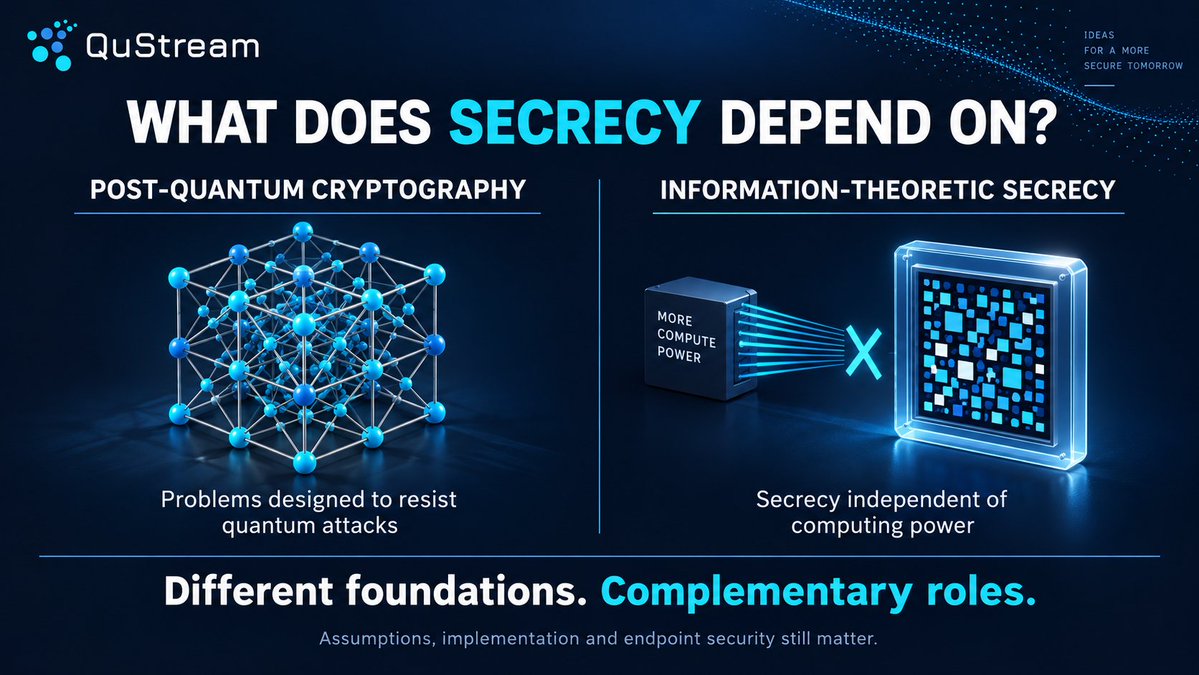
Quantum-resistant and information-theoretic aren't the same thing.
PQC relies on problems designed to stay hard for quantum computers. ITS keeps secrecy independent of computing power, under its security assumptions.
That difference is at the heart of QuStream.
Round 3 is live
Staking, delegation and rewards are now integrated into the QuStream Dashboard, bringing your node’s activity and choices into one place.
The reward pool starts at $50,000.
If network revenue takes longer than expected to begin, we’ll add $10,000 for each additional month until revenue starts.
Staking is optional.
A fully staked node requires 200,000 $QST and receives 1.0 reward weighting. Unstaked nodes receive 0.3, including during the 7-day unstaking cooldown. Rewards reflect cumulative eligible runtime and these weightings.
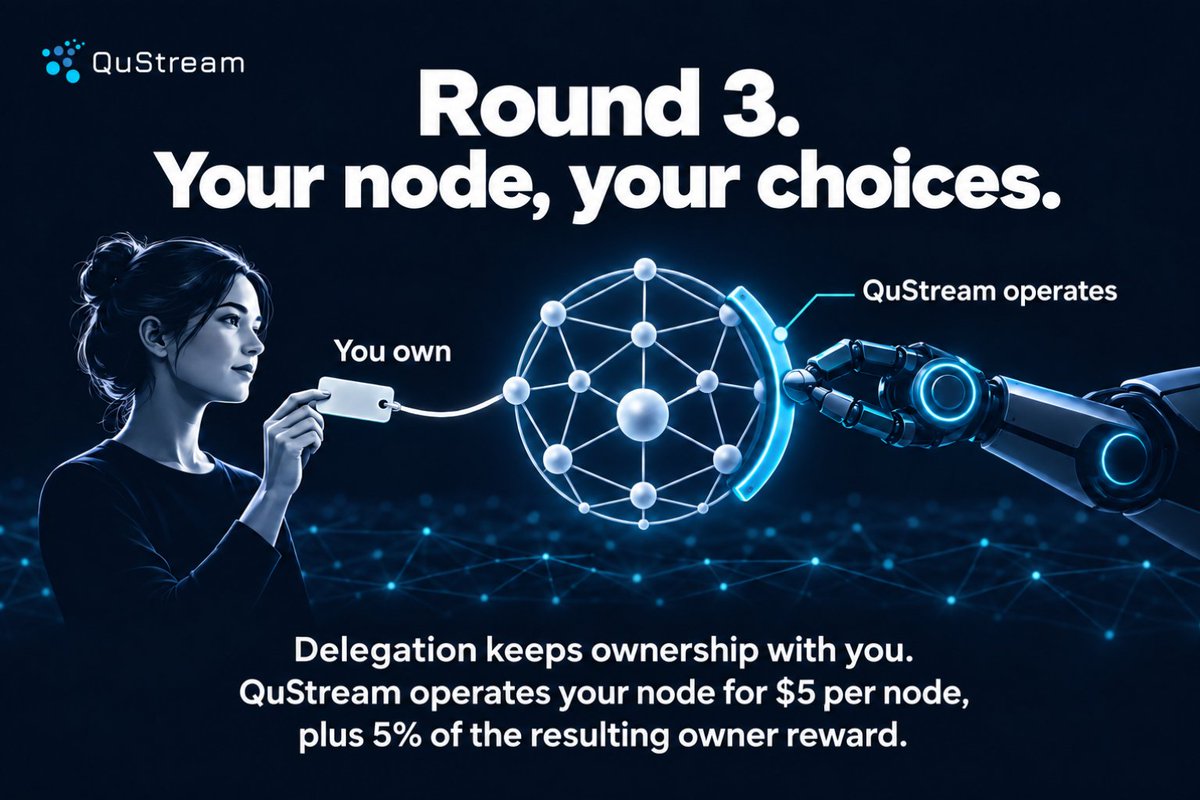
Prefer us to handle operations?
Delegation lets you keep ownership while QuStream operates your node. It costs $5 per node, payable in QST or USDC, with 5% deducted from the resulting owner reward.
Round 2 is retired. You can withdraw your QST immediately to your original wallet, with bulk withdrawals also available, or voluntarily migrate by adding 180,000 QST to your existing 20,000 QST stake.
Open the Dashboard to review your node and choose your next step.
There’s a place for you in QuStream’s network, even if running servers isn’t your thing.
Own a node and delegate it to our team OR run it yourself.
Both routes let you participate in network rewards.
Just remember: no node = no network rewards. 👇
AI is becoming the operating layer for business. Every agent creates more valuable data in motion.
PQC strengthens the handshake.
QuStream keeps fresh keys moving throughout the journey with software-delivered, bounded ITS.
Scale intelligence. Move security with it.
Perfect secrecy has always inspired the security world. QuStream gives bounded information-theoretic security a path to scale.
Public epochs move over ordinary IP. Provisioned edges derive fresh keys in software; no quantum hardware on the link.
Load once. Rekey continuously.♾