Tesla didn't just show a new Roadster tonight. It showed a car that leaves the ground.
Elon said it best: "Turns out the future does have flying cars."
The top version is called Rocket. One seat, invite only, and it flies on SpaceX-style cold-gas thrusters. Tesla says it does 0-60 in under 0.59 seconds, goes past 230 mph and covers over 300 miles.
But the part that broke my brain isn't the flying.
It's the suction. A fan system pulls air out from under the car so hard that Tesla says it can hold the Roadster upside down while it's standing still. Grip before you even move.
And you don't need an invite to get in on it. There are three versions: Performance for the road at under 1.6 seconds, Thrust for the track at under 0.9 seconds, and Rocket for the sky.
Reservations are already open. Prices? Tesla hasn't said yet.
My take: every carmaker is chasing a faster 0-60. Tesla just changed the question. When a road car borrows hardware from a rocket company, the spec sheet stops being about horsepower and starts being about physics. Nobody else can copy this next year.
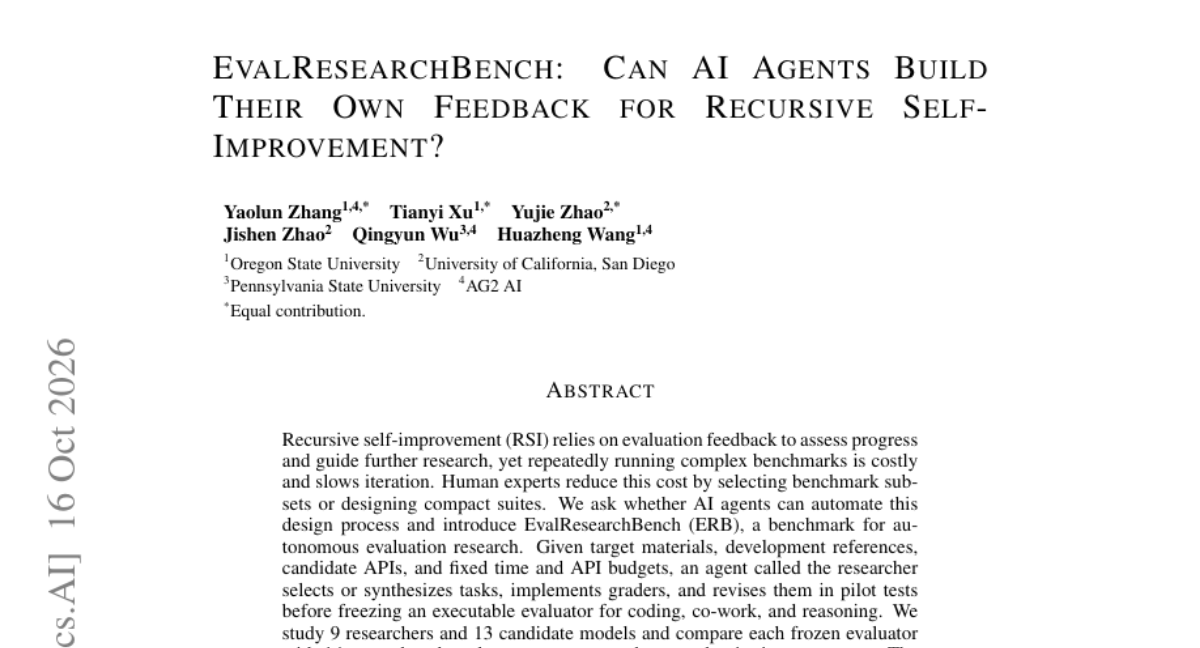
Repeatedly running full benchmarks slows recursive self-improvement, and EvalResearchBench tests whether agents can build the cheaper evaluator themselves.
→ What it does: an agent called the researcher selects or synthesizes tasks, implements graders, and revises them in pilot tests before freezing an executable evaluator
→ What it replaces: human experts hand-picking benchmark subsets or writing compact suites to cut evaluation cost
→ Scope: coding, co-work, and reasoning evaluators, built under fixed time and API budgets
→ Setup: 9 researchers and 13 candidate models, with each frozen evaluator compared against 14 target benchmarks on score concordance and pairwise agreement
It's a Hugging Face Daily Paper with 19 upvotes. The open question is whether agent-built evaluators track the full benchmarks closely enough to trust during iteration.
Model selection is moving into the agent loop. Grandet exposes listed API prices for each model as a callable tool, so agents can choose an endpoint at runtime.
→ Coverage: listed prices from 1,800+ official APIs, inference providers and relay sites
→ Access: anonymous remote MCP server over Streamable HTTP, with no sign-up or API key
→ Install: an Agent Skill that runs in Codex, Claude Code and Cursor
Traction: 751 GitHub stars in 20 days, about 37 per day. Over the next quarter, expect price-aware routing to sit alongside latency and quality signals as a standard agent decision instead of a manual lookup.
The strongest AI engineering workflow right now is a stack of models and tools working together, not one model doing everything.
• Multi-file repo fixes in an open agent loop → OpenHands v1.29 (open-source, model-agnostic backend selector)
• Sub-50 ms routine agent calls → Liquid AI LFM2.5-1.2B on RIPL (14.4 to 28.4x lower p95 latency than Qwen3.5-0.8B on vLLM, one B200)
• Multi-tenant LLM serving across GPU and TPU fleets → llm-d 1.0 (cache-aware routing, zero-downtime upgrades)
• Large-scale RL and training runs → NVIDIA Vera Rubin on Google Cloud (instances GA next month, Europe expansion planned)
• GPU compute inside Java services → TornadoVM 7 (GPU-native workloads without leaving the JVM)
• Local agent prototyping before cloud scale → DGX Spark (developer box for building and scaling agents locally)
Bookmark this stack map for your current build.
The best AI engineering workflow right now is a multi-model / multi-tool stack, not a single model.
• Multi-file refactor planning → Claude (long-context reasoning across the whole repo before any edit)
• Routine agent steps like file reads and lint fixes → Gemma 4 E4B (small local model cutting latency and token cost)
• Serving open-weight models behind an endpoint → vLLM (continuous batching for higher throughput per GPU)
• Persistent agent memory across sessions → Letta (stateful copilot memory beyond the prompt)
• Time-series demand forecasting → NVIDIA Kumo Forecast (pretrained representations plus historical pattern retrieval)
• Engineering simulation on GPUs → NVIDIA cuDSS (now generally available for CUDA-X solver workloads)
Bookmark this stack map for your current build.
@mark_k that's the best thing they can do to drive users to Chinese models, they are just retarded. Obv they had some pressure from major game studios like nintendo to stop the REA stuff (alongside Anthropic).
Coding agents invent imports, rename working functions, and rewrite whole files when you asked for one fix. This rule blocks all three in Claude Code, Cursor, or OpenHands sessions.
Paste this into your CLAUDE md or Cursor rules file:
1. Before editing, list every import you plan to add and confirm each module exists in the repo or the lockfile. If it does not, stop and ask instead of guessing a package name.
2. Make the smallest diff that satisfies the request. Do not rename, reformat, or reorder code outside the lines the task names.
3. After each change, run the existing test or type check. If it fails, fix only the failure you caused, then report the exact command and its output.
4. Never say a fix works without showing a passing command. If you cannot run it, say so in one sentence.
Bookmark this rule for your next agent session.