One of the reasons we set up @Turningthe_Tide was because keeping up with the fluid literature is hard - and abstracts rarely tell you what a trial really means.
So we’re doing the legwork.
For every major study, we’ll give you a clear summary, a critical analysis of what it does and doesn’t show, and what it means for practice.
If you work in the UK, sign up free:
https://t.co/efre1r5qh3
Ever wondered why a coronary occlusion gives the ECG it does?
Block any part of the coronary circulation on a 3D heart and watch the 12-lead (and the echo!) evolve.
Free for learning and teaching. Have fun!
https://t.co/xsLx9GMqLL
#FOAMed#ECG#OMI#MedEd#Cardiology
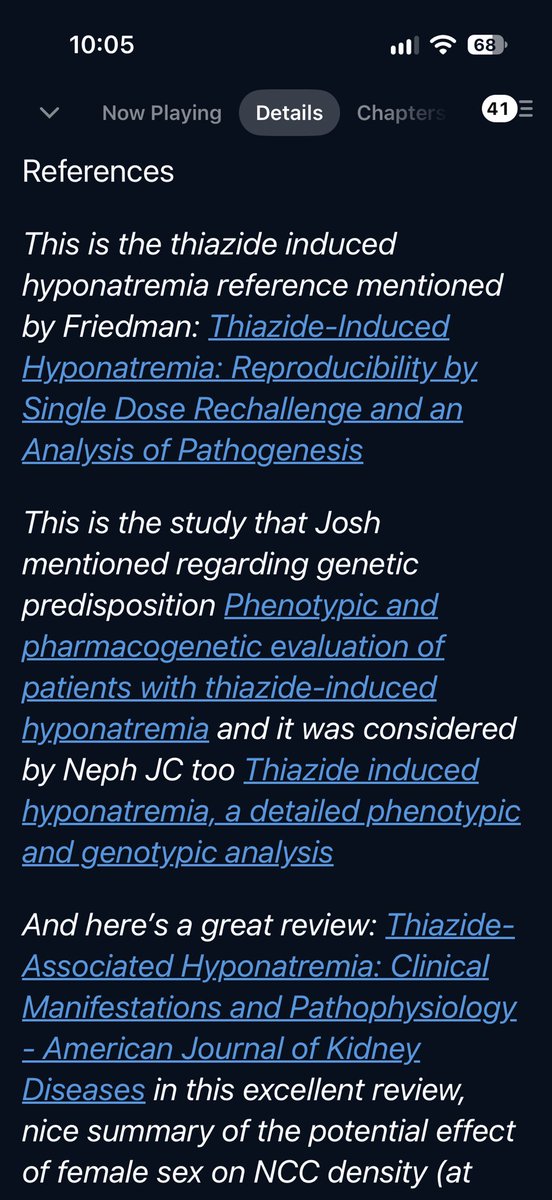
Part two of our three part arc on chapter 23 Hypoosmolar States – Hyponatremia is out
This is a good episode (They’re all good episodes, Brant)
Link: https://t.co/yp6aUx6Xst
Each chapter is fully referenced and every episode has chapters
1/14
I saw a patient last week with a hemoglobin of 4.3 g/dL.
Sitting comfortably.
Normal oxygen saturation.
Normal blood pressure.
Heart rate in the 70s.
How can the body tolerate such a profound reduction in oxygen-carrying capacity?
A physiology thread. 🧵
FGEBM Episode 2 just dropped! In which Jerry and I conclude our discussion on NS vs Balanced Solutions, discussing PLUS, BaSICS, and the BEST-Living Meta-analysis. https://t.co/9zvAH4iEVB
This paper states that it is necessary to perform the HINTS exam on every emergency department patient with an recent acute vertigo episode, whether or not the vertigo is positional. Can you explain why this is a terrible recommendation?
It's an interesting evolution...but actually, have we moved on with IV fluid therapy?!
Have a read...
https://t.co/1kfIsSNIKL
Please do join us as a member of @Turningthe_Tide ...together we can make sure our patients are safe from what can be seen silent assasin!
#FOAMed #POCUS #FOAMcc @Fluid_Academy@Manu_Malbrain #criticalcare
Venous congestion does not harm organs because CVP “pushes backwards”.
That explanation is too simple.
Sometimes flow falls because the whole circulation is failing.
Sometimes it falls because congestion creates local external constraint, compressing the microcirculation.
The pressure gradient is the signature, not the mechanism.
https://t.co/zX0QsJdNXw
I love POCUS and ECG. For interest, lets take a look at this case from more of an ECG perspective (with extra analysis of these ECGs by the Queen of Hearts @PMcardioApp):
1st ECG:
1⃣ NSR with RBBB
1⃣To my eye this is nonspecific (could be PE, CTEPH, or ischemia).
1⃣ The queen doesn't see ischemia either. But she does flag this as reduced LVEF (<40%) which is unexpected and should be a red flag that something weird is happening.
2nd ECG:
2⃣ RBBB has resolved and now we can discern ischemic STE with TWI in V1-V4. Resolving chest pain and emerging TWI suggest that he may have experienced a transient occlusion overnight with re-perfusion.
2⃣ Could the right precordial TWI be due to PE? It's possible but less likely. Absence of TWI in the inferior leads argues against PE. Significant STE with mild TWI seems more consistent with MI than PE.
2⃣ The queen flags this as a high-risk NSTEMI with 88% probability and continues to flag a reduced LVEF.
2⃣ At this point it's increasingly clear that we're dealing with LAD-territory ischemia. Transient LAD ischemia explains the transient RBBB seen on the 1st ECG (septal perforators from the LAD perfuse the right bundle). The queen keeps on telling us the EF is low. Cardiac cath needed.
In retrospect, I think the RBBB pattern may have camouflaged a subtle Wellens pattern in the first ECG.
Overall, the ECG and echo data play out in parallel.
I’ve started a Substack: The Dependent Variable.
X is great for short-form discussion, but it’s not ideal for building a coherent archive.
This will be the home for longer-form writing on cardiovascular physiology, haemodynamics, fluids, shock, ultrasound and critical care reasoning. All in one place, easier to follow and return to.
First post: https://t.co/om8CMEgs6W
Vomiting with no diarrhea, no vertigo, no cannabis and a benign belly. Should always make you pause. Routine labs show a mild aki and elevated anion gap. You have to do more than just replace their loses. Pivot and check theirs med list. Classic SGLT-2 euglycemic DKA.
yikes
wonder how much our promotion structure incentivizes this
these authors' H index will rise, they will have an NEJM image listed on their CV, no one checks since it's a counting game
as long as you get papers and grants, bad science is not penalized, unless very egregious fraud and gets covered by a major news outlet (not if internally reported)
Introducing Ultrasound Basics: a practical video series designed to help emergency clinicians confidently perform and interpret high-yield bedside ultrasound exams. 🩺
Inside the series, you’ll learn:
The eFAST Exam 🚑
The Cardiac Exam ❤️
The Ocular Exam 👁️
The Aorta Exam 🫀
Deep Vein Thrombosis (DVT) Assessment 🩸
The Biliary Exam 🟡
Bladder Volume Evaluation 💧
Build your skills, sharpen your interpretation, and bring more confidence to the bedside. 💪
#Ultrasound #EM #EMRAP #EFast #CardiacExam #OcularExam #EmergencyMedicine
A MUST-READ!
This is probably one of my most important papers where I try to teach how to fish rather than offer fish.
How I Read a Clinical Trial Report?
BG’s primer for Busy Clinicians.
Thank you @JCOOP_ASCO@EthicsdoctorP for the kind invitation. I hope the readers will find this useful.
https://t.co/HJhZlsBpU2
An amazing case with a laughable diagnosis.
NSTEMI. The less severe MI.
This NSTEMI:
- Left Main Occlusion
- Pulmonary Oedema
- Cardiogenic Shock needing Inotropes and ECMO
In what crazy world is this a less severe heart attack.
Nevertheless, well done to the team.
I finally found a circumstance that favors succinylcholine over rocuronium
"The drug-seeking behavior in this case was not euphoria but perceived psychological calmness likely tied to transient hypoxia and hypercarbia from respiratory muscle paralysis."
https://t.co/0WG1ZAoXb7
APPROACH TO ANEMIA
A follow-up:
After the reticulocyte count, resist the pull of MCV.
It sorts.
But it doesn’t explain.
Ask:
Is the marrow responding?
If not:
materials
signal
machinery
space
Four mechanisms.
That’s the map.