“We hold these truths to be self evident…” followed by a list of some of the most radical claims ever made, some of which seem dubious even to this day was an incredible move
The thing to understand about wokeness, is that as annoying as it may be, it is ultimately borne of prosocial attitudes
Suppressing it is fine, but if you try to invert it, the result is straight up evil
i wonder how many HVAC guys get Cask of Amontillado’d every year. just seems like you’re kinda asking for it frequenting strangers’ attics and basements all the time. i’ll bet it’s not zero
An abbreviation (ABB) in a journal article (JA) or Grant Application (GA) is rarely worth the words it saves. Every ABB requires cognitive resources (CR) and at my age by the time I'm halfway through a JA or GA I no longer have the CR to remember what your ABB stood for.
Celine Song raving about FURY ROAD on The Daily today: “I just don’t trust anybody who says they don’t like that movie. I’m like, oh, you don’t like movies.”
spotify home page:
-last 15 albums you listened to
-random video podcast talking about the FDA
-the three worst new pop albums
-John Green audiobook
-last 15 albums you listened to but with a different header
-AI generated playlist titled “dirtbag woo woo vibe time energy”
“I don’t know what Salesforce even does”. Well have you tried to go out and learn or did you just think such knowledge would somehow emerge spontaneously in your brain?
There's a sense of absolute security in Tintin afforded by the background colonialism. There is always a hospital, a mental institution, an English doctor around the corner; a touch of reality should things go wrong.
pretty clever
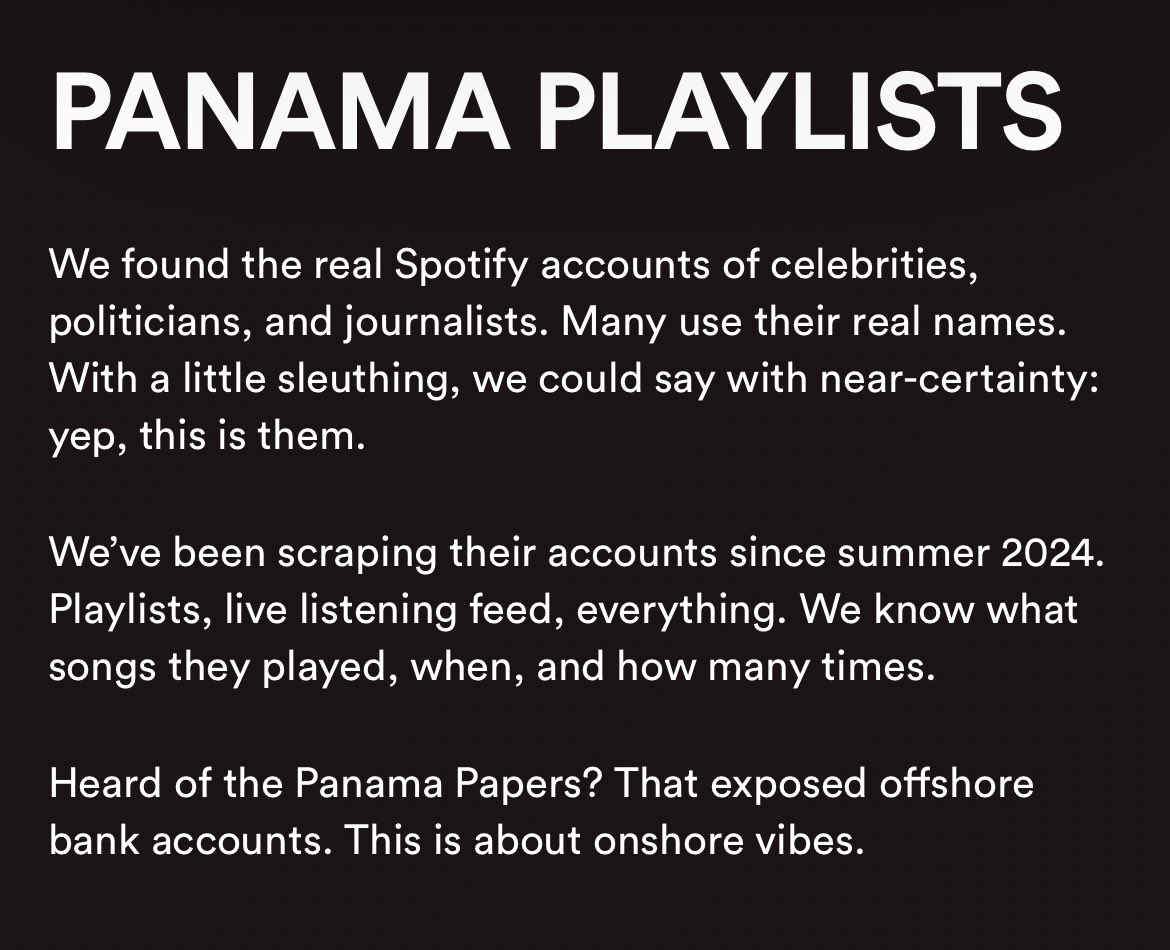
someone who claims to have scraped public listening data from a number of public figures — politicians, celebrities, journalists — spun up their alleged playlists and made it into a site
thankfully mine isnt too embarrassing but others…
https://t.co/3LBhzY1UQm
📦 Can industrial policy work? Yes—the East Asian experience shows it can (at least partially).
But its success rests on a key condition: labor control.
🇯🇵🇰🇷🇹🇼 Japan, South Korea, and Taiwan industrialized rapidly under authoritarian or semi-authoritarian regimes. Wages and labor rights were systematically repressed to favor capital accumulation and export competitiveness.
This was especially stark in South Korea during the 1980s–1990s, when unions clashed with the state and business. (If you’ve watched Squid Game, it’s in the backstory of Seong Gi-hun.)
⚠️ Authoritarianism wasn’t incidental—it was functional.
Not all authoritarian regimes succeed with industrial policy, but successful cases relied on the ability to suppress real wages and labor rights.
🇦🇷 This is why Latin America’s Big Push programs failed: their political base—urban working-class voters (e.g., Peronistas)—couldn’t sustain the wage repression required. The strategy collapsed under its own contradiction.
💥 You can’t push industrialization with cheap labor and depend politically on those who demand higher wages. The internal logic breaks. Latin America’s populism was a road to nowhere.
As far as I can tell, there are no examples of country-wide industrial policy success where real wages (and consumption) were not kept relatively low.
🇨🇳 China is not so different today.
🧾 Consumption as a share of GDP remains exceptionally low—even compared to countries at similar stages of development.
That wouldn’t be the case if China were a democracy. High savings and low consumption are features, not bugs, of its growth model.
🤔 That’s why I’m puzzled when advocates defend industrial policy from a progressive position that favors high wages and democratic institutions. You can’t have your cake and eat it too.
📚 This point isn’t new: @pseudoerasmus has made it for years. And long before him, it was central to Marx, Gerschenkron, and Dobb—and deeply embedded in the logic of socialist Big Push programs, from Stalin to Mao.