"We fail much more than we ever succeed. We know that. We accept that. We're amazing at dealing with failure. That's what scientists do."
2021 chemistry laureate David MacMillan on what failure means to him as a scientist.
On 3 November, MacMillan joins other laureates and expert panellists to discuss what future we want to build for ourselves and for the next generation of scientists. Read more here: https://t.co/qhNhds34O4
BREAKING NEWS
The Royal Swedish Academy of Sciences has decided to award the 2025 #NobelPrize in Chemistry to Susumu Kitagawa, Richard Robson and Omar M. Yaghi “for the development of metal–organic frameworks.”
I feel incredibly emotional and proud as I reflect on all the hard work, sacrifices, and amazing lessons learned during my Master of Science degree. Feeling so grateful to @dcsiiserkol, @iiserkol and @AB_Group_IISER. Excited for the future with blessings from everyone.
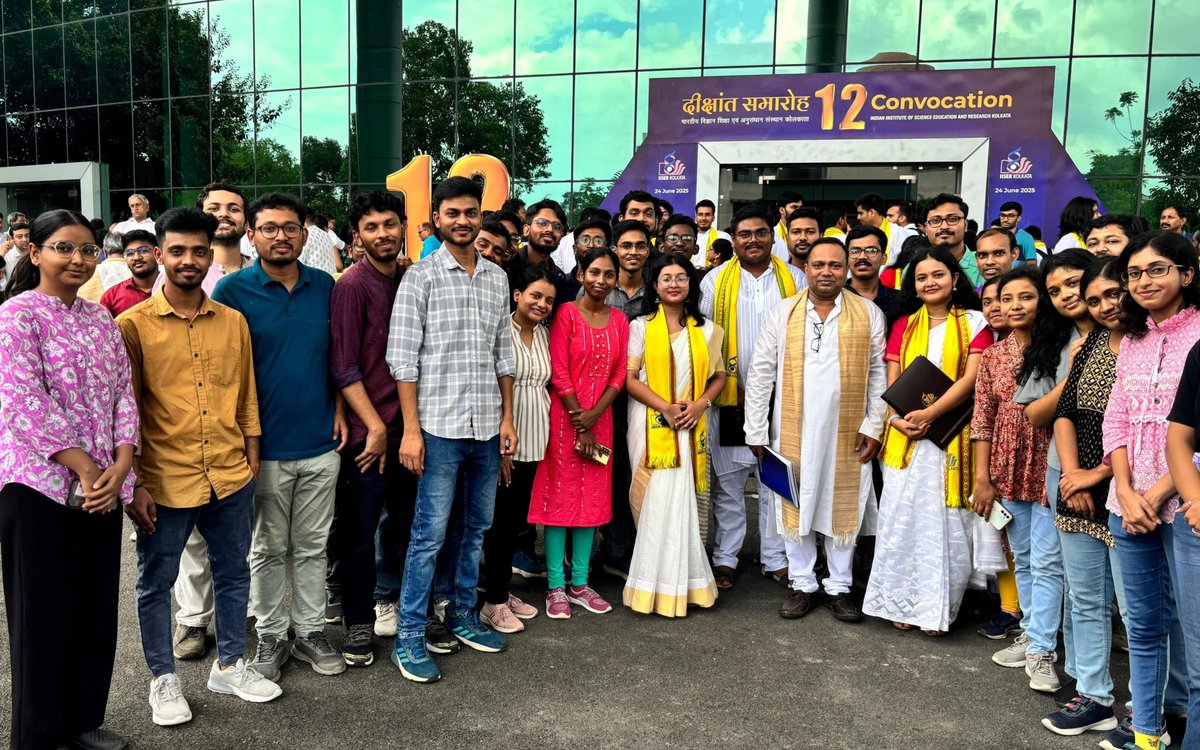
Hearty congratulations to our recent graduates Dr. Debgopal Jana, Dr. Pranay Shyamal, Dr. Ranjit Murmu, Ms. Shanoli Das, Ms. Tiyasa Roy and Mr. Sourasish Das! Wish you all the best for your future endeavors.
12th Convocation of IISER Kolkata held on 24th June, 2025
Chief Guest: Prof. Abhay Karandikar, Secretary to the Govt. of India, Dept. of Science & Technology
Guest of Honour: Prof. Sukumar Mishra, Director, IIT Dhanbad
@EduMinOfIndia@IndiaDST@PTI_News@skkhare781@priyank_june
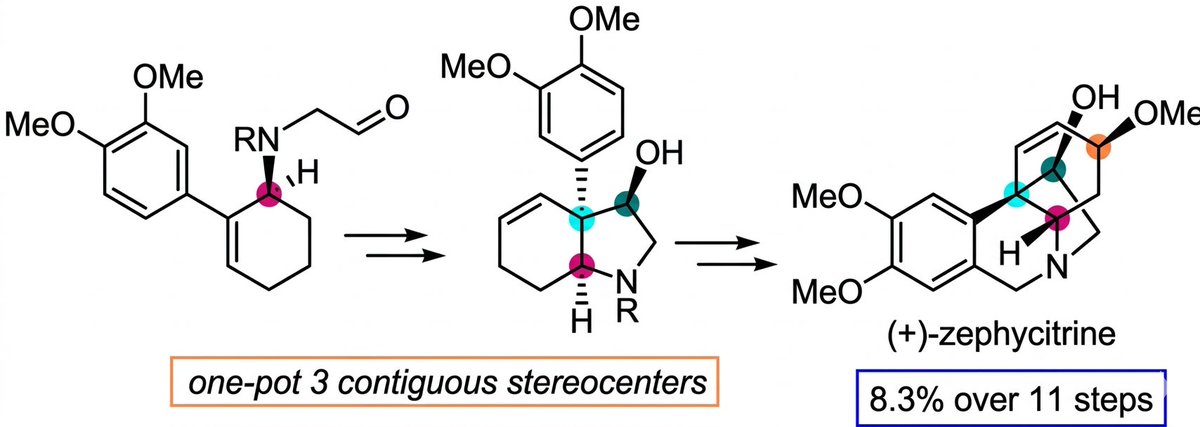
Glad to announce the first catalytic asymmetric #totalsynthesis of naturally occuring Amaryllidaceae alkaloid (+)-11-hydroxyvittatine, achieved in just 9 steps! Huge congrats to Dr. Ayan, Mr. Abhishek & Ms. Tiyasa on their just-accepted #OrgLett. paper!
https://t.co/lbghOl69YY
Indeed, Total Synthesis papers are amongst the most downloaded, which is a measure of importance and broad interest. It is worth reflecting on the discrepancy between downloads and citations. It is not uncommon in total synthesis to have more than 10,000 downloads with fewer than 50 citations. If I were obsessed with my h-factor, I would stop publishing total syntheses now. But you have to do what you truly love doing!
Happy to share our latest work published in @JACS_Au on the enantioselective total synthesis of Taiwaniadducts I, J & L, involving cycloadditions as a key strategy for constructing complex tetraterpenoids. Many congratulations to the team! Check this out: https://t.co/VXOXYJ1ZJ5
(-)-Narcipavline & (-)-codeine synthesis breakthrough! 🎉 Our latest research on these complex molecules have been featured in Synfacts by Erick M. Carreira & Dirk H. Trauner. Check these out!
https://t.co/EJ9ugb3Qqp
https://t.co/QHlkQmxerp
Just had a fascinating lunch with a 22-year-old Stanford grad. Smart kid. Perfect resume. Something felt off though.
He kept pausing mid-sentence, searching for words. Not complex words - basic ones. Like his brain was buffering.
Finally asked if he was okay. His response floored me.
"Sometimes I forget words now. I'm so used to having ChatGPT complete my thoughts that when it's not there, my brain feels... slower."
He'd been using AI for everything. Writing, thinking, communication. It had become his external brain. And now his internal one was getting weaker.
Made me think about calculators. Remember how teachers said we needed to learn math because "you won't always have a calculator"? They were wrong about that.
But maybe they were right about something deeper.
We're running the first large-scale experiment on human cognition. What happens when an entire generation outsources their thinking?
Don’t get me wrong, I’m beyond excited about what AI and AI agents will do for people in the same way that I was excited in 2009 when the App Store was launched.
But thinking out loud you got to think this guy I met with isn't the onnnnnly one that's going to be completely dependent on AI.