I think we need to build this.
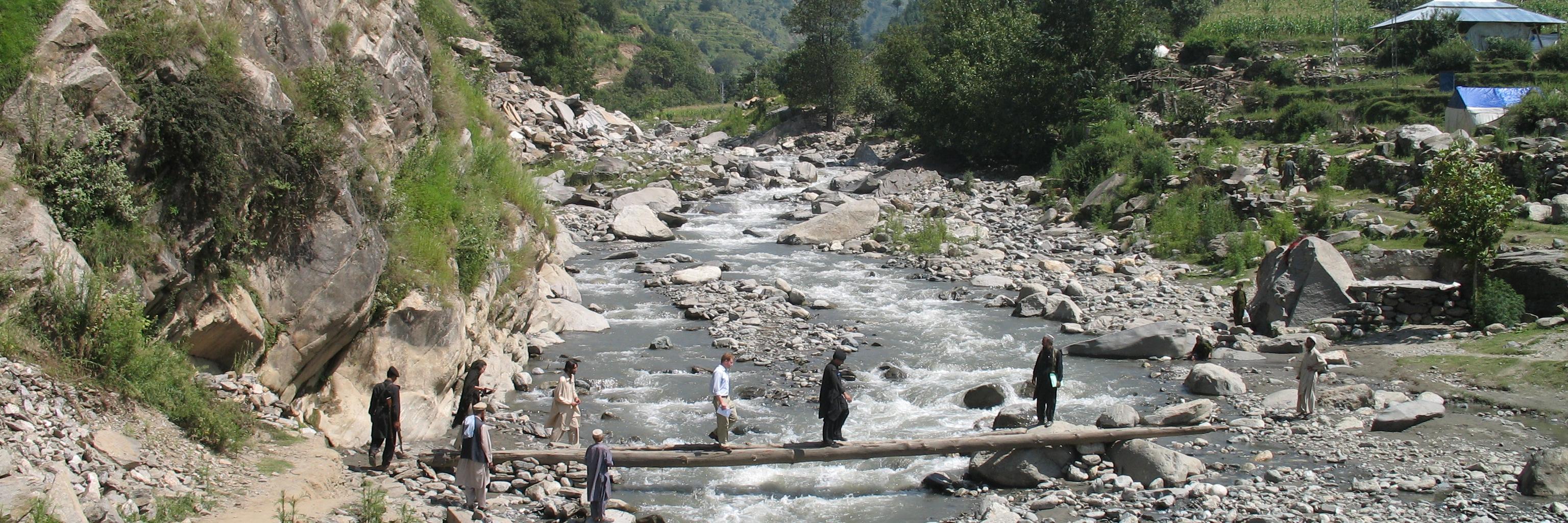
I designed this below image, representing Lewis and Clark on the Mississippi in the style of Argonath.
At $1 Billion or more, I think it can be done.
Singapore’s Foreign Minister, Dr Balakrishnan casually explaining how he built his own AI agent (a 2nd brain for diplomacy) using Claude & WhatsApp integration etc. on a Raspberry Pi
“You cannot govern a technology you have only been briefed on.” 🇸🇬
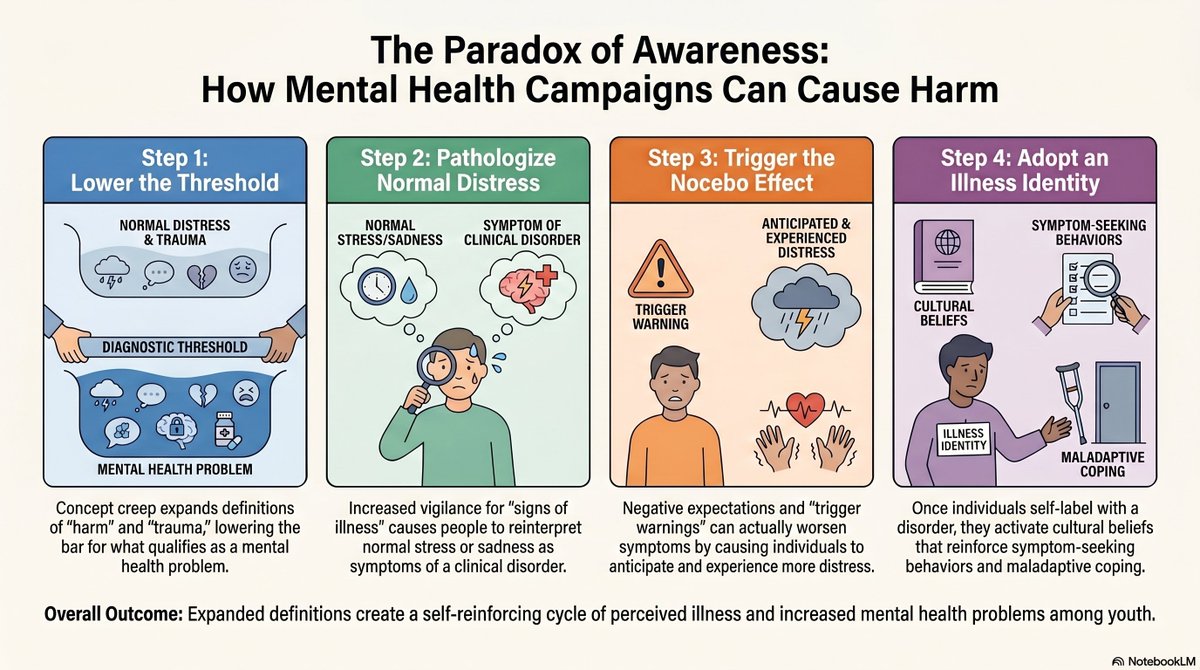
Imagine a 19-year-old scrolling TikTok. She watches a creator list five "signs you have undiagnosed anxiety." She recognizes three in herself. By the end of the week, she's describing herself as anxious to her friends. A month later, she's avoiding situations she used to handle fine.
What went wrong?
In a new paper by my PhD student Dasha Sandra, titled "Why mental health awareness can harm: Converging explanations for a societal problem", we argue that well-meaning mental health awareness can backfire, and we identify how. Four separate literatures (concept creep, nocebo effects, prevalence inflation, and illness self-labeling) have been circling the same problem from different angles. We show they converge on three mechanisms:
1.Awareness lowers the threshold for what counts as a disorder.
2. It trains people to scan their inner lives for symptoms and reinterpret normal distress as pathology.
3. Once someone adopts an illness identity, they behave in ways that confirm and deepen it.
The evidence is wide. Learning that loneliness is harmful makes solitude feel worse. Learning that stress is harmful worsens well-being and performance. Awareness videos about fake conditions like "wind turbine syndrome" produce real headaches. Trigger warnings raise anticipatory anxiety without reducing distress.
This does not mean awareness should stop. It means awareness can have unintended consequences, including manufacturing the suffering it tries to prevent. Inoculating people against these mechanisms works, and we already have evidence it does.
Link to paper: https://t.co/ucoGyhEuAj
Friends outside of tech: lol copilot is dumb
Friends in tech: I just bought iodine tablets and have made an offer on land upstate. My supplies of antibiotics and potable water are sufficient but I need to set up hydroponics to make it through the first few years.
Those wheels you’re looking at are 0.75 millimeters thick. That’s half the thickness of a US dime. Each one was carved from a single block of aluminum, and NASA sent six of them to Mars knowing they’d eventually shred.
Curiosity was built for a 2-year mission. It landed in August 2012, and by December that year NASA had already extended the mission indefinitely. Thirteen years and 35.5 kilometers later, the rover is still going, but the wheels started cracking just 14 months in. The damage came faster than anyone at JPL predicted. Sharp embedded rocks were punching straight through the skin between the treads.
So NASA assembled a Wheel Wear Tiger Team (a crisis problem-solving tradition that goes back to Apollo 13) and got to work. In 2017, they uploaded a traction control algorithm from Earth that adjusts each wheel’s speed in real time based on the terrain, reducing force on the front wheels by 20%. They rerouted the rover to softer ground and started driving backward when possible, because pulling wheels over rocks produces less force than pushing them into rocks.
The wildest part: if enough treads snap off, Curiosity is designed to find a sharp rock on Mars and use it to deliberately rip out the damaged inner section of its own wheel. JPL tested this on a replica rover and found Curiosity can keep driving on just the outer third. They predict this won’t be needed until around 2034.
Every 1,000 meters, the rover pulls over and uses the camera on its robotic arm to photograph its own wheels so engineers on Earth can count every crack. Each wheel also has tiny holes that spell “JPL” in Morse code, which Curiosity uses to measure distance by photographing its own tracks in the dirt.
These photos directly changed the next rover. When NASA built Perseverance, engineers 3D-printed about 70 different tread designs before landing on 48 curved treads instead of Curiosity’s 24, with thicker skin. They tested the new wheels over 60 kilometers and got zero damage by Curiosity’s original failure definition. “A boring graph with no data on it,” as one JPL engineer put it.
A $2.5 billion machine doing self-surgery with rocks on another planet because the mission outlasted its design by 6x.
Some thoughts on destruction of oil and gas infrastructure in the Gulf.
It is not exactly a new insight that modern economies operate on oil. Oil access, synthesis, and interdiction was a major theater of WW2. 100 years ago oil-poor nations spent heavily and participated in terrible wars over oil. See, for example, the Combined Bombing Offensive, Operation Tidal Wave, and the destruction of the Leuna synthetic fuel plants, not to mention the effectiveness of the submarine war in the waters around Japan.
In 2022, energy producer Russia invaded Ukraine, instantly throwing into stark relief the idiocy of European energy policy, where an unholy alliance of heavily regulated energy contractors and astroturfed "green" activists managed to get Germany to shut down their nuclear industry. Even as solar panel production, largely initially developed and funded in the West, grew to overwhelming proportions, Europe insisted on sending roughly $1b *per day* to Russia for access to their oil and gas.
If Europe had adjusted course in early 2022, then they would be able to support their power grids and probably some synthetic fuel production by now. The US built nuclear weapons from scratch in 2.5 years in the 1940s in competition with other national priorities at the same time. It's been more than four years since Ukraine's invasion.
But no, they did sweet fuck all about ensuring energy sovereignty. Indeed, they even went in the other direction. Britain concentrated government resources on cracking down on free speech and stopped drilling for oil. The continent continued their ill-informed blanket ban on fracking, and working age people continued to pay the price, in the form of ever higher costs, ever higher taxes, ever poorer public services, ever dropping fertility.
What about the rest of the oil importing developed world? France and Japan maintained their nuclear industry, their navies, their shipping industries and the fungibility of their supply - to an extent - even as they continued to actively burn up their economies in other more insidious ways.
New Zealand shut down their last refinery. Australia exports a lot of crude and gas but mostly lacks the ability to close their supply chain in their own borders, and fuel prices have almost doubled. California continued to ban new drilling and continues to wage open regulatory warfare against their oil refineries, perversely increasing oil-related air pollution in the state from foreign oil tanker imports and pushing gasoline prices ever higher.
More of the world has attempted to switch to natural gas supply, with investments exceeding $1t on gas import and export terminals, as though it's some fundamental law of nature that hydrocarbons must cross an ocean before they're used. As though the US fracking boom will last forever, or Asian demand growth won't see European prices continue to increase, further crushing their economic dynamism.
I have been in the room with various Asian and European energy ministers and have asked them point blank: What's your plan? I have never gotten a better answer than a shrug, as though they'll muddle through and soon it'll be someone else's problem.
The best time to get serious about domestic energy supply chains was four years ago. The second best time is today. The pain will ease just as soon as you say the magic words: I must increase my own energy supply!
And yes, it is totally possible to produce synthetic oil and gas pretty much anywhere that people live with a solar-based process we've spent four years developing at @TerraformIndies, it is future proof, it is strategically robust, it is price-linked to solar manufacturing cost, which continues to fall like a rock. It's not entirely trivial to do but, given that Europe spends about 100,000x more on Russian oil and gas imports than they do on (privately funded) synthetic fuel development, I am on safe ground when I accuse Europe's leaders of committing gross capital misallocation. Imagine what the synthetic fuel industry could achieve with $1b/day!
If you are an energy minister, now is a good time to reflect on fates worse than losing an election. Get back to work!
Paul Ehrlich has died. He was 93.
He is survived by 8,300,678,394 people (134% increase from 1968), with a daily worldwide average calorie intake of 2,800 kcal (a 22% increase).
the most underrated hire right now is a great product person.
when i say product person i'm def not talking about a product manager. perhaps i think there has to be somewhat of a new role. i don't have a good name for it yet but maybe something like "product thinker".. someone with an intuitive grasp of the product as it exists, where it's soft, where it sings, & how to iterate it toward something even sharper. in some sense, this person has to cohesively hold in their head where this product should be 2 years from now & work backwards from that.
i say this cuz when building was hard, engineering was the bottleneck & the status hierarchy often reflected that. building is no longer hard. which means the variance in outcomes has shifted almost entirely to judgment on what to build, how to sequence it, & how to talk about it.
& the story matters as much as the thing. internally, it organizes the team around a shared model of why. externally, it shapes the interpretive frame users bring to their first experience. you can't retrofit narrative onto a product & expect it to land, it has to be load bearing from the start.
the rarest version of this person sits at the intersection of culture & deep technology. someone genuinely bilingual. they know what's technically possible & they know which cultural currents are real vs. ephemeral. that combo is what separates products that feel inevitable from products that feel assembled.
before ppl clap back with this person has always been valuable, i know.. i am just saying now they might be the most *important* person in the room. their value compounds like never before.
Pretty draconian from Google. Be careful out there if you use Antigravity. I guess I'll remove support.
Even Anthropic pings me and is nice about issues. Google just... bans? https://t.co/JBq9YCB7nB
My project this weekend was building a bookmarks scraper for Twitter. 1,193 tweets → local markdown with threads and media, now connected with Obsidian as I build a system for continuous learning.
Twitter had no export feature. Now it does. Repo is here: https://t.co/iRRoBV2sqJ
As an as accomplished “person who makes the lines work” this seems inevitable. And w/ the power to create becoming table stakes, the near term formula for success feels like agency + ownership
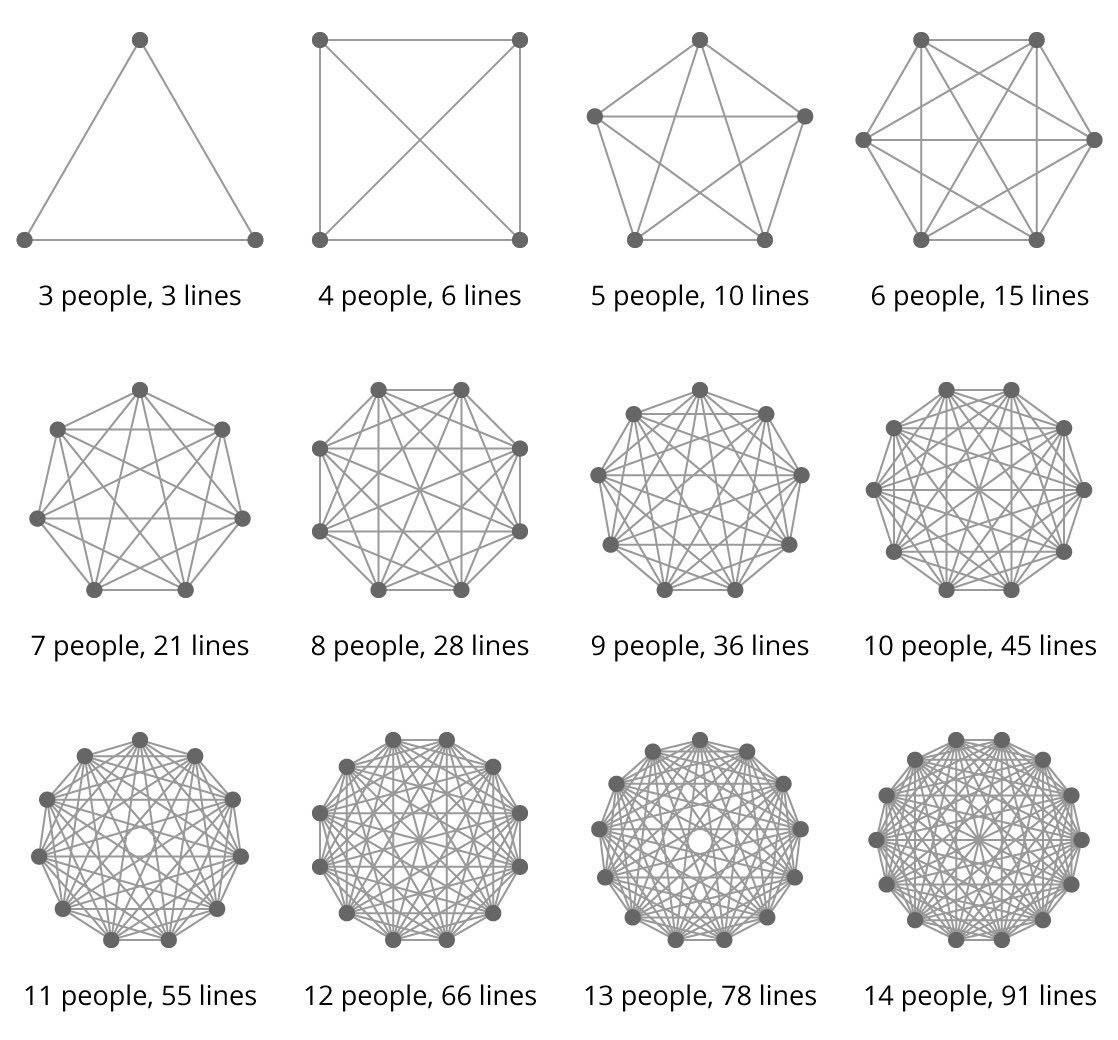
What a lot of “AI won’t take the jobs” people don’t seem to understand is the degree to which white collar orgs are essentially structured to solve this chart.
Imagine that each node is a person who actually does stuff (engineering, writing marking copy, drafting contracts, selling to customers). These jobs are getting automated by AI, but yes, you do need a human in the loop because someone ultimately has to sign off and take responsibility for the output.
However, every edge in this graph is a relationship, communication pathway, or dependency, and as an organization grows, these edges explode exponentially and become so numerous that they require their own systems and personnel to manage. Fundamentally, this is what management is: lubricating the edges. Gaze upon the face of bureaucracy and tremble.
Except, not anymore. Imo, these jobs are going to be absolutely decimated by AI, because:
1. The number of nodes will decrease, and just as a linear increase in nodes results in an exponential increase in edges, so too does a linear decrease in nodes cause an exponential decrease in edges. And the quantity of middle management personnel is a function of the number of edges.
2. AI is really really good at managing this sort of stuff. I’ll link to an article below from an OAI researcher, but he shows that the availability of a personal bot that can answer arbitrary questions about other people’s work means that suddenly these lines can be self-managed.
Point is: so much white collar work is overhead, and so much overhead is just endless 15 minute calls and emails to “sync up”, “close the loop”, and “align” various stakeholders. Bitch all you want about your PM and disparage all those “stupid do-nothing email jobs”, but this stuff is really hard! The mathematics of social graphs has born countless legions of consultants, MBAs, and desk jockeys whose sole job is to Lubricate the Lines.
That their work is based in social skills does not constitute a defense against AI, because even if AI cannot do their job directly (itself a dubious claim), they will largely eliminate the need for it. A few will survive as P&L owners + their trusted sergeants, but many many layers will be thrown out. It may take a while, but it’ll happen.