This is more than a breakfast meeting. It is an important conversation about the future of Zimbabwe’s land, agriculture and economy.
On Thursday, 27 August 2026, the High-Level Stakeholder Breakfast Meeting at Hyatt Regency Harare brings together key policymakers and stakeholders to engage on land tenure reform, title deeds, bankability and agricultural investment.
The calibre of the featured speakers reflects the significance of the conversation: Dr K. Tagwirei, Chairman of the Land Tenure Implementation Committee; Dr A. Masuka, Minister of Agriculture, Mechanisation & Water Resources Development; Hon. V. Haritatos, Minister of Lands & Rural Development; Hon. Prof. Mthuli Ncube, Minister of Finance, Economic Development and Investment Promotion; Hon. Ziyambi Ziyambi, Minister of Justice, Legal and Parliamentary Affairs; and Hon. Daniel Garwe, Minister of Local Government, Public Works and National Housing.
For farmers, financiers, investors, policymakers and businesses connected to agriculture, this is an opportunity to engage with the people at the centre of implementation.
Secure tenure must translate into bankable land, greater investment and higher agricultural productivity.
If you have a stake in Zimbabwe’s agricultural and economic future, this is a conversation worth being in the room for.
Upcoming Episode Alert!
Heritage is so much more than culture and tradition—it is our gold, our lithium, and the unique natural wealth that sets #Zimbabwe apart. But how do we unlock its true global potential?
In our upcoming special episode, ZimTrade CEO Mr. Allan Majuru breaks down the power of heritage-based exports. Imagine harvesting fresh muboora/ibhokola (pumpkin leaves) in the evening, placing them on an @FlyAirZimbabwe flight and having them arrive fresh in the #UnitedKingdom the very next morning. No artificial refrigeration, just the pure, natural bounty of our land ready for the world.
Don't miss this insightful discussion on how we are transforming our natural advantages into international trade success!
📺 Where: Our YouTube Channel : https://t.co/hPXMDdxOr3
📅 When: 25 August
⏰ Time: 08:00 hrs
Set your reminders and join the conversation #ZimTrade #HeritageExports #MadeInZimbabwe #BuyZimbabwe #TradeMatters @MabasaSasa@chinamevich@ZimTradeAlerts@ZimtraderZ@zimtrade@ZimTradeForum@ZimTradeBlog
Upcoming Episode Alert!
From $4 billion in 2019 to a phenomenal $9.7 billion today, #Zimbabwe’s merchandise exports are on a massive upward trajectory, successfully surpassing the 2025 targets. But what is the roadmap to hitting the ambitious $14 billion goal by 2030 under #NDS2?
In this compelling and insightful discussion, ZimTrade CEO Mr. Allan Majuru sits down with Zim@Large Podcast host Tinashe Chiname and co-host Mabasa Sasa to break down the numbers, the movement and the future of trade.
📅 Date: 25 August 2026
⏰ Time: 08:00 AM
Catch the full interview on our YouTube channel! 👉 https://t.co/hPXMDdymgB #ZimTrade #ZimbabweExports #ZimAtLarge #TradeDevelopment #NDS2 #MadeInZimbabwe @ZimTradeAlerts@MabasaSasa@chinamevich
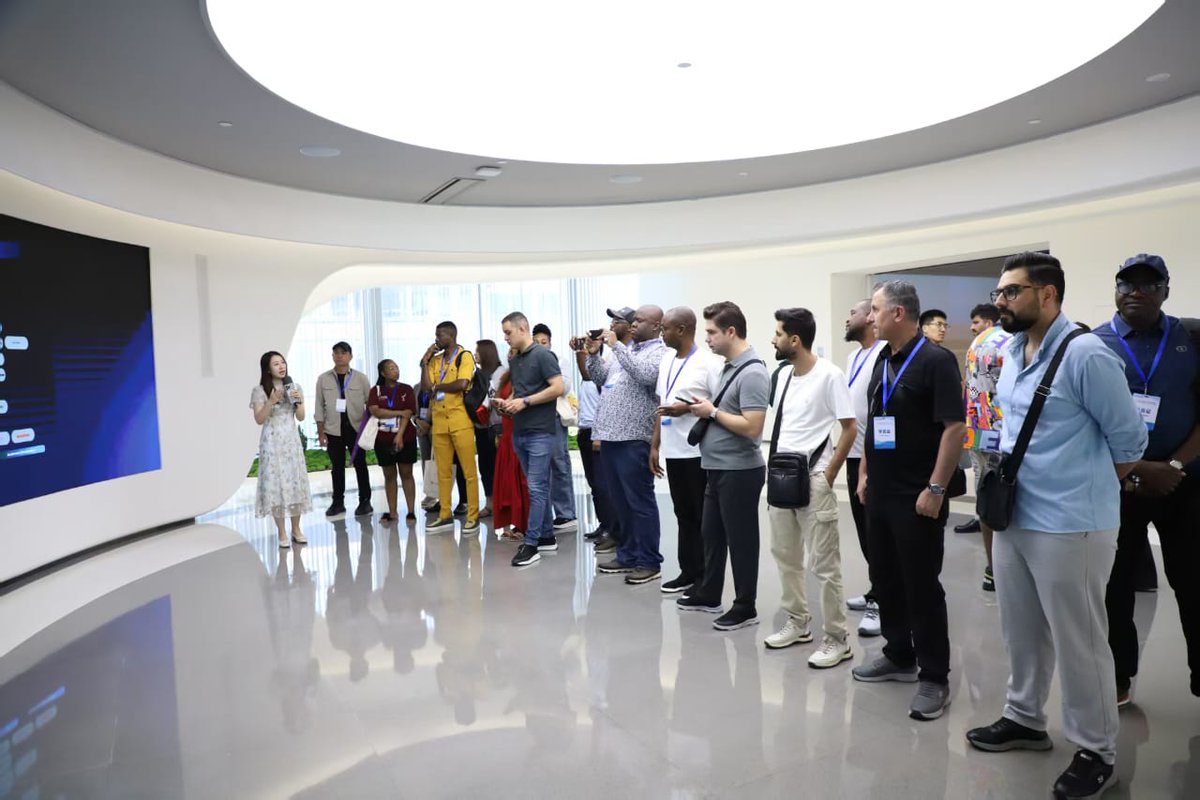
I’m in Yiwu, Zhejiang Province, China, at the China-Africa Building - in a city often called the “world’s supermarket” because of its extraordinary concentration of manufacturers, traders and global buyers.
For Africa, Yiwu is becoming an increasingly important gateway into China’s vast trading ecosystem.
In 2025, Yiwu-Africa trade reached RMB150.65 billion (US$21.0 billion), up 23.4%.
In just the first half of 2026, trade had already reached RMB102.60 billion (US$14.3 billion) - surging 42.65% year-on-year.
Even more encouraging, Yiwu’s imports from Africa jumped 126.45% during the same period.
China’s expansion of zero-tariff access for African countries creates an even bigger opportunity.
Africa already knows how to buy from China. The next frontier is producing, processing, packaging and selling more African products into China.
For Zimbabwe, that is the opportunity we must seize.
China has opened the door. Africa must walk through it.
Our host, Tinashe Chiname, spoke with Ambassador Kwame Muzawazi, the Chief Executive Officer of INSTAK. In this thought-provoking discussion, Ambassador Muzawazi explains how the Liberation City - which holds National Priority Project Status - was founded and brought into operation, and reflects on INSTAK's 10th anniversary celebrations. He highlights how knowledge sovereignty resonates with the teachings of His Excellency, President @edmnangagwa, and the wider goal of creating a knowledge-driven #Zimbabwe.
🎙️ Upcoming Episode Alert!
Our host, Tinashe Chiname, sat down with Ambassador Kwame Muzawazi, Chief Executive Officer of INSTAK.
In this insightful conversation, Ambassador Muzawazi unpacks the establishment and operationalisation of the Liberation City, which has National Priority Project Status, and talks about INSTAK’s 10th anniversary celebrations.
He emphasizes how knowledge sovereignty aligns with the teachings of His Excellency, President @edmnangagwa , and the broader vision of building a knowledge‑driven #Zimbabwe.
📅 29 July 2027 at 06:00hrs
📷 Watch the full podcast video on our YouTube channel: 👉 https://t.co/hPXMDdymgB
#ZimAtLarge #Podcast #LiberationMuseum #KnowledgeSovereignty #Zimbabwe
Mayor of Harare, Cllr Jacob Mafume, the City Town Clerk and other dignitaries visited the Museum of African Liberation site, enjoying breathtaking sunset views and a stunning 360° panorama of Harare.
Before we start, please Like, RT & Bookmark this thread. I put a lot of time and effort into creating this content.
Follow me @kabukistory for more alpha.
Payments as Infrastructure - What Zimbabwe Must Learn from Ant Group of China
Yesterday, I visited the headquarters of Ant Group in Beijing, China. It was a crisp, cloudless morning, and the tour unfolded like a masterclass in what happens when digital ambition is matched with execution, policy discipline and an uncompromising belief in national-scale innovation. As someone who has participated in Zimbabwe’s digital ecosystem for over two decades - from the years before the introduction of mobile financial services to the rise and quiet retreat of our own super-app experiments - I left the building not only inspired, but unavoidably confronted by the gap between what I had just seen and what we have yet to realise back home.
Ant Group is not merely a company - it is an institution that has engineered a digital civilisation. What began as a payments app has evolved into a multi-layered operating system for modern economic life. The Alipay super-app is now the front-end of a sophisticated stack that encompasses credit, wealth management, insurance, merchant services, logistics, identity systems and even AI-powered compliance tools. Behind it lies a formidable technological backbone - OceanBase, a distributed database built in-house to power Alipay’s massive transaction volumes; a host of risk engines; and an expanding AI infrastructure that regulates content, credit and behaviour in real time. Yet the real innovation lies not only in what Ant built, but in how it was sequenced. Payments were simply the trojan horse. Once trust was established, users embraced credit. Once data was rich, credit became precision-targeted. Once merchants came onboard, ecosystem monetisation became exponential. And once the Chinese state saw its strategic value, Ant’s survival became too important to ignore - though not immune to regulation.
Ownership is central to understanding the Ant model. Though originally spun out of Alibaba, today Ant Group sits within a carefully calibrated structure that balances private enterprise with state oversight. Jack Ma’s reduced influence, post-2020 reforms and the presence of state-linked stakeholders all point to a model where innovation is tolerated - even encouraged - as long as it does not threaten macroprudential stability or national policy objectives. In this regard, Ant is a unique Chinese hybrid: entrepreneurial in origin, infrastructural in nature, and politically tethered to the broader objectives of the Communist Party. For Zimbabwe, the implications are sobering. We often speak of public-private partnerships in theory, but we have rarely treated digital finance as infrastructure. We regulate it as telecoms, tax it like luxury, and isolate it from policy strategy until it either threatens monetary control or becomes politically inconvenient.
And yet, Zimbabwe once led. Telecel's Skwama (which later became TeleCash) then EcoCash was nothing short of a marvel. They emerged at a time when the economy had dollarised and the banking system could not absorb the needs of an informalised populace. The Ecocash service filled a gap so efficiently that it became not just a tool, but a verb. But that momentum stalled. Unlike Alipay, EcoCash remained a wallet, not a platform. It processed transactions, but it did not grow the rails needed to support credit, identity, merchant onboarding or cross-border trade. And while the user base expanded, the absence of a comprehensive fintech stack meant it lacked both strategic depth and economic durability. Its attempts to scale into broader services were often met with regulatory hostility, monetary instability, or internal hesitation.
The ambitions did not end there. Sasai, TalkChat and Vaya each emerged as attempts to craft a uniquely Zimbabwean answer to global platform dominance. Sasai wanted to be everything at once - a messaging app, a wallet, a media platform and a ride-hailing service. It failed not because it lacked funding or vision, but because it lacked focus. It entered a saturated messaging market with no dominant use-case, and its functionality, though broad, never became indispensable. TalkChat, under various rebrands, offered patriotic optimism, but it could not overcome the gravitational pull of WhatsApp’s network effects. It taught us that technology alone does not determine adoption - social habits do. Vaya, perhaps the most practical of the three, was born into economic challenges. Drivers were squeezed by inflation, and the platform struggled to compete with better-capitalised international players. The outcome was not surprising - Vaya quietly shrank, Sasai fell into dormancy, and TalkChat disappeared from the conversation.
These failures are not a reason to retreat from platform thinking. Rather, they should serve as cautionary tales about timing, sequencing and design. Ant Group did not try to become a super-app in a single sprint. It started with one habit - payments - and scaled outward through data, trust and partnerships. It partnered with banks instead of replacing them. It created tools for merchants rather than absorbing them. And it built infrastructure not as a feature, but as a foundation. Zimbabwe, on the other hand, pursued interface before architecture. We built apps where we should have built protocols. We centralised control instead of decentralising collaboration. And we tried to be everything before we mastered one thing.
Still, the opportunity is not lost. Africa, and Zimbabwe in particular, has conditions that could support a platform-first ecosystem. We have mobile penetration, a large informal economy, and populations that already operate on digital money even in the absence of full financial inclusion. What we lack is a policy commitment to infrastructure. If we are to build a truly African Ant, it must begin with interoperability as a principle, not a negotiation. We must standardise QR codes, allow all wallets to talk to each other, and create open APIs for digital identity, e-KYC and microcredit data. We must view payments as an on-ramp to broader economic participation - not as a toll booth.
Government must lead by example. State services - licensing, utilities, school fees, tax - should be payable through certified local platforms. Regulatory sandboxes must be empowered to fast-track new models of savings, lending and insurance. Our data protection laws must be sharpened not to prevent innovation, but to secure it. And most critically, we must protect the autonomy of platforms while enforcing the responsibilities that come with scale.
My visit to Ant Group reminded me that digital ecosystems are not accidents. They are policy choices, design philosophies and long-term bets. China made those bets - and won. Zimbabwe made the right start, then hesitated. What comes next is not inevitable. We can build platforms that are inclusive, interoperable, secure and economically transformative - but only if we abandon our fear of scale and our addiction to short-termism.
Ant Group is not flawless. It is heavily regulated, occasionally controversial, and subject to geopolitical tension. But it exists. It functions very well. And it serves over a billion users daily with precision, resilience and ambition. That is more than most countries can say of their entire financial sector.
We may not need to copy Ant Group. But we would do well to study its discipline, its sequencing and its ability to turn friction into infrastructure. The next Ant could still be African - but only if we are willing to build not for applause, but for permanence.
SCOTLAND FC CONGRATULATES DR. KUDZAI TAGWIREI ON GLOBAL AWARD OF EXCELLENCE
Scotland FC extends its heartfelt congratulations to Dr. Kudakwashe Tagwirei, owner of Sakunda Holdings, on receiving the prestigious Global Award of Excellence from the Seventh-day Adventist Church.
Dr. Tagwirei was honoured in recognition of his outstanding philanthropic contributions, particularly his unwavering commitment to advancing education. Notably, he has made history as the first Black African to receive this distinguished accolade.
Sakunda Holdings, under Dr. Tagwirei’s leadership, continues to play a pivotal role in various initiatives, including serving as a headline sponsor for Scotland FC.
According to H.E. President Dr. E.D. Mnangagwa, who is Vice President General (Rtd) Dr. C.G.D.N Chiwenga?
Speaking at Vice President General (Rtd) C.G.D.N Chiwenga's wedding, President Dr. E.D. Mnangagwa said:
"He was one of our commanders, becoming a member of the (ZANLA) High Command. Thereafter, when we became independent, he remained in the armed forces of the new Republic of Zimbabwe, and he discharged all the assignments given by the First Republic as well as currently under the Second Republic.
I congratulate him. He is a man of integrity. He is a man who does not take no for an answer - he interrogates every aspect of an issue.
I am sure everybody knows that it is not easy to rise to that level if you are not of high intellect.
Dominic has walked a very hard journey from the time of our armed struggle…
Each time I see him, I see the other commanders that have left us, and he is still a symbol of that armed struggle which we waged.
I think the Lord above has kept him all this way for a reason, and today we are all assembled to celebrate his wedding.
As we go away, we are satisfied that we leave a man of integrity, a man who has seen it all, to continue walking the correct line of the revolution, to continue leading this country to prosperity, and to continue to maintain unity in the nation."