Google’s AI team is instructing applicants to take special steps to avoid their resumes getting discarded by the company's AI systems https://t.co/EENlYVrtA4
@Sangeli7@theinformation logic would dictate that they were expecting a revenue boost from releasing AI features they are now holding back because they would have been too expensive to pencil out
100% agree with this. I would say there’s a bit a nuance however wrt what teams you might be working with. Trying to role out CC CLI to a tech org vs a finance org of accountants vs a data org of data scientists. Broad patterns may hold but I’ve found they each present a slightly different set of obstacles/opportunities around adoption, mastery and how to create leverage
I think the eventual resolution here is that there is a lot of very weakly moated SaaS that’s at risk, ie the sort of niche for a certain vertical stuff that a largish company currently getting jammed up on a 3 year contract can at least threaten to displace internally and collapse margins on in contracting. That threatens long term viability of those SaaS products/firms which over time weakens their value prop. One resolution here is potentially A LOT of cigar stub SaaS M&A over time by the larger non-displaceable SaaS platforms. I’m not sure how much genuine proprietary “replacement” we see of these products by companies but it’s a spectrum depending on how feature rich and appropriately priced the SaaS product was in the first place
> join AI startup
> realize SaaS is still matter-of-factly used all over the place: slack, jira/confluence, hubspot... (I had never used any of these before)
> long software
> wonder if “SaaSprocalpse” was overstated by finance bros/journos who never used SaaS in the first place
@sampullara Big companies appear to be leaning into copilot vs codex or CC so this is probably reflecting that reality. Codex is low penetration to enterprise and Anthropic is $$$ and not already on everyone’s desktop
@WalkerDReynolds@ClaudeDevs Well, nothing stopping me from continuing to do some version of manual coordination, I assume this will just make it all hang together a little better
@Vtrivedy10 I agree and I think models are general but harnesses end up being where you build the actual business going forward and where the differentiation will start to live at scale
Great post. Truth is models haven’t changed much since o1 and the addition of RL based post training for reasoning. Much of the “unhobbling” has come from harnesses (tool calls, agents and loops, retry, memory management, etc). I do however think there’s a broader extrapolation here worth thinking about
If you’ve worked in enough real companies before, you’ll recognize harnesses as the “enterprise”.
Corporate intranets/email (memory), procedures, policies and runbooks (skills, agent.md), performance reviews (evals), middle management (orchestration), etc.
Since models are non deterministic, I predict the way we will scale large multi-agent systems will end up looking a like how we scale human driven organizations.
I think people are overcomplicating agent harnesses.
I've been building backend systems for almost 20 years. When I look at an AI agent harness, I recognize 70% of it.
In simple terms, an AI harness is the infrastructure around the model, and it is what makes it reliable enough for production.
The way I see it:
→ Tool routing looks like an API gateway.
→ Memory builds on storage, retrieval, and context management.
→ Agent workflows are state machines.
→ Checkpoints are durable workflow state.
→ Retries, timeouts, and fallbacks are resilience patterns.
→ Guardrails and tool permissions are authorization.
→ Tracing is observability.
→ Evals test non-deterministic behavior.
→ Human approval is a workflow gate.
We have used many of these concepts for decades.
Now, the remaining 30% is where AI changes the rules.
The model is probabilistic, so the same input can produce a different decision, tool call, or execution path. It can also produce something that looks correct while being completely wrong.
Traditional software executes the path we define. An agent may help choose the path while it is running.
And that unpredictability is why evaluations, observability, permissions, and constraints matter so much.
I think that many of these "ground-breaking" concepts are just old backend patterns with a new name.
If you take a 10,000-foot view, things will start to look similar.
Thoughts?
@HowardMyones I fired a trainer in 2016 and got an almost similarly negative reaction. Basically trying to bully me into reconsidering. I guess a number of personal trainers are fairly unhinged
@jasonfried Hmm, I mean it cuts both ways. Maintaining software is also getting easy and cheap. There’s a lot of ways this could evolve. I think even if this is directionally right, the margins still have to collapse for it to be right
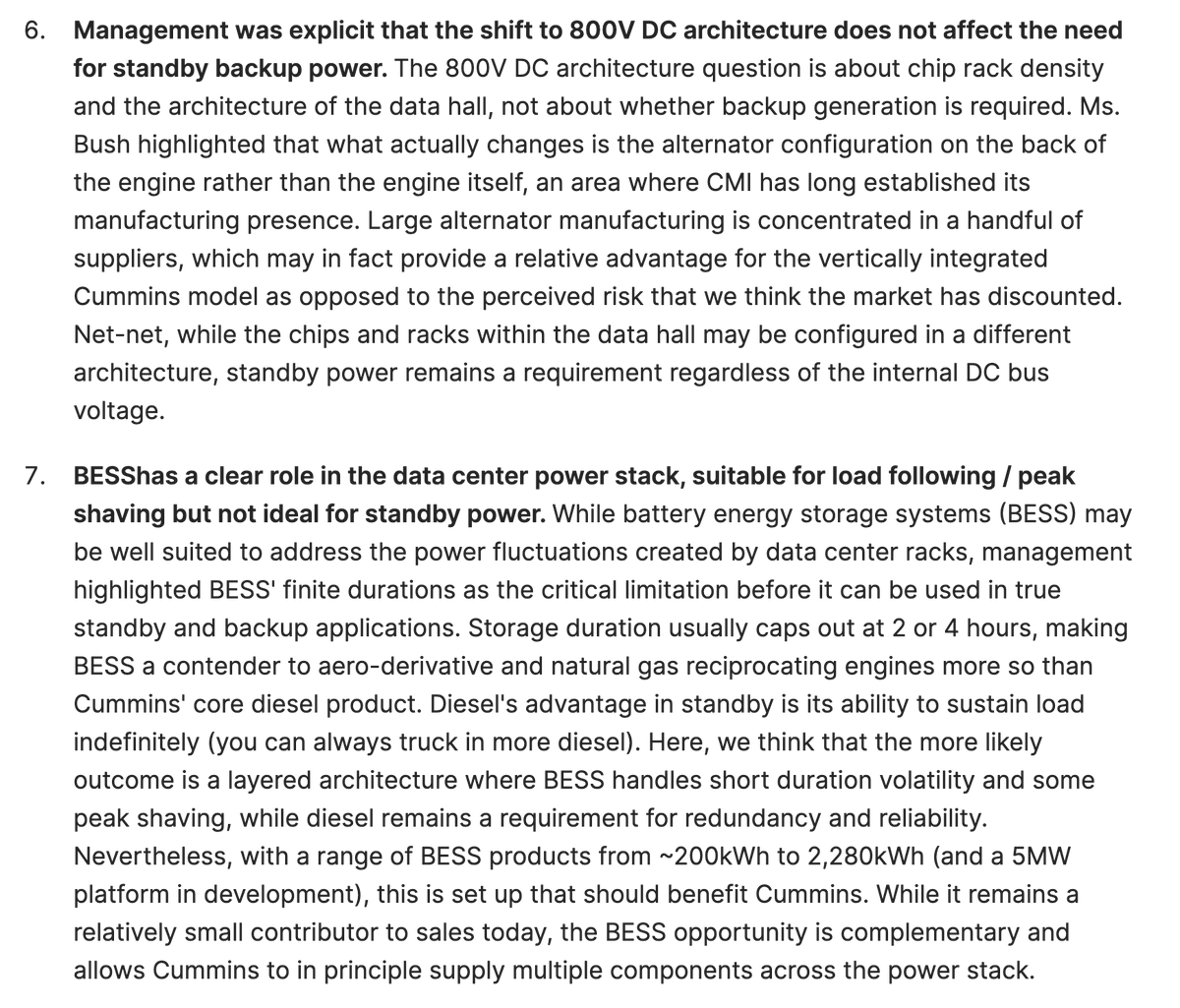
AI capex isn’t dead, but it’s moving away from inside the racks (semi and semi cap) to the actual infra to support these psychotic new hardware requirements. (nat gas, generators, batteries, solar, eventually maybe wind and geothermal, and very eventually maybe nukes). This doesn’t even cover cooling or actual grid, just the behind the meter stuff
Case in point:
Interesting nugget from an MS note in conversations with management at Cummings.
For context, this is the point in time where i'm obsessed with the power/utility part of the market again. As our report tomorrow will demonstrate :)