@mu_chrinovic@furan One of my many projects over at AInekko, with more to come.
This one in particular started as my project, let me know if you have any questions.
The hard, but hilarious lesson learned today, is that this works _only_ when left untouched. :-)
I created a openclaw-like agent to interact with the pipeline, and it overreacts into action like an anxious person high on caffeine.
Came to Venice for a family matter. Left my multi-agent system running back in Cambridge.
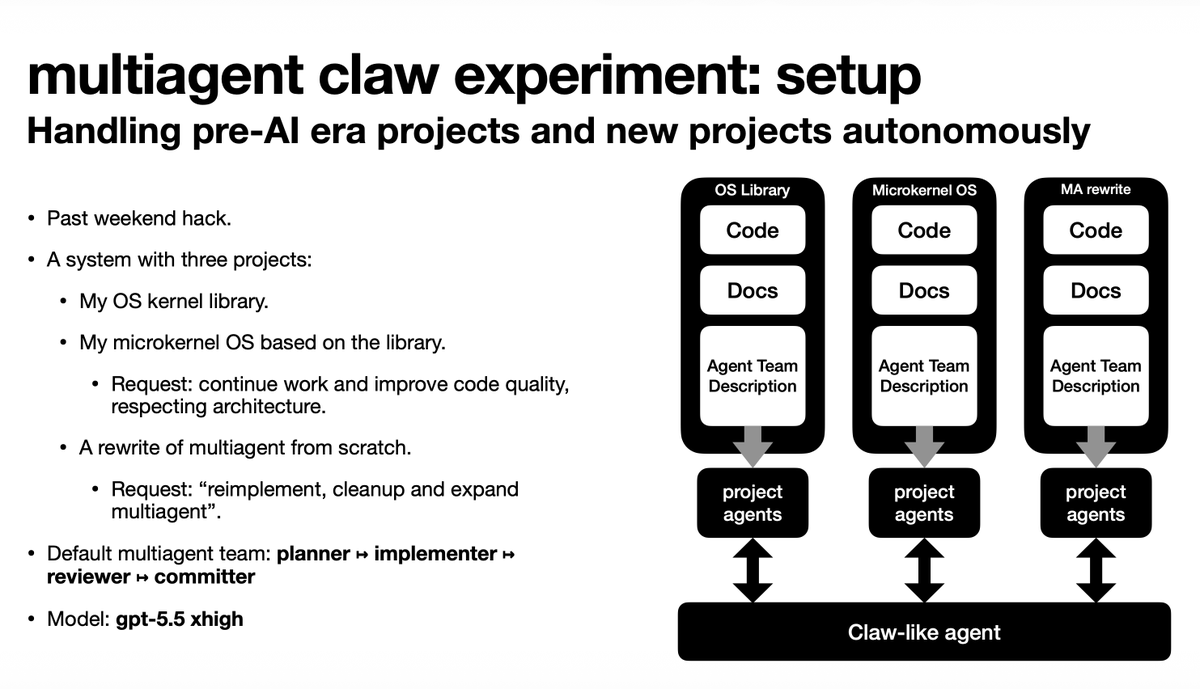
It’s been autonomously advancing my personal OS rewrite (MurgiaHack + NUX) — 132 commits and counting.
Fully autonomous planning.
They spent half a day documenting everything, cleaned up the build system, then implemented IOMMU support.
I asked why they put it directly in the kernel instead of generalizing into the common NUX library.
Their answer: “Too early to settle on a portable interface.” Exactly what I would have done.
This is real Autonomous Engineering. And it’s ridiculously fun!
I get what you mean, agentic system have a tendency to either work asymptotically towards the goal or yolo it in a single pass, both unacceptable, but this is something that I have solved having a hierarchy of agents and some massaging of rules and principles.
Also, a commit is a unit of work, not a unit of measure, and it's essentially fungible. I much prefer my agents to work slowly in security features, doing one thing right at the time, rather than trying to find out if they're really that smart. So commits are small, but there's a continuous push towards the milestone.
What the system is doing is: improving riscv64, implementing the IOMMU for x86 while keeping the original interface -- that supported this -- and for each feature do: 1) implement, 2) test + fuzz, 3) document.
That's a lot of work.
Also if by failure to recovery you mean an instability on the commit sequence, no, I mean the system is far from perfect but also not what's happening.
(If you're referring to the "failed" job in the photo, those just bubble up above the others, all those irq fixes were done before the vtd, and have been autonomously fixed)
@damageboy It’s my own system, currently uncommitted but you can follow my trajectory on my GitHub (https://t.co/aAD350e76x) looking in order at agentws, git-agents and multiagent)
One of the things that's happening is that now I have exactly two engineering souls: the one that took decades to grow, that cares obsessively about code details and the soul of a project I am working on, and another one that is more interested in this massive push to automating engineering.
I now have two very disjoint sets of projects in my drives. Those that I want to keep as my organic human grown projects and those that I want to use in an engineering conveyor belt.
I still need to define rules to move a project from one side to another, and it's at the moment impossible for me to find a middle ground.
@FelixCLC_ I wanted to actively _avoid_ videogames. My sister was the local hero of mid-80s videogames, couldn’t compete, so I told her: “You play, I am doing serious stuff”, with the poorly masked frustration of realising early you’re the dumber sibling.
@rhatr Not to mention my secret plan that involves expanding postscript (they already have small matmul in the VM) to have proper transformers in it, so you can tell the printer "print a document about X" instead of using the computer to make it up, as a way to save bandwidth. :-)
Exactly to the point, as always. Of course I built this particular system, I know exactly how this happened, and the engineer in me knew it could do that. It's just that another part, that developed expectations of what a computer can do, is out of sync with reality.
It's very hard to realise that I now have the tools at the basis of my childhood's science fiction.
Telling your agent “instead of typing would be fun if we spoke” just as a comment before entering a very long comment, then move on to other agents, until you hear in your headphones “Hello Gianluca” was one of the biggest wake up moment for me.