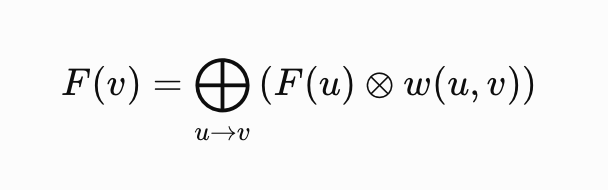
If you remove different representations, you find out that many algorithms are either the same, or almost the same.
Shortest path is semiring based computation.
More here: https://t.co/IiKh56Cijg
I realized this when I was writing my book on OR algorighms. There are hundreds of algos I went through. Sometimes, you could find 40-50 algorithms, that are different only in one parameter, or one function in the function composition.
---
I am 100% sure, there are abstract algorithms in space search + reduction, that could simplify what already exist and provide dozens of real world useful algos for thousands of various usecases.
This paper with the brilliant @0xbnd and Dr. Caughman was a big effort, I'm happy to share the preprint now that it's live: https://t.co/xe2QJGPyDu
It uses group theory to analyze how the size of a set of undesirable symmetric configurations scales with n and d (dimension)
@emhill2100 The * operations are constrained by properties like associativity or commutativity, and then we prove general things about them, so you can prove things about number addition, multiplication, matrix multiplication, etc all simultaneously.
My uncle asked me this when I was talking the class, great question actually!
Algebra as it's taught in primary school uses concrete operations like +,-
But abstract algebra uses variable operations like * where * is some function that takes two elements of a set and returns a third.
@QuantaMagazine@kkakaes Autoformalization is awesome, but any autoformalization still needs a faithfulness review to make sure the Lean code matches the natural language statements. https://t.co/aCULsXTbAr