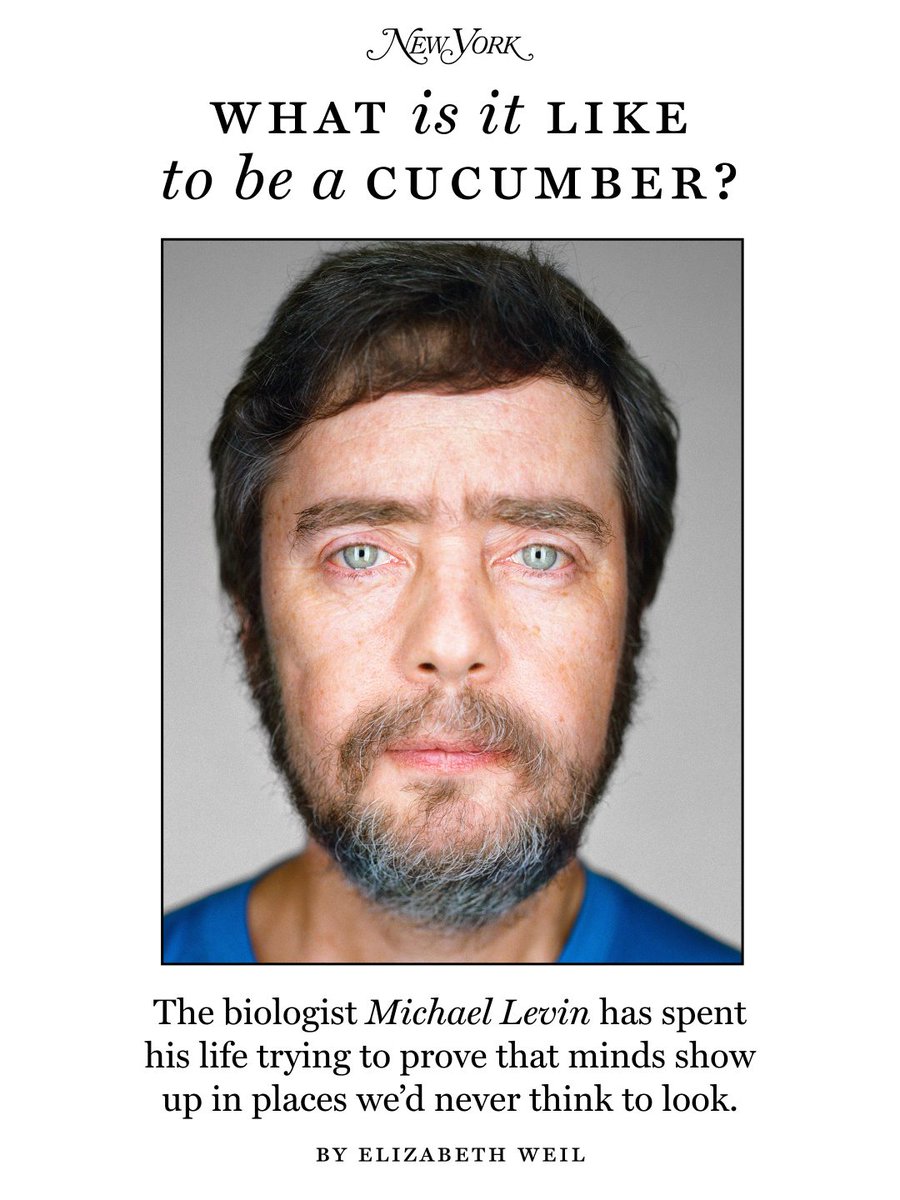
Michael Levin did not expect to reach middle age and still be making a living as a biology professor. He figured his life trajectory would likely involve getting kicked out of the academy, as the academy is fond of people asking narrow questions, not boundary-crashing, precariously close-to-woo-sounding paradigmatic thinkers whose ideas strain the limits of language. Yet the opposite has happened — he’s become a foremost expert in his field, and to many, a cult hero.
Levin has been releasing his ideas slowly his entire adult life. Five years ago, he was at 50 percent. Now he’s at 80 percent. A big jump came last year when Levin published a preprint paper called “Ingressing Minds.” In it, he argues that intelligence comes from a nonphysical realm and flows (“ingresses”) into bodies. That nonphysical realm, he says, is where mathematical ideas like pi and e reside. We already accept there is some stuff in that realm. Why would we assume there is not more?
Critics accuse Levin of all kinds of teleological crimes — making unfalsifiable claims, using words in ways that render those words meaningless. Levin is unfazed. His true retort is his wet lab. There, at the bench, he’s working to prove his metaphysics by running old-school (in a way) biological experiments. He studies flatworms with two heads. Frogs with eyes on their stomachs. Little round creatures called xenobots, synthesized from frog skin cells. They swim like tiny Pac-Men. They do not exist in nature.
Elizabeth Weil spends time with the biologist who argues that your body has many minds: https://t.co/TaeRjReQLi
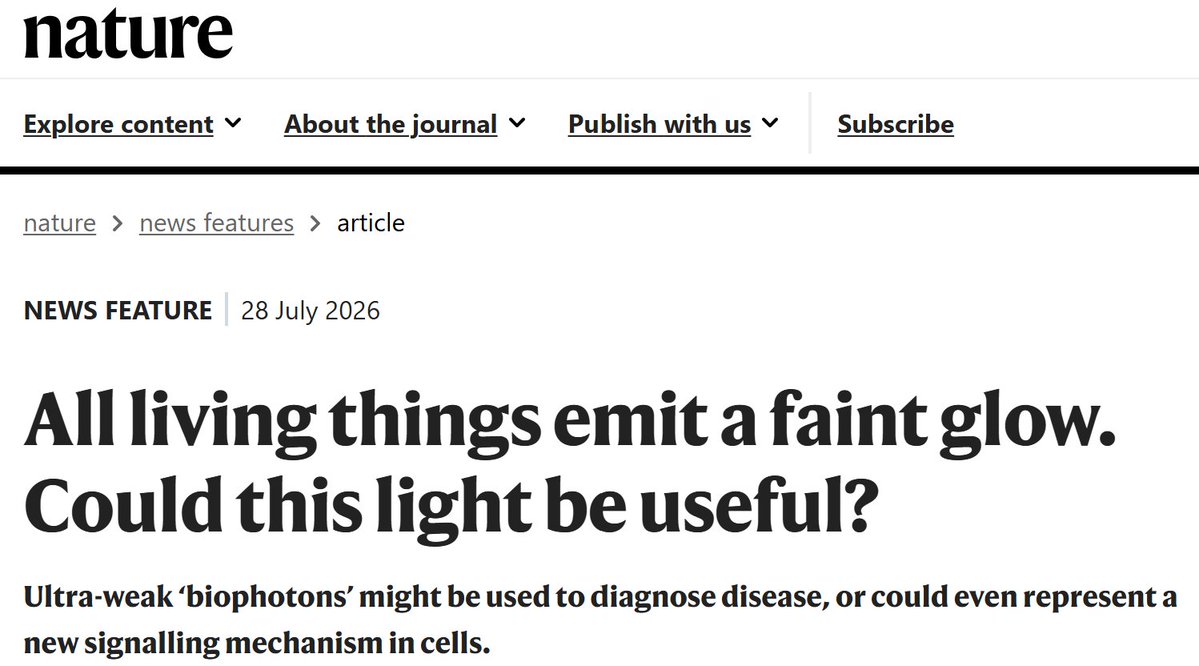
You emit light.
Expanding biology beyond molecules allows us to consider another layer of life: how energy, including light, may reflect and perhaps help coordinate biological activity.
Thank you to @JoMarchant and @Nature for featuring our work alongside other leaders in the field, and for opening a broader conversation about what might be possible, the tools we must build, and the next generation of scientists we must train.
Now, we have the opportunity to determine what the light of life is telling us.
“Nations are not powerful because they possess wide lands, safe ports, large navies, huge armies, fortifications, stores, money, and credit. They acquire those advantages because they are powerful, having devised on correct principles the political structure which allows the flow of energy to take its proper course. The question is, how; for the generator and the possible transmission lines and available outlets to either benefit or destruction are always the same.
The only difference between past and present in respect of energy is quantitative, a higher potential available at a higher flow, which makes a wrong hook-up more appalling in its effect by the given ratio, becoming apparent literally in a world explosion. The principles of the conversion of energy and of its appropriate mechanism for human use cannot change; these are universals.”
The God of the Machine, Isabel Paterson (1943)
New preprint with @GiovanniPezzulo :
https://t.co/migcMiTGA2
Bootstrapping Life-Inspired Machine Intelligence: The Biological Route from Chemistry to Cognition and Creativity
"Achieving advanced machine intelligence remains a central challenge in AI research, often approached through scaling neural architectures and generative models. However, biological systems offer a broader repertoire of strategies for adaptive, goal-directed behavior - strategies that emerged long before nervous systems evolved. This paper advocates a genuinely life-inspired approach to machine intelligence, drawing on principles from biology that enable robustness, autonomy, and open-ended problem-solving across scales. We frame intelligence as flexible problem-solving, following William James, and develop the concept of cognitive light cones to characterize the continuum of intelligence in living systems and machines. We argue that biological evolution has discovered a scalable recipe for intelligence - and the progressive expansion of organisms' "cognitive light cone", predictive and control capacities. To explain how this is possible, we distill five design principles - multiscale autonomy, growth through self-assemblage of active components, continuous reconstruction of capabilities, exploitation of physical and embodied constraints, and pervasive signaling enabling self-organization and top-down control from goals - that underpin life's ability to navigate creatively diverse problem spaces. We discuss how these principles contrast with current AI paradigms and outline pathways for integrating them into future autonomous, embodied, and resilient artificial systems."
Very excited to be launching our new Substack, "The Science and Experience of Energy" w/ @MitoPsychoBio and the rest of the wonderful team.
We are used to studying the world through molecules and mechanisms, but our lived states are also patterns of energy and information.
Our goal with this new digital space is to reach beyond the scientific silos to share ideas, connect with you, and build community to reshape how we understand health, experience change, and remain aware of what is now clearly emerging.
Here we go....!
https://t.co/6RveC3pG0D
The Birch and Swinnerton–Dyer Conjecture is one of the deepest unsolved problems in mathematics
Though still unproven, visualizing its structures reveals something unmistakable: elegant geometry, hidden order, and patterns far too coherent to feel accidental
@mkoeris My father was a disabled Korean and Vietnam war veteran. Excited to see this progress, as well as continued pain management for veterans off combat.
NSF is launching one of the most ambitious experiments in federal science funding in 75 years.
The program is called Tech Labs, and the goal is to invest ~$1 billion to seed new institutions of science and technology for the 21st century.
Instead of funding projects, the NSF will fund teams. I’m in the @WSJ today with a piece on why this matters (gift link): https://t.co/xteQ3NgWVC
Here’s the basic case:
1) Most federal science funding takes the form of small, incremental, project-based grants to individual scientists at universities.
2) The typical NSF grant is ~$250k/year to a professor with a couple of grad students and modest equipment over a few years. This is a perfectly reasonable way to fund some science, but it's not the only way.
3) A healthy portfolio needs more than one instrument. Project-based grants are like bonds: low-risk, steady, safe. But no one trying to maximize long-run returns would put 70% of their portfolio in bonds.
4) Yet that's basically what our civilian science funding portfolio looks like. Around 3/4ths of NSF and NIH grant funding is project-based.
5) Tech Labs is NSF's attempt to diversify that portfolio. The Tech Labs program is aiming for:
- $10-50 million/year awards per team
- 5+ year commitments
- Measuring impact through advancement up the Tech Readiness Level scale rather than papers published
- Up to ~$1 billion for the program
- Supporting research orgs outside traditional university structures
6) Scientific production looks very different than it did when the NSF launched 75 years ago. The lone genius at the chalkboard can only do so much. Frontier science + tech today is increasingly team-based, interdisciplinary, and infrastructure-intensive.
7) The team behind AlphaFold just won the Nobel Prize in Chemistry. It came from DeepMind, an AI lab with sustained institutional funding and full-time research teams. It would be near-impossible to fund this kind of work on a 3-year academic grant.
8) Same pattern at the @arcinstitute (8-year appointments, cross-cutting technical support teams) and @HHMIJanelia (massive infrastructure investments to map the complete fly brain). Ambitious science increasingly needs core institutional support, not a series of project grants stapled together.
9) Similarly, Focused Research Organizations (@Convergent_FROs) have showcased a new model supporting teams with concrete missions and predefined milestones to unlock new funding.
10) There’s a whole ecosystem of philanthropically-supported centers doing amazing research, like the Institute for Protein Design, the Allen Institute, the Flatiron Institute, the Whitehead Institute, the Wyss Institute, the Broad — the list goes on.
11) But philanthropy can’t reshape American science alone. The federal government spends close to $200 billion each year on research and development, an order of magnitude more than even the largest foundations.
12) If we want to change how science gets done at scale, federal funding has to evolve. And the NSF and NIH don’t have dedicated funding mechanisms to support or seed these sorts of organizations.
13) Earlier this year, I started working on a related framework called “X-Labs” that built on all this exciting institutional experimentation that’s been happening within the private and philanthropic sectors. It’s time for the federal government to step into the arena: https://t.co/0iVLobqQeA
14) Traditional university grants are still important for training the next generation of scientists and for certain kinds of curiosity-driven work. But after 75 years of putting nearly everything into one model, we should try something different.
15) And key program details are still being developed! You can reply to the Request for Information with suggestions or feedback on how to design this program here: https://t.co/R6MNo0ZfN1
16) Science is supposed to be about experimentation. Science funding should be too.
Check out our continuously updating page for the Platonic Space symposium https://t.co/ikhEx5Ppxn - some great new talks added recently. @DrTomFroese, @KarlFristonNews, @ThouArtThat, @blaiseaguera, J. P. Aguilera (https://t.co/Z7pBPN8q33), @akarshkumar0101, Chris Fields (https://t.co/cKowXz5reT), Lauren Ross (https://t.co/zXi1f63AXX), Lucy Spouncer (https://t.co/0pqp0wSCHe), Mariana Emauz Valdetaro (https://t.co/DTNDC8o5ev), @okw, Ben Lyons (https://t.co/WSLs3efgTA), Alexey Tolchinsky (https://t.co/eJGcx7LhsH), Joel Dietz (https://t.co/8taLeqfoGt), and more coming!
Light as an instructive signal for biology is finally getting the attention it deserves!
Way to go @hubermanlab & Glen Jeffery for highlighting the importance of light in living systems beyond conventional topics like circadian rhythms & visual perception.
Brain health, metabolism, aging, and so many other facets of human health are impacted by the artificial & natural light all around us. Medicine, public health, and even architectural design must thoughtfully integrate this information.
And.... while this conversation focuses on how external light influences the body, an equally important frontier is emerging: the internal light we emit ourselves: ultra-weak photon emissions/biophotons.
I hope this step into photobiology opens the door for deeper discussions about the body’s own light signals.
Had the honor of joining a roundtable with @drmichaellevin @msahsorin & @tlhammett to hear @StuartHameroff present his newest version of Orch-OR, showing microtubules as fractal time crystals. Lots of new, never before heard concepts shared here!
https://t.co/M57Os6bVld
Great discussion with @MitoPsychoBio and @drmarkhyman on why our bodies aren't fixed blueprints but dynamic energy systems.
Perhaps our health reflects how the body handles these energy constraints, and what we call unconventional therapies may help because they modify the basic physical conditions that shape metabolic and repair responses.
Full video here: https://t.co/CkJTJGqEVo
Question - putting this into further context with diabetes, curious if y’all have reviewed how GLP-1s are impacting ERP? Ex: There’s evidence that activation of GLP-1 signalling (via agonists) can increase thermogenesis, especially via activation of brown adipose tissue and browning of white adipose tissue (at least in pre-clinical models).
Relates back to the discussion of heat being either dissipated inefficiently or used for work
By popular demand, there will be an Energy-ERP Part 2.
In this discussion we will focus on an energy-based understanding of diabetes and insulin resistance.
With @msahsorin
Link to register: https://t.co/SlsMsf1U2d