new micro-essay: "You Must Change Your Feed" — how and why to take back your Facebook feed from the algorithm, and find what you actually want to want. Plus related life tips from #Rumi and #Rilke. Latest in my #Possibilist newsletter:
https://t.co/8I33sLj0mU
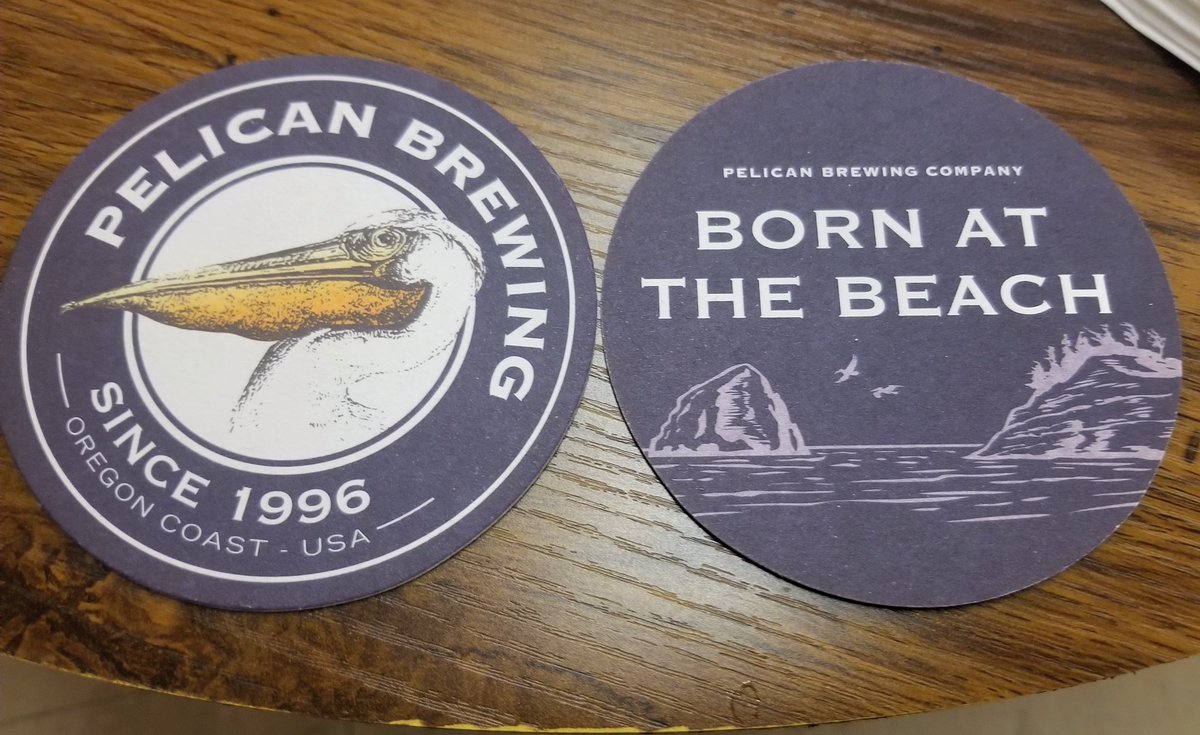
@anthropam "Born at the Beach"… relatable. The slogan of #PelicanBrewing, one of my favorite #Oregon craft breweries — the original location is beachfront in #PacificCity.
[I just happened to have these coasters in front of me, made me think of you and the thread!👋]
@anthropam ah thanks. looks like really a dream adventure for me, unfortunately not very plausible, for reasons including I have a house/farm-stay gig in July already. I'll be there in spirit, and be keen to see what emerges!
@karpathy pleased to discover that what I've been developing lately for research/writing is in many ways fairly close to that of #AndrejKarpathy — legend, inventor and term-coiner of #VibeCoding! [my prototype system: #Toposcope]
https://t.co/ElzWBqR5Zp
@karpathy pleased to discover that what I've been developing lately for research/writing is in many ways fairly close to that of #AndrejKarpathy — legend, inventor and term-coiner of #VibeCoding! [my prototype system: #Toposcope]
https://t.co/ElzWBqR5Zp
LLM Knowledge Bases
Something I'm finding very useful recently: using LLMs to build personal knowledge bases for various topics of research interest. In this way, a large fraction of my recent token throughput is going less into manipulating code, and more into manipulating knowledge (stored as markdown and images). The latest LLMs are quite good at it. So:
Data ingest:
I index source documents (articles, papers, repos, datasets, images, etc.) into a raw/ directory, then I use an LLM to incrementally "compile" a wiki, which is just a collection of .md files in a directory structure. The wiki includes summaries of all the data in raw/, backlinks, and then it categorizes data into concepts, writes articles for them, and links them all. To convert web articles into .md files I like to use the Obsidian Web Clipper extension, and then I also use a hotkey to download all the related images to local so that my LLM can easily reference them.
IDE:
I use Obsidian as the IDE "frontend" where I can view the raw data, the the compiled wiki, and the derived visualizations. Important to note that the LLM writes and maintains all of the data of the wiki, I rarely touch it directly. I've played with a few Obsidian plugins to render and view data in other ways (e.g. Marp for slides).
Q&A:
Where things get interesting is that once your wiki is big enough (e.g. mine on some recent research is ~100 articles and ~400K words), you can ask your LLM agent all kinds of complex questions against the wiki, and it will go off, research the answers, etc. I thought I had to reach for fancy RAG, but the LLM has been pretty good about auto-maintaining index files and brief summaries of all the documents and it reads all the important related data fairly easily at this ~small scale.
Output:
Instead of getting answers in text/terminal, I like to have it render markdown files for me, or slide shows (Marp format), or matplotlib images, all of which I then view again in Obsidian. You can imagine many other visual output formats depending on the query. Often, I end up "filing" the outputs back into the wiki to enhance it for further queries. So my own explorations and queries always "add up" in the knowledge base.
Linting:
I've run some LLM "health checks" over the wiki to e.g. find inconsistent data, impute missing data (with web searchers), find interesting connections for new article candidates, etc., to incrementally clean up the wiki and enhance its overall data integrity. The LLMs are quite good at suggesting further questions to ask and look into.
Extra tools:
I find myself developing additional tools to process the data, e.g. I vibe coded a small and naive search engine over the wiki, which I both use directly (in a web ui), but more often I want to hand it off to an LLM via CLI as a tool for larger queries.
Further explorations:
As the repo grows, the natural desire is to also think about synthetic data generation + finetuning to have your LLM "know" the data in its weights instead of just context windows.
TLDR: raw data from a given number of sources is collected, then compiled by an LLM into a .md wiki, then operated on by various CLIs by the LLM to do Q&A and to incrementally enhance the wiki, and all of it viewable in Obsidian. You rarely ever write or edit the wiki manually, it's the domain of the LLM. I think there is room here for an incredible new product instead of a hacky collection of scripts.
new micro-essay: "You Must Change Your Feed" — how and why to take back your Facebook feed from the algorithm, and find what you actually want to want. Plus related life tips from #Rumi and #Rilke. Latest in my #Possibilist newsletter:
https://t.co/8I33sLj0mU
new micro-essay: "You Must Change Your Feed" — how and why to take back your Facebook feed from the algorithm, and find what you actually want to want. Plus related life tips from #Rumi and #Rilke. Latest in my #Possibilist newsletter:
https://t.co/8I33sLj0mU
new post: Halfway Homegoing — travels across the US and Canada since August
[in my Possibilist newsletter, Dec 16th]. An update from four months on the road https://t.co/RINmWM3F2d. #HalfwayHomecoming#OCanada
@anthropam omg that is like my wildest dream: am I up for it?… I'd do almost anything to take such a dramatic & wonderful leap in life, & into SE Asia with which so far I have no direct experience of but for which have such fascination… but I don't see how, why would I qualify, be able?
@bronzeagemantis@MissSarahWise Paglia, Camille (1991). "Junk bonds and corporate raiders: Academe in the hour of the wolf." Arion: a Journal of Humanities and the Classics 1 (2), 139-212, 1991. https://t.co/WdcKPtc0H4
https://t.co/EWYB6Yvoo3
Full text of Paglia's great essay "Junk Bonds and Corporate Raiders: Academe in the Hour of the Wolf," the ultimate takedown of humanities academics, "critical theory" and especially of Foucault
Read it to inoculate yourself against this stupidity
https://t.co/OT8TXjbXhH
@michael_wiebe however, as a rhetorical/advocacy/political matter, seems like "You/we need to use careful #GeneralEquilibrium analyses" needs some branding, messaging, naming help! What are, what might be keen terms, strategies for promoting such 🤔? Eg #BigPicture, holistic, "community-level"?
@aarmlovi many great urban high-amenity areas were way more affordable in 2000 than today though right? also perhaps often less gentrified, homogenized. Eg in 2000 I was living my best life in E Village NYC studio on Tompkins Sq, rent < $1k, quite better cafes and cheap food, more diverse
@ProfSchleich "How the Gentry Won: Property Law's Embrace of Stasis." Schleicher, David and Hills, Roderick Maltman. (Feb 27, 2025). Yale Law & Economics Research Paper, Yale Law School, Public Law Research Paper, Available at https://t.co/UGcRqpk8FE c/@RickHills2#HowTheGentryWon
@michael_wiebe however, as a rhetorical/advocacy/political matter, seems like "You/we need to use careful #GeneralEquilibrium analyses" needs some branding, messaging, naming help! What are, what might be keen terms, strategies for promoting such 🤔? Eg #BigPicture, holistic, "community-level"?
@michael_wiebe yes, imo a key problem in #homelessness: local/intervention studies are cited predominantly, while far more relevant #GeneralEquibrium ie #AggregateEffects studies w/very different conclusions are widely ignored; & leading figures seem unaware of the issue
https://t.co/3FVSxVerMX
@michael_wiebe to me land value is a case study in #polarization. Opposed camps constantly use, implicitly or explicitly, different theories; often seem partial, expedient. How do we ever unwind, transcend this sort of conceptual severing that so often means people are talking past each other?
@michael_wiebe e.g. I often hear see analyses citing @TernerHousing's policy model, and that seems to take land value as static in considering a policy change, making me wonder if it could be supporting significantly incomplete/fallacious args, or this be why it diverges from empirical findings
@michael_wiebe this might seem to be refuting #ResidualLandValue approach, but really says it may be crucially incomplete. Otoh, seems to me it's common in policy discussions to ignore it, endogeneities of land value, which may also be crucially incomplete or lead to fallacious reasoning.