I don't grow food.
I grow soil.
Honestly, you could probably fix 1/3 of the nations issues - weather, flood, food quality, health, and a few others... by rebuilding soil.
I think with an approach like this you could significantly improve 1-2% of the nation's growing soils per year.
Take a natural biological process - decay of carbon materials of almost any kind, such as wood chips, straw, peanut hulls, shredded cardboard, etc. - combine with organic waste streams, supercharge with high intensity, short to mid duration animal impact, then inoculate with appropriate cover crops to deepen and mix...
You would stop billions of pounds of trash from landfills, billions of gallons of water running off land, increase nutrient density of food by spades, and more.
There are layers to getting this right and few are putting them all together. It may even surprise you guys to know that grass fed meat has a huge spread in nutrient density. It isn't all the same.
Thread time
🧵
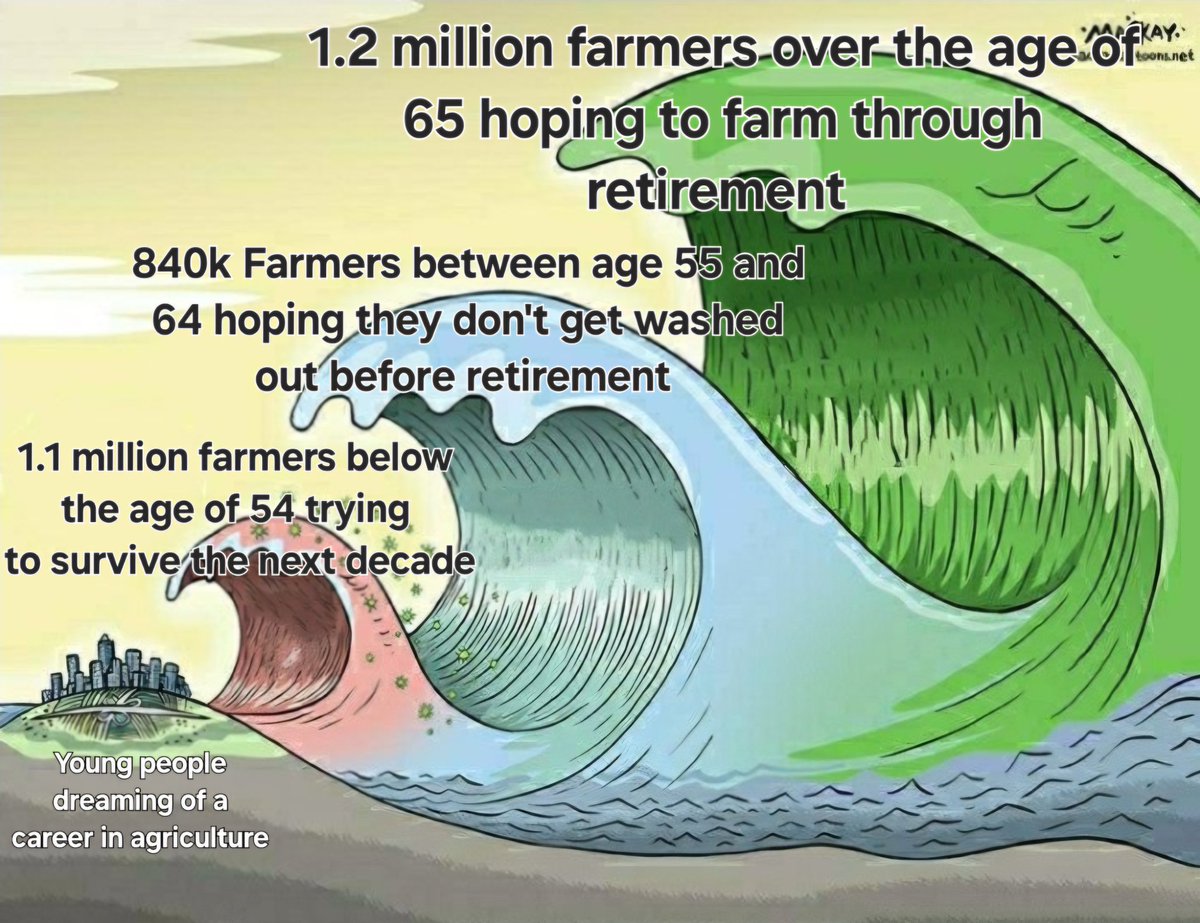
I don't think most non-ag people realize that a huge percentage of full-time farmers/ranchers live almost entirely on borrowed money throughout the year.
They take out an operating line of credit that pays for living expenses.
Interest accrues.
Then they hope to have a crop to sell, valuable enough to repay the loan P&I and their other term loans, with a few bucks left over to reinvest in the operation.
I'm not sure of another occupation where this is common practice.
It goes hand in hand with regen ag. Younger generations look at land as a living being to steward, While older gens look at is as a tool to make money. Both gens can learn from each other, but one gen has 95% of the wealth. Thats how you get our current national soil situation
@untappedgrowth has figured out the core issue that needs to solved in ag and has the solution to “scale” regenerative ag.
It’s not about getting more corporations involved or about realigning consumer preferences or whatever the latest talking point is.
Give this a listen 👇
Two decades ago, researchers started an experiment that would challenge the prevailing scientific understanding of plant communities.
While modern agriculture treats diversity as inefficient, the Jena Experiment proved the opposite: complexity is the key to resilience.
@jonathanrawles@TornadoNate Been a good number of years now. We followed his method animal impact and rest. the whole idea eventually morphed into adaptive grazing. It's hard to know where his ideas ended and the cumulative experience of his early followers adapting his methods to their own context began.
The Vibe Shift in America is Underway 🇺🇸
I talked with @santiagopliego about the vibe shift, culture wars, backing companies defined by American ideals and positive national vision, DEI and ESG, bitcoin, and creating solutions.
Full episode on X. This was a banger - enjoy :)
“It is the tragedy of American society that we have used our land, not to establish a nation of independent farmers and home owners, but to indulge in gigantic speculation in real estate,”
https://t.co/oRwXZFgqfe
“It is the tragedy of American society that we have used our land, not to establish a nation of independent farmers and home owners, but to indulge in gigantic speculation in real estate,”
https://t.co/oRwXZFgqfe
“we have raised enough grain this year to feed us and all our decedents for 100 years yet have to sell every bushel of it to pay expenses.”
The above quote best illustrates the dilemma caused by government subsidies and money printing.
I'm working through American history writing about the forces that destroyed agrarianism.
My third essay in the series spans the Civil War through the turn of the 20th cen.
This one covers the governments use of subsidies as a tool that brought many western farmers to ruin.
I'm working through American history writing about the forces that destroyed agrarianism.
My third essay in the series spans the Civil War through the turn of the 20th cen.
This one covers the governments use of subsidies as a tool that brought many western farmers to ruin.