Every child has an inner mathematician, and our mission is to nurture it through play. Teachers and parent join us in making maths an adventure, not a chore.
@MEIMaths The combination of problem solving and team discussion is what makes Ritangle distinctive. It gives students space to test partial ideas rather than racing straight to an answer.
@arithmagicians Splitting ×12 into ×10 and ×2 keeps the distributive structure visible. Once pupils can explain 7×12 as 70+14, the method becomes reusable rather than another rule to memorise.
@GemsKs2 The mix matters here: short daily practice builds recall, while games and challenges reveal whether pupils can use facts flexibly. Both are needed for genuine fluency.
@CasioMaths Treating the calculator as a tool for conjecture can change the lesson completely: vary one input, predict the effect, then explain the pattern. Checking becomes only one of several mathematical uses.
@Advanced_Maths Curriculum sequencing and supporting colleagues are often the two hardest parts of stepping into KS5 leadership. Treating both as learnable practices should give new coordinators a useful starting point.
@robertkaplinsky Digits 1 to 9 only, so x to a positive power stays positive across the interval and the sign can come from one place: whether the lower limit exceeds the upper. A good way to drag swapped limits into the open, since they usually arrive as a rule rather than a consequence.
@jamestanton Nice that n = 1 gives the familiar pair 2 and 4. Since (1+1/n)^n climbs to e while (1+1/n)^(n+1) falls to it, every one of these pairs straddles x = e, which is exactly where ln x / x peaks and where the two branches of the curve meet.
@d_welshbest Worth splitting: index laws are about combining exponents, while this one is (ab)^n = a^n b^n, and the error is not misremembering a rule but failing to see the sign and coefficient as part of the base. It resurfaces in b^2 in the quadratic formula.
@KarenCampe The 'how many ways over the month' framing is the part I'd keep: three methods on one problem gets more discussion than thirty done once, since comparing methods is where the reasoning shows. Do the older Mathematics Teacher problems reward changing representation more?
@UKMathsTrust The odd dimension is what costs you: the 2 by 2 by 6 part takes three 2-cubes, but the leftover slab is only one inch thick, so it can only go into 12 unit cubes. Change the block to 2 by 4 by 6 and the whole thing is six 2-cubes, which makes a neat follow-up question.
@pwharris The 1/16 rung is where the work happens: once 1/8 is 8 oz, halving gives 4 and 3/16 falls straight out as 12. Then 15/16 tells you whether they are iterating sixteenths or taking 4 off the whole 64.
Dividing fractions. Do you teach 'keep, change, flip' first and reason later, or withhold the trick until they can explain why it works?
Both camps have a real argument. Which are you, and did you ever switch?
#MathsTwitter#mathschat#EduTwitter
@LaSalleEd Choosing sessions is half the challenge with a schedule like this. Going in with one question you want answered can make the day much easier to turn into classroom action.
@Advanced_Maths Starting with the maths behind models makes AI feel less like a black box. Pairing that with Python and real data gives students something concrete to test and question.
@arithmagicians Compensation is so useful here because pupils can see the total stays balanced: add 3 to 17, subtract 3 from 24. Making that equivalence explicit often helps the strategy stick.
@GemsKs2 Linking each strategy to year-group objectives should make progression much easier to see. It also helps avoid mental maths becoming a collection of disconnected tricks.
First week back and you can already spot the Year 7s who have decided they are 'not a maths person'.
What gives it away first for you: the hedging, the rubbing out, or waiting to be told they got it wrong?
#MathsTwitter#mathschat#iteachmath
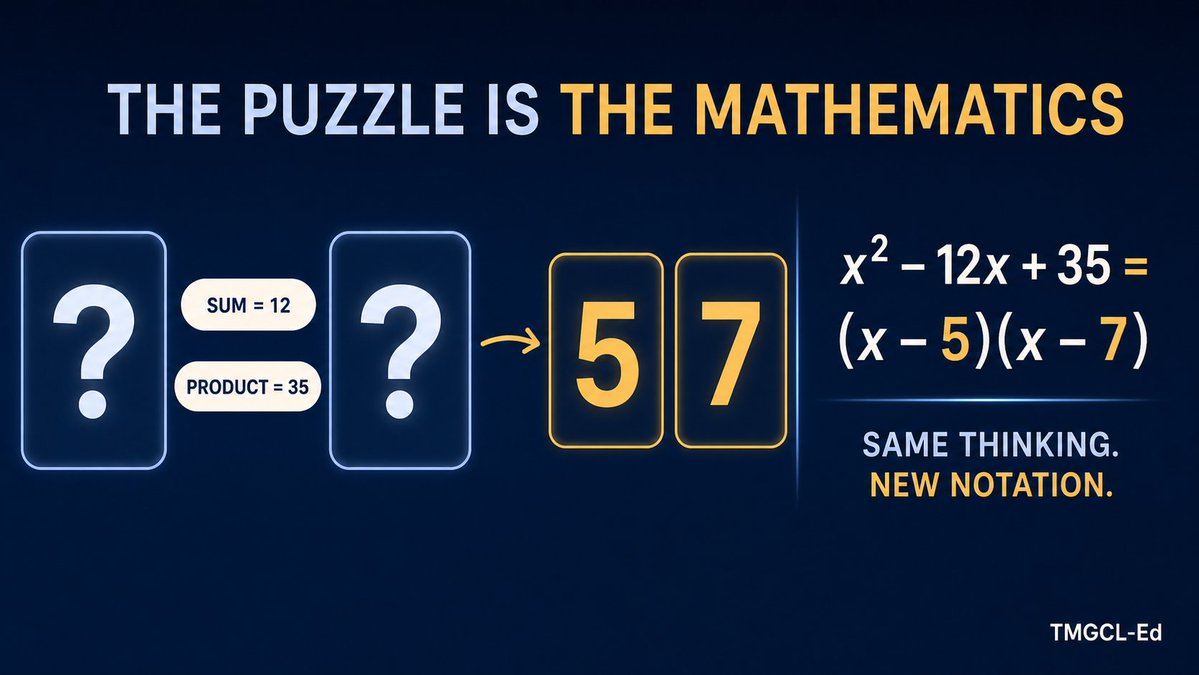
Two hidden numbers add to 12 and multiply to 35. Year 7s find 5 and 7 by reasoning. In Year 10, the same thinking factorises x² − 12x + 35. The puzzle is the maths; notation names it. Does teaching it in that order work? #MathsEducation#GCSEMaths#KS3Maths
Seating plans get set for behaviour. But motivation is contagious - lower attainers gain from sitting beside stronger habits (Kobe Desender, cited in Tes today).
If motivation travels desk to desk, teams are the same lever at scale.
#MathsTwitter#TeacherTwitter#numeracy