So, the same people that thought the assassination attempt in butler was staged are offended because we think that ilhan smollett's attack was staged are upset?
The most persistent climate scare story over the last two years has been this hypothesis that a vital North Atlantic Ocean current, the Atlantic Multidecadal Overturning Circulation (AMOC), will collapse by the end of the century, if not sooner.
The implication of this would be that Europe get sent into the icebox as surface air temperatures drop by at least 1°C per decade, eventually stabilizing at 5-15°C below current averages (Westen et al., 2024). This will then trigger Arctic sea ice expansion, probably causing the rest of the Northern Hemisphere to cool as well, albeit to what extent is uncertain.
🔗https://t.co/kbbSY4t4AL
From a climate pant soiler's point of view, I don't really see why this would inherently be a bad thing considering that they, most of whom live in western Europe (especially the United Kingdom), think that the planet is too hot and that the climate during the Little Ice Age was more ideal for human civilization. But, who am I kidding, they're never consistent.
Now, for the laypeople out there, what exactly is the AMOC?
Well, ocean water is always being circulated around the globe by ocean 𝑐𝑢𝑟𝑟𝑒𝑛𝑡𝑠. And, there are three main types of ocean currents.
1⃣ 𝑇𝑖𝑑𝑎𝑙 – driven by the gravitational effects between the Earth, moon and sun
2⃣ 𝑆𝑢𝑟𝑓𝑎𝑐𝑒 – driven by wind speed and direction
3⃣ 𝐷𝑒𝑒𝑝 𝑤𝑎𝑡𝑒𝑟 – currents that extend from the ocean surface to the sea floor; they are driven by density gradients resulting from changes in salinity and water temperature.
The last one is critical to understanding the AMOC.
🌡️ Cold water is denser than comparatively warmer water, so it sinks.
🧂 Saltwater is denser than freshwater, so it sinks as well.
These large and slow-moving deep ocean currents are what oceanographers call the 𝑡ℎ𝑒𝑟𝑚𝑜ℎ𝑎𝑙𝑖𝑛𝑒 𝑐𝑖𝑟𝑐𝑢𝑙𝑎𝑡𝑖𝑜𝑛. 🔁
One of these conveyor belts is in the Atlantic Ocean, and it is called the “Atlantic Multidecadal Overturning Circulation” (AMOC). This current is responsible for transporting warm, tropical water poleward and vice versa. Warm water in the tropics is carried north by the Gulf Stream, a surface-based current. As the water flows poleward, it cools and some of it will eventually freeze, forming sea ice. 🧊
When water freezes, it leaves the salt behind in the cold (but not frozen) liquid water, which makes the water denser, causing it to sink and be carried back to the equator where it eventually becomes warm enough once again to rise to the surface, and then the process repeats itself.
🔗https://t.co/0vp8Qw7X7C
However, this process is extremely slow! 🐢
1 m³ of water is estimated to take over 1,000 years just to complete the cycle. 🕑
Although the process itself is slow, there have been a few papers published that suggest the AMOC is weakening due to high freshwater melt flux off of the Greenland ice sheet. Caesar et al. (2018), for example, found that AMOC speed has declined by 15% since 1950. The follow-up paper, Caesar et al. (2021), found that it the AMOC is 20% weaker now than it was during the mid-20th century.
🔗https://t.co/MtHgIyC6gG
🔗https://t.co/DphKabLl7I
Weakening has also been suggested in other recent papers such as aforementioned Westen et al. (2024) and the paper of interest here, Ren et al. (2025), which was just published in the journal Nature Communications Earth & Environment.
🔗https://t.co/ZnzmO6XE6L
These studies contend that the AMOC is nearing a “tipping point” due to Greenland ice sheet-induced freshwater melt flux. If it isn't stopped, some scientists suggest it could raise sea levels significantly along the east coast of the U.S. while causing Europe to cool rapidly, as mentioned earlier.
However, there is significant disagreement about this because AMOC strength is not directly measured, and different proxies are used to estimate its strength (e.g. subpolar North Atlantic sea surface temperatures, air-sea heat flux, etc.). Several other recent studies found that the AMOC has actually been remarkably stable, or at the very least, 𝑟𝑒𝑠𝑖𝑙𝑖𝑒𝑛𝑡 (e.g., Fu et al., 2020; Parker & Ollier (2021); Worthington et al., 2021; Latif et al., 2022; and Terhaar et al., 2025).
🔗https://t.co/OKhZSu33LM
🔗https://t.co/ovJWaOAkQH
🔗https://t.co/YKEG8Kc0nY
A couple of these are interesting:
In Fu et al. (2020), the authors assembled a multi-decadal observational data set drawing on repeated hydrographic section measurements in both the subtropical and subpolar North Atlantic spanning from the early 1990s through the 2010s. Contrary to climate model projections, the study found no robust decline in observed AMOC transport in the Atlantic over the last three decades. The transport estimates in the most recent decade are “not distinctly different” from those in the early 1990s.
🔗https://t.co/AJlr5gnNU8
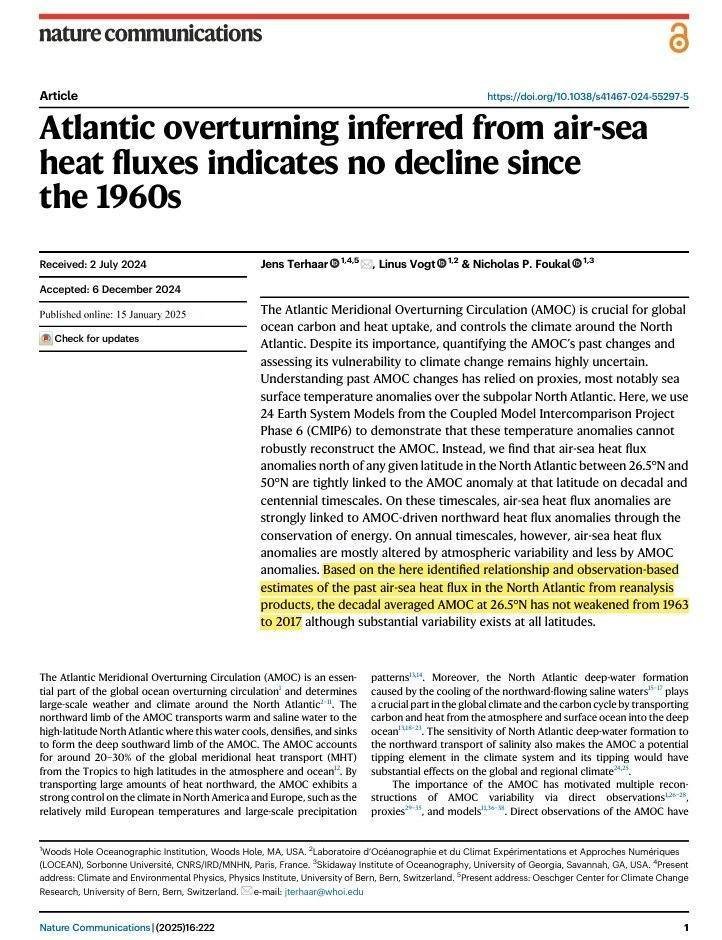
And, in Terhaar et al. (2025), the authors used air-sea heat flux in the North Atlantic from 26.5-50°N as an AMOC strength proxy. They found no AMOC weakening over a longer period, specifically between 1963 and 2017.
🔗https://t.co/5tiACrZIJC
In many of the modeling studies, scientists can only get the AMOC to collapse (i.e., shut down) by imposing a strong and unrealistic freshwater forcing in their models and running it for several centuries. Westen et al. (2024), for instance, put in a freshwater forcing from Greenland ice sheet melt that translated to a sea level rise (SLR) rate of 6 cm / year, which is greater than the rate caused by the collapse of the ice sheet covering North America at the end of the last glacial maximum.
In fact, under that forcing, the authors had to run the model 400 years before natural variability's dominance waned and then out to virtual year 1,750 to get the AMOC to shut down. This is unrealistic, even under the IPCC's worst-case, high-emission SSP5-8.5 / RCP8.5 scenario.
While the AMOC has never completely shut down (to our knowledge) in historical records, it has slowed down in the past naturally (that had nothing to do with us) and that too can have similar, albeit less severe downstream impacts. In any case, based on all of the weight of evidence here, I fail to be convinced that this is something seriously worrying about.
Future projections on AMOC strength are speculation based on modeling and questionable assumptions; they're far from scientific fact.
A few words on "equity," perhaps a few years too late.
What does "equity" really mean, and how does that compare with how we encounter it, and why and how did this shift occur?
Equity is an eternally old concept. Indeed, it is biblical. A fundamental Jewish and Christian belief is that God will, in his perfect justice, resolve all inequities. This tells us what it really means: it means receipt of one's just desserts.
This use of the term is reflected in its other common usages, say in finance, capital holdings, or real estate. Equity refers to your ownership interest minus liabilities, or, in other words, how much ownership you can justly claim is yours.
Obviously, in terms of so-called Woke "social justice," which is the basis for the related but less-discussed concept of "social equity," the term means something else. In fact, it refers specifically not just to social equity but to administered social equity. That is, it refers to "social justice" (group equality) produced by redistribution of shares by some administrative entity, usually the state.
The difference in the two usages of the term can be ascribed to two fundamentally different perspectives on fairness, one real and the other socialist fantasy.
In reality, your just desserts (equity) are a return on your investments into value produced (not merely outlay, risk, or effort provided). Equity refers to the state of there being a high rate of faithful correspondence between value produced and return obtained (just desserts). An inequitable situation is one in which this degree of correspondence is low such that some people are getting poorer return while others are getting greater return than they deserve based on how much value they are producing.
In the socialist fantasy, everyone is entitled to a relatively high rate of return regardless of value produced. People who produce more are expected to contribute more specifically so that people who produce less are able to get a greater return. These desserts are "socially just," not actually just, based upon appeals to some principle of humanitarianism, egalitarianism, or intrinsic socialism either alongside or superseding the principle of correspondence between value provided and return expected.
This "social equity," being unjust in the sense of having low faithfulness to the correspondence between value produced and reward expected, ends up dragging down the system. Like it or not, callous or not, causing harm or not, people are profoundly demotivated by being expected to perform in an unfair system where fairness is defined in the objective way of getting roughly what you deserve and not getting roughly what you don't deserve.
Entitlement, appeals to humanitarianism, charity, empathy, compassion, egalitarianism, or intrinsic socialism nearly always fail to override the basic human sensitivity to actual equity (fairness) in return. This is why socialism (a) will not work, (b) is immoral, and (c) is immoral to force upon people because it will not work.
Unless you can demonstrate actual and objective arbitrary or unjust impediment in your circumstances, you will not succeed in overriding this extremely fundamental aspect of human nature. Feeling or perceiving "injustice" is not sufficient, particularly not for justifying state action.
Charity is another matter, and it is also a biblical value to participate in it. People in tough situations can appeal to any of those alternative principles or others to inspire people to voluntarily redistribute their own resources, or those they can amass from voluntary others, to the "needy." No one thinks this is unfair because it is all voluntary.
The voluntary nature of not just charity but also other forms of exchange and trade is central to understanding equity versus social equity. As always, the underlying incentives tell the story.
In voluntary exchanges (including free enterprise and charity giving), a primary underlying incentive is not to waste one's own resources (capital, money, whatever). Therefore, exchanges (including charity) will only occur when any party that is parting with some of its private property (capital, money, whatever) believes it obtains higher value in exchange for having done so. This fundamental incentive is the incentive of positive-sum games, so, the production of wealth and abundance.
Voluntary exchange, which is dependent upon the secured right to private property, encourages innovation and ingenuity for solving problems for yourself and that have solutions others might benefit from, so it produces a higher quality of life by solving problems for self and others. It also incentivizes both efficiency and economy in doing so because the primary incentive is to minimize one's own outlay of resources for the expected value of the return in the exchange.
What results in a system where this is the primary guiding principle is that efficiency and economy in activity are incentivized, as is producing a salable surplus within one's range of comparative advantage, as is the peace-promoting conditions of mutual trade, as is innovation and ingenuity in solving problems and doing so in better ways.
In return, people engage in voluntary exchange because they are able to increase their held value on both sides of the exchange, which is a just dessert of solving problems efficiently and economically. That is, equity results. It may not be perfect, but there's an accurate perception that the reward one can expect to receive for participating corresponds rather faithfully to the value produced. Because voluntary exchange also includes the fundamental right to exclude, there is also negotiating leverage to help that correspondence become more faithful when and where it deviates.
So, voluntary exchange produces lots of great things including the three E's: efficiency, economy, and equity.
The problem is that the state doesn't have any of these incentives because the state is always a third-party actor. It is using other people's money to achieve ends that other people make use of. It is never a true first-party actor in the economic domain, even when it tries to force itself into being one through systems like Fascism and Socialism. This is because it, if nothing else, retains a monopoly on force and can therefore compel participation (say, taxation or even work camps). It also cannot "lose everything," save by collapsing as a state (which mostly harms its citizens), so it doesn't have the same incentives toward economy or efficiency that a private actor does.
The state does engage in relevant activity, though, and we generally want it to, at least on some level. It therefore has to simulate efficiency and economy through policy because it lacks the incentive structures to get to them organically. These policies are always inadequate to reality, and they are frequently corrupt (or end up corrupted, often badly). State actors don't have great incentives to fix these problems and often do have (bad) incentives to increase or take advantage of them.
Back in 1968, the field of public administration was doing what everything else was doing under influence of the New Left. It was grappling with this idea that public administration had a duty toward "social justice." It concluded that efficiency and economy were not sufficient as a basis for public administration policy and guidance and that equity had to be introduced.
The problem is that since the state is always a third-party actor, how on Earth can it be expected to produce or have "just desserts," which is what equity actually means? What are the state's "just desserts"?
Like with policies for efficiency and economy, public administration adopted policies for "equity," which it took as social equity, meaning equity by groups (on average). H. George Frederickson later explained: "In 1981, the ASPA Professional Standards and Ethics Workbook and Study Guide for Public Administrators, in the section on professional ethics, listed as the first two Principles to be the pursuit of equality, which is to say citizen A being equal to citizen B, and equity, which is to say adjusting shares so that citizen A is made equal to citizen B" (bold added).
So within the field of public administration, looking back to the late 1960s, the "equity" policy it would adopt for itself was ultimately one of "adjusting shares to make citizens equal," which is known as socialism. Equity, or "actual equality" as the Soviets called it, made its way in under the guise of public administrators allegedly having a responsibility to create more just desserts than the market seems to have allowed for.
This notion is the basis in public administration of "social equity theory" which seeks to generate "socially just desserts," or "social justice." Public administration (the state) has absolutely no mechanisms for achieving genuine equity (faithful correspondence between value produced and rewards expected) and can only generate injustices and iniquities according to the real meaning of the term, but nevertheless they persisted.
Just as the state can only simulate efficiency and economy through policy, it can also only simulate equity, which requires it to have some model for what it believes "just desserts" must look like. Since there's no way it can deal with this on an individual level, to begin with, and because it took place in the 1960s, under the undeniable influence of Marxists, the model it accepted is "social equity," which is to say "social justice," which is to say socialism according to the group-based analysis dictated under Soviet programs of "actual equality" (Фактическое равенство).
The "Social Justice Warriors" of the New Left, particularly in Critical Legal Studies circles and public administration, took off with this idea and developed the program heavily, not least under the doctrines of Affirmative Action and Disparate Impact discrimination analysis. These were the vehicles of Woke "equity" as we know it today (social equity as an element of "social justice").
In both of these programs, public administrators (the state) would examine the outcomes of a free system to see if they produced equal outcomes by group and then adjust shares so that the group outcomes would be made more equal (on average, not at the level of any individuals). Absolutely none of the incentives is aligned correctly for anything except zero-sum and negative-sum identity politics and entitlements, and as a result, the organic incentives in the "adjusted" groups (in both directions) are undercut and corrupted. The results we can see. It's a total catastrophe in virtually all ways.
So this is the story of how equity, which means "just desserts" got twisted into (social) Equity, which means socialism with identity-group characteristics. It cannot work. It is not moral. It cannot be made successful or moral, no matter how good someone's intentions. The underlying incentives are all wrong for the state and only exist under the conditions of voluntary exchange.
So what role does the state have? It has the role of securing the means of voluntary exchange. Where the ASPA Guide for Public Administrators called for a principle of equality, "which is to say citizen A being equal to citizen B [under the law and application of public administration policy]," there it should have stopped. Affirmative Action and Disparate Impact analyses need to be completely thrown out. The Civil Rights Act(s) need to be pulled back in alignment with the Equal Protection Clause of the 14th Amendment as it was intended. The state has a role in doing this.
In fact, as indicated in the American Declaration of Independence, one of the few just powers of the state is in taking pains to secure the unalienable rights of free citizens, which includes their right to private property, the fundamental right to exclude that goes along with that, and thus the right to exchange their own private property on terms they find acceptable to themselves. Protecting private property and equality under the law are therefore roles for the state that most citizens are willing to pay their taxes to fund.
Why should the state do this? Because if it believes in equity, which is to say just desserts, which is to say justice, then it must. If it does not believe in those things, it has no business being a state over a free people, as has also always been the American way and is also given in our Declaration of Independence.
Equity means just desserts. Just desserts are the result of our secured rights, particularly to property. Socialism, which is the state meddling in these affairs to create "more just" desserts (social equity, actual equality, socialism, etc.) will always interfere with the underlying incentive structures that produce equity in the first place and will therefore always fail. Socialism is therefore always immoral and will never work.
Thank you for your attention to this matter!
A few words on "equity," perhaps a few years too late.
What does "equity" really mean, and how does that compare with how we encounter it, and why and how did this shift occur?
Equity is an eternally old concept. Indeed, it is biblical. A fundamental Jewish and Christian belief is that God will, in his perfect justice, resolve all inequities. This tells us what it really means: it means receipt of one's just desserts.
This use of the term is reflected in its other common usages, say in finance, capital holdings, or real estate. Equity refers to your ownership interest minus liabilities, or, in other words, how much ownership you can justly claim is yours.
Obviously, in terms of so-called Woke "social justice," which is the basis for the related but less-discussed concept of "social equity," the term means something else. In fact, it refers specifically not just to social equity but to administered social equity. That is, it refers to "social justice" (group equality) produced by redistribution of shares by some administrative entity, usually the state.
The difference in the two usages of the term can be ascribed to two fundamentally different perspectives on fairness, one real and the other socialist fantasy.
In reality, your just desserts (equity) are a return on your investments into value produced (not merely outlay, risk, or effort provided). Equity refers to the state of there being a high rate of faithful correspondence between value produced and return obtained (just desserts). An inequitable situation is one in which this degree of correspondence is low such that some people are getting poorer return while others are getting greater return than they deserve based on how much value they are producing.
In the socialist fantasy, everyone is entitled to a relatively high rate of return regardless of value produced. People who produce more are expected to contribute more specifically so that people who produce less are able to get a greater return. These desserts are "socially just," not actually just, based upon appeals to some principle of humanitarianism, egalitarianism, or intrinsic socialism either alongside or superseding the principle of correspondence between value provided and return expected.
This "social equity," being unjust in the sense of having low faithfulness to the correspondence between value produced and reward expected, ends up dragging down the system. Like it or not, callous or not, causing harm or not, people are profoundly demotivated by being expected to perform in an unfair system where fairness is defined in the objective way of getting roughly what you deserve and not getting roughly what you don't deserve.
Entitlement, appeals to humanitarianism, charity, empathy, compassion, egalitarianism, or intrinsic socialism nearly always fail to override the basic human sensitivity to actual equity (fairness) in return. This is why socialism (a) will not work, (b) is immoral, and (c) is immoral to force upon people because it will not work.
Unless you can demonstrate actual and objective arbitrary or unjust impediment in your circumstances, you will not succeed in overriding this extremely fundamental aspect of human nature. Feeling or perceiving "injustice" is not sufficient, particularly not for justifying state action.
Charity is another matter, and it is also a biblical value to participate in it. People in tough situations can appeal to any of those alternative principles or others to inspire people to voluntarily redistribute their own resources, or those they can amass from voluntary others, to the "needy." No one thinks this is unfair because it is all voluntary.
The voluntary nature of not just charity but also other forms of exchange and trade is central to understanding equity versus social equity. As always, the underlying incentives tell the story.
In voluntary exchanges (including free enterprise and charity giving), a primary underlying incentive is not to waste one's own resources (capital, money, whatever). Therefore, exchanges (including charity) will only occur when any party that is parting with some of its private property (capital, money, whatever) believes it obtains higher value in exchange for having done so. This fundamental incentive is the incentive of positive-sum games, so, the production of wealth and abundance.
Voluntary exchange, which is dependent upon the secured right to private property, encourages innovation and ingenuity for solving problems for yourself and that have solutions others might benefit from, so it produces a higher quality of life by solving problems for self and others. It also incentivizes both efficiency and economy in doing so because the primary incentive is to minimize one's own outlay of resources for the expected value of the return in the exchange.
What results in a system where this is the primary guiding principle is that efficiency and economy in activity are incentivized, as is producing a salable surplus within one's range of comparative advantage, as is the peace-promoting conditions of mutual trade, as is innovation and ingenuity in solving problems and doing so in better ways.
In return, people engage in voluntary exchange because they are able to increase their held value on both sides of the exchange, which is a just dessert of solving problems efficiently and economically. That is, equity results. It may not be perfect, but there's an accurate perception that the reward one can expect to receive for participating corresponds rather faithfully to the value produced. Because voluntary exchange also includes the fundamental right to exclude, there is also negotiating leverage to help that correspondence become more faithful when and where it deviates.
So, voluntary exchange produces lots of great things including the three E's: efficiency, economy, and equity.
The problem is that the state doesn't have any of these incentives because the state is always a third-party actor. It is using other people's money to achieve ends that other people make use of. It is never a true first-party actor in the economic domain, even when it tries to force itself into being one through systems like Fascism and Socialism. This is because it, if nothing else, retains a monopoly on force and can therefore compel participation (say, taxation or even work camps). It also cannot "lose everything," save by collapsing as a state (which mostly harms its citizens), so it doesn't have the same incentives toward economy or efficiency that a private actor does.
The state does engage in relevant activity, though, and we generally want it to, at least on some level. It therefore has to simulate efficiency and economy through policy because it lacks the incentive structures to get to them organically. These policies are always inadequate to reality, and they are frequently corrupt (or end up corrupted, often badly). State actors don't have great incentives to fix these problems and often do have (bad) incentives to increase or take advantage of them.
Back in 1968, the field of public administration was doing what everything else was doing under influence of the New Left. It was grappling with this idea that public administration had a duty toward "social justice." It concluded that efficiency and economy were not sufficient as a basis for public administration policy and guidance and that equity had to be introduced.
The problem is that since the state is always a third-party actor, how on Earth can it be expected to produce or have "just desserts," which is what equity actually means? What are the state's "just desserts"?
Like with policies for efficiency and economy, public administration adopted policies for "equity," which it took as social equity, meaning equity by groups (on average). H. George Frederickson later explained: "In 1981, the ASPA Professional Standards and Ethics Workbook and Study Guide for Public Administrators, in the section on professional ethics, listed as the first two Principles to be the pursuit of equality, which is to say citizen A being equal to citizen B, and equity, which is to say adjusting shares so that citizen A is made equal to citizen B" (bold added).
So within the field of public administration, looking back to the late 1960s, the "equity" policy it would adopt for itself was ultimately one of "adjusting shares to make citizens equal," which is known as socialism. Equity, or "actual equality" as the Soviets called it, made its way in under the guise of public administrators allegedly having a responsibility to create more just desserts than the market seems to have allowed for.
This notion is the basis in public administration of "social equity theory" which seeks to generate "socially just desserts," or "social justice." Public administration (the state) has absolutely no mechanisms for achieving genuine equity (faithful correspondence between value produced and rewards expected) and can only generate injustices and iniquities according to the real meaning of the term, but nevertheless they persisted.
Just as the state can only simulate efficiency and economy through policy, it can also only simulate equity, which requires it to have some model for what it believes "just desserts" must look like. Since there's no way it can deal with this on an individual level, to begin with, and because it took place in the 1960s, under the undeniable influence of Marxists, the model it accepted is "social equity," which is to say "social justice," which is to say socialism according to the group-based analysis dictated under Soviet programs of "actual equality" (Фактическое равенство).
The "Social Justice Warriors" of the New Left, particularly in Critical Legal Studies circles and public administration, took off with this idea and developed the program heavily, not least under the doctrines of Affirmative Action and Disparate Impact discrimination analysis. These were the vehicles of Woke "equity" as we know it today (social equity as an element of "social justice").
In both of these programs, public administrators (the state) would examine the outcomes of a free system to see if they produced equal outcomes by group and then adjust shares so that the group outcomes would be made more equal (on average, not at the level of any individuals). Absolutely none of the incentives is aligned correctly for anything except zero-sum and negative-sum identity politics and entitlements, and as a result, the organic incentives in the "adjusted" groups (in both directions) are undercut and corrupted. The results we can see. It's a total catastrophe in virtually all ways.
So this is the story of how equity, which means "just desserts" got twisted into (social) Equity, which means socialism with identity-group characteristics. It cannot work. It is not moral. It cannot be made successful or moral, no matter how good someone's intentions. The underlying incentives are all wrong for the state and only exist under the conditions of voluntary exchange.
So what role does the state have? It has the role of securing the means of voluntary exchange. Where the ASPA Guide for Public Administrators called for a principle of equality, "which is to say citizen A being equal to citizen B [under the law and application of public administration policy]," there it should have stopped. Affirmative Action and Disparate Impact analyses need to be completely thrown out. The Civil Rights Act(s) need to be pulled back in alignment with the Equal Protection Clause of the 14th Amendment as it was intended. The state has a role in doing this.
In fact, as indicated in the American Declaration of Independence, one of the few just powers of the state is in taking pains to secure the unalienable rights of free citizens, which includes their right to private property, the fundamental right to exclude that goes along with that, and thus the right to exchange their own private property on terms they find acceptable to themselves. Protecting private property and equality under the law are therefore roles for the state that most citizens are willing to pay their taxes to fund.
Why should the state do this? Because if it believes in equity, which is to say just desserts, which is to say justice, then it must. If it does not believe in those things, it has no business being a state over a free people, as has also always been the American way and is also given in our Declaration of Independence.
Equity means just desserts. Just desserts are the result of our secured rights, particularly to property. Socialism, which is the state meddling in these affairs to create "more just" desserts (social equity, actual equality, socialism, etc.) will always interfere with the underlying incentive structures that produce equity in the first place and will therefore always fail. Socialism is therefore always immoral and will never work.
Thank you for your attention to this matter!
A few words on "equity," perhaps a few years too late.
What does "equity" really mean, and how does that compare with how we encounter it, and why and how did this shift occur?
Equity is an eternally old concept. Indeed, it is biblical. A fundamental Jewish and Christian belief is that God will, in his perfect justice, resolve all inequities. This tells us what it really means: it means receipt of one's just desserts.
This use of the term is reflected in its other common usages, say in finance, capital holdings, or real estate. Equity refers to your ownership interest minus liabilities, or, in other words, how much ownership you can justly claim is yours.
Obviously, in terms of so-called Woke "social justice," which is the basis for the related but less-discussed concept of "social equity," the term means something else. In fact, it refers specifically not just to social equity but to administered social equity. That is, it refers to "social justice" (group equality) produced by redistribution of shares by some administrative entity, usually the state.
The difference in the two usages of the term can be ascribed to two fundamentally different perspectives on fairness, one real and the other socialist fantasy.
In reality, your just desserts (equity) are a return on your investments into value produced (not merely outlay, risk, or effort provided). Equity refers to the state of there being a high rate of faithful correspondence between value produced and return obtained (just desserts). An inequitable situation is one in which this degree of correspondence is low such that some people are getting poorer return while others are getting greater return than they deserve based on how much value they are producing.
In the socialist fantasy, everyone is entitled to a relatively high rate of return regardless of value produced. People who produce more are expected to contribute more specifically so that people who produce less are able to get a greater return. These desserts are "socially just," not actually just, based upon appeals to some principle of humanitarianism, egalitarianism, or intrinsic socialism either alongside or superseding the principle of correspondence between value provided and return expected.
This "social equity," being unjust in the sense of having low faithfulness to the correspondence between value produced and reward expected, ends up dragging down the system. Like it or not, callous or not, causing harm or not, people are profoundly demotivated by being expected to perform in an unfair system where fairness is defined in the objective way of getting roughly what you deserve and not getting roughly what you don't deserve.
Entitlement, appeals to humanitarianism, charity, empathy, compassion, egalitarianism, or intrinsic socialism nearly always fail to override the basic human sensitivity to actual equity (fairness) in return. This is why socialism (a) will not work, (b) is immoral, and (c) is immoral to force upon people because it will not work.
Unless you can demonstrate actual and objective arbitrary or unjust impediment in your circumstances, you will not succeed in overriding this extremely fundamental aspect of human nature. Feeling or perceiving "injustice" is not sufficient, particularly not for justifying state action.
Charity is another matter, and it is also a biblical value to participate in it. People in tough situations can appeal to any of those alternative principles or others to inspire people to voluntarily redistribute their own resources, or those they can amass from voluntary others, to the "needy." No one thinks this is unfair because it is all voluntary.
The voluntary nature of not just charity but also other forms of exchange and trade is central to understanding equity versus social equity. As always, the underlying incentives tell the story.
In voluntary exchanges (including free enterprise and charity giving), a primary underlying incentive is not to waste one's own resources (capital, money, whatever). Therefore, exchanges (including charity) will only occur when any party that is parting with some of its private property (capital, money, whatever) believes it obtains higher value in exchange for having done so. This fundamental incentive is the incentive of positive-sum games, so, the production of wealth and abundance.
Voluntary exchange, which is dependent upon the secured right to private property, encourages innovation and ingenuity for solving problems for yourself and that have solutions others might benefit from, so it produces a higher quality of life by solving problems for self and others. It also incentivizes both efficiency and economy in doing so because the primary incentive is to minimize one's own outlay of resources for the expected value of the return in the exchange.
What results in a system where this is the primary guiding principle is that efficiency and economy in activity are incentivized, as is producing a salable surplus within one's range of comparative advantage, as is the peace-promoting conditions of mutual trade, as is innovation and ingenuity in solving problems and doing so in better ways.
In return, people engage in voluntary exchange because they are able to increase their held value on both sides of the exchange, which is a just dessert of solving problems efficiently and economically. That is, equity results. It may not be perfect, but there's an accurate perception that the reward one can expect to receive for participating corresponds rather faithfully to the value produced. Because voluntary exchange also includes the fundamental right to exclude, there is also negotiating leverage to help that correspondence become more faithful when and where it deviates.
So, voluntary exchange produces lots of great things including the three E's: efficiency, economy, and equity.
The problem is that the state doesn't have any of these incentives because the state is always a third-party actor. It is using other people's money to achieve ends that other people make use of. It is never a true first-party actor in the economic domain, even when it tries to force itself into being one through systems like Fascism and Socialism. This is because it, if nothing else, retains a monopoly on force and can therefore compel participation (say, taxation or even work camps). It also cannot "lose everything," save by collapsing as a state (which mostly harms its citizens), so it doesn't have the same incentives toward economy or efficiency that a private actor does.
The state does engage in relevant activity, though, and we generally want it to, at least on some level. It therefore has to simulate efficiency and economy through policy because it lacks the incentive structures to get to them organically. These policies are always inadequate to reality, and they are frequently corrupt (or end up corrupted, often badly). State actors don't have great incentives to fix these problems and often do have (bad) incentives to increase or take advantage of them.
Back in 1968, the field of public administration was doing what everything else was doing under influence of the New Left. It was grappling with this idea that public administration had a duty toward "social justice." It concluded that efficiency and economy were not sufficient as a basis for public administration policy and guidance and that equity had to be introduced.
The problem is that since the state is always a third-party actor, how on Earth can it be expected to produce or have "just desserts," which is what equity actually means? What are the state's "just desserts"?
Like with policies for efficiency and economy, public administration adopted policies for "equity," which it took as social equity, meaning equity by groups (on average). H. George Frederickson later explained: "In 1981, the ASPA Professional Standards and Ethics Workbook and Study Guide for Public Administrators, in the section on professional ethics, listed as the first two Principles to be the pursuit of equality, which is to say citizen A being equal to citizen B, and equity, which is to say adjusting shares so that citizen A is made equal to citizen B" (bold added).
So within the field of public administration, looking back to the late 1960s, the "equity" policy it would adopt for itself was ultimately one of "adjusting shares to make citizens equal," which is known as socialism. Equity, or "actual equality" as the Soviets called it, made its way in under the guise of public administrators allegedly having a responsibility to create more just desserts than the market seems to have allowed for.
This notion is the basis in public administration of "social equity theory" which seeks to generate "socially just desserts," or "social justice." Public administration (the state) has absolutely no mechanisms for achieving genuine equity (faithful correspondence between value produced and rewards expected) and can only generate injustices and iniquities according to the real meaning of the term, but nevertheless they persisted.
Just as the state can only simulate efficiency and economy through policy, it can also only simulate equity, which requires it to have some model for what it believes "just desserts" must look like. Since there's no way it can deal with this on an individual level, to begin with, and because it took place in the 1960s, under the undeniable influence of Marxists, the model it accepted is "social equity," which is to say "social justice," which is to say socialism according to the group-based analysis dictated under Soviet programs of "actual equality" (Фактическое равенство).
The "Social Justice Warriors" of the New Left, particularly in Critical Legal Studies circles and public administration, took off with this idea and developed the program heavily, not least under the doctrines of Affirmative Action and Disparate Impact discrimination analysis. These were the vehicles of Woke "equity" as we know it today (social equity as an element of "social justice").
In both of these programs, public administrators (the state) would examine the outcomes of a free system to see if they produced equal outcomes by group and then adjust shares so that the group outcomes would be made more equal (on average, not at the level of any individuals). Absolutely none of the incentives is aligned correctly for anything except zero-sum and negative-sum identity politics and entitlements, and as a result, the organic incentives in the "adjusted" groups (in both directions) are undercut and corrupted. The results we can see. It's a total catastrophe in virtually all ways.
So this is the story of how equity, which means "just desserts" got twisted into (social) Equity, which means socialism with identity-group characteristics. It cannot work. It is not moral. It cannot be made successful or moral, no matter how good someone's intentions. The underlying incentives are all wrong for the state and only exist under the conditions of voluntary exchange.
So what role does the state have? It has the role of securing the means of voluntary exchange. Where the ASPA Guide for Public Administrators called for a principle of equality, "which is to say citizen A being equal to citizen B [under the law and application of public administration policy]," there it should have stopped. Affirmative Action and Disparate Impact analyses need to be completely thrown out. The Civil Rights Act(s) need to be pulled back in alignment with the Equal Protection Clause of the 14th Amendment as it was intended. The state has a role in doing this.
In fact, as indicated in the American Declaration of Independence, one of the few just powers of the state is in taking pains to secure the unalienable rights of free citizens, which includes their right to private property, the fundamental right to exclude that goes along with that, and thus the right to exchange their own private property on terms they find acceptable to themselves. Protecting private property and equality under the law are therefore roles for the state that most citizens are willing to pay their taxes to fund.
Why should the state do this? Because if it believes in equity, which is to say just desserts, which is to say justice, then it must. If it does not believe in those things, it has no business being a state over a free people, as has also always been the American way and is also given in our Declaration of Independence.
Equity means just desserts. Just desserts are the result of our secured rights, particularly to property. Socialism, which is the state meddling in these affairs to create "more just" desserts (social equity, actual equality, socialism, etc.) will always interfere with the underlying incentive structures that produce equity in the first place and will therefore always fail. Socialism is therefore always immoral and will never work.
Thank you for your attention to this matter!
Okay. I'll bite. 🎣
Was it President Joe Biden's fault for the flooding and devastation across northeast Georgia and the Carolina backcountry last year when the remnants of Helene tore through?
Was it Biden's fault for the fires that blazed through the Pacific Palisades in January?
Do tell, Senator.
Or, are natural disasters only a President's fault when Republicans are in power? Because this has been one of Democrats' recycled talking points since at least Hurricane Katrina.
Here are some critical facts that you choose to ignore, Senator @ChrisMurphyCT:
1⃣ The National Weather Service (NWS) office in New Braunfels (covering Austin / San Antonio) was staffed with a total of five meteorologists during the events on Thursday and Friday. That is more than usual, despite the fact that their Warning Coordination Meteorologist (WCM) spot is vacant.
🔗https://t.co/oez4ZRxOxA
2⃣ NWS Austin / San Antonio posted a flood watch for the area at 1:18 p.m. CDT on Thursday, more than 15 HOURS in advance, urging locals to be aware. At 1:14 a.m., the NWS issued a flash flood WARNING for Kerr County, including Hunt (which is near where Camp Mystic is located), more than three hours before the Guadalupe River began to rapidly crest to 29.45 feet.
🔗https://t.co/gtV5wxZ3US
🔗https://t.co/9EkSijeu3R
There was ample warning from forecasters and there is no evidence suggesting that cuts to the federal employee headcount at NWS offices had any material effect on both forecast accuracy and the issuance of alerts to the public.
3⃣ All forecasts underestimated rainfall totals, but it had nothing to do with cuts to NOAA by the Trump administration. Instead, it had to do with the fact that many of the physical processes involved in Barry's remnant interaction with a tropical upper tropospheric trough (TUTT) retrograding into Texas are very poorly understood. As a result, computer models cannot accurately predict when or where convective banding will occur that causes heavy downpours.
The cuts you are up in arms over are proposed for the start of the next fiscal year, which begins October 1st. The FY 2026 budget proposal, however, needs to be approved by Congress. And, that will be a challenge as no Democrats will vote for these cuts (because they do not care about spending) and certain Republicans will not vote for it either (because they want to cut far more than Trump has from the budget).
And, regardless, the FY 2026 budget request from the Trump White House actually increases funding to the NWS by $91,480.
🔗https://t.co/yI9p9DkFJN
Regardless of rainfall estimates, there were plenty of warnings posted detailing flash flood potential.
4⃣ The flooding was unavoidable.
But, the lack of a county-level flood warning system and the ill-timing of the event being in the early morning hours when people were sound asleep meant that most warnings probably went unnoticed or were ignored due to false alarms in the past.
If there is any blame to go around, it would be to the state and local government officials for failing to heed the warnings issued by forecasters, and their failure to implement a flood warning system decades ago due to the long and documented history of floods along the Guadalupe River Valley.
While first responders and recovery teams are looking for the bodies of the dozens of deceased children, you'd rather score some political points by pinning the blame on inaccurate forecasts and President Trump because of your TDS, which is a huge disservice to all of the hardworking meteorologists who prioritize and help to facilitate public safety.
You are a disgrace, Senator. An utter disgrace.












![ConceptualJames's tweet photo. A few words on "equity," perhaps a few years too late.
What does "equity" really mean, and how does that compare with how we encounter it, and why and how did this shift occur?
Equity is an eternally old concept. Indeed, it is biblical. A fundamental Jewish and Christian belief is that God will, in his perfect justice, resolve all inequities. This tells us what it really means: it means receipt of one's just desserts.
This use of the term is reflected in its other common usages, say in finance, capital holdings, or real estate. Equity refers to your ownership interest minus liabilities, or, in other words, how much ownership you can justly claim is yours.
Obviously, in terms of so-called Woke "social justice," which is the basis for the related but less-discussed concept of "social equity," the term means something else. In fact, it refers specifically not just to social equity but to administered social equity. That is, it refers to "social justice" (group equality) produced by redistribution of shares by some administrative entity, usually the state.
The difference in the two usages of the term can be ascribed to two fundamentally different perspectives on fairness, one real and the other socialist fantasy.
In reality, your just desserts (equity) are a return on your investments into value produced (not merely outlay, risk, or effort provided). Equity refers to the state of there being a high rate of faithful correspondence between value produced and return obtained (just desserts). An inequitable situation is one in which this degree of correspondence is low such that some people are getting poorer return while others are getting greater return than they deserve based on how much value they are producing.
In the socialist fantasy, everyone is entitled to a relatively high rate of return regardless of value produced. People who produce more are expected to contribute more specifically so that people who produce less are able to get a greater return. These desserts are "socially just," not actually just, based upon appeals to some principle of humanitarianism, egalitarianism, or intrinsic socialism either alongside or superseding the principle of correspondence between value provided and return expected.
This "social equity," being unjust in the sense of having low faithfulness to the correspondence between value produced and reward expected, ends up dragging down the system. Like it or not, callous or not, causing harm or not, people are profoundly demotivated by being expected to perform in an unfair system where fairness is defined in the objective way of getting roughly what you deserve and not getting roughly what you don't deserve.
Entitlement, appeals to humanitarianism, charity, empathy, compassion, egalitarianism, or intrinsic socialism nearly always fail to override the basic human sensitivity to actual equity (fairness) in return. This is why socialism (a) will not work, (b) is immoral, and (c) is immoral to force upon people because it will not work.
Unless you can demonstrate actual and objective arbitrary or unjust impediment in your circumstances, you will not succeed in overriding this extremely fundamental aspect of human nature. Feeling or perceiving "injustice" is not sufficient, particularly not for justifying state action.
Charity is another matter, and it is also a biblical value to participate in it. People in tough situations can appeal to any of those alternative principles or others to inspire people to voluntarily redistribute their own resources, or those they can amass from voluntary others, to the "needy." No one thinks this is unfair because it is all voluntary.
The voluntary nature of not just charity but also other forms of exchange and trade is central to understanding equity versus social equity. As always, the underlying incentives tell the story.
In voluntary exchanges (including free enterprise and charity giving), a primary underlying incentive is not to waste one's own resources (capital, money, whatever). Therefore, exchanges (including charity) will only occur when any party that is parting with some of its private property (capital, money, whatever) believes it obtains higher value in exchange for having done so. This fundamental incentive is the incentive of positive-sum games, so, the production of wealth and abundance.
Voluntary exchange, which is dependent upon the secured right to private property, encourages innovation and ingenuity for solving problems for yourself and that have solutions others might benefit from, so it produces a higher quality of life by solving problems for self and others. It also incentivizes both efficiency and economy in doing so because the primary incentive is to minimize one's own outlay of resources for the expected value of the return in the exchange.
What results in a system where this is the primary guiding principle is that efficiency and economy in activity are incentivized, as is producing a salable surplus within one's range of comparative advantage, as is the peace-promoting conditions of mutual trade, as is innovation and ingenuity in solving problems and doing so in better ways.
In return, people engage in voluntary exchange because they are able to increase their held value on both sides of the exchange, which is a just dessert of solving problems efficiently and economically. That is, equity results. It may not be perfect, but there's an accurate perception that the reward one can expect to receive for participating corresponds rather faithfully to the value produced. Because voluntary exchange also includes the fundamental right to exclude, there is also negotiating leverage to help that correspondence become more faithful when and where it deviates.
So, voluntary exchange produces lots of great things including the three E's: efficiency, economy, and equity.
The problem is that the state doesn't have any of these incentives because the state is always a third-party actor. It is using other people's money to achieve ends that other people make use of. It is never a true first-party actor in the economic domain, even when it tries to force itself into being one through systems like Fascism and Socialism. This is because it, if nothing else, retains a monopoly on force and can therefore compel participation (say, taxation or even work camps). It also cannot "lose everything," save by collapsing as a state (which mostly harms its citizens), so it doesn't have the same incentives toward economy or efficiency that a private actor does.
The state does engage in relevant activity, though, and we generally want it to, at least on some level. It therefore has to simulate efficiency and economy through policy because it lacks the incentive structures to get to them organically. These policies are always inadequate to reality, and they are frequently corrupt (or end up corrupted, often badly). State actors don't have great incentives to fix these problems and often do have (bad) incentives to increase or take advantage of them.
Back in 1968, the field of public administration was doing what everything else was doing under influence of the New Left. It was grappling with this idea that public administration had a duty toward "social justice." It concluded that efficiency and economy were not sufficient as a basis for public administration policy and guidance and that equity had to be introduced.
The problem is that since the state is always a third-party actor, how on Earth can it be expected to produce or have "just desserts," which is what equity actually means? What are the state's "just desserts"?
Like with policies for efficiency and economy, public administration adopted policies for "equity," which it took as social equity, meaning equity by groups (on average). H. George Frederickson later explained: "In 1981, the ASPA Professional Standards and Ethics Workbook and Study Guide for Public Administrators, in the section on professional ethics, listed as the first two Principles to be the pursuit of equality, which is to say citizen A being equal to citizen B, and equity, which is to say adjusting shares so that citizen A is made equal to citizen B" (bold added).
So within the field of public administration, looking back to the late 1960s, the "equity" policy it would adopt for itself was ultimately one of "adjusting shares to make citizens equal," which is known as socialism. Equity, or "actual equality" as the Soviets called it, made its way in under the guise of public administrators allegedly having a responsibility to create more just desserts than the market seems to have allowed for.
This notion is the basis in public administration of "social equity theory" which seeks to generate "socially just desserts," or "social justice." Public administration (the state) has absolutely no mechanisms for achieving genuine equity (faithful correspondence between value produced and rewards expected) and can only generate injustices and iniquities according to the real meaning of the term, but nevertheless they persisted.
Just as the state can only simulate efficiency and economy through policy, it can also only simulate equity, which requires it to have some model for what it believes "just desserts" must look like. Since there's no way it can deal with this on an individual level, to begin with, and because it took place in the 1960s, under the undeniable influence of Marxists, the model it accepted is "social equity," which is to say "social justice," which is to say socialism according to the group-based analysis dictated under Soviet programs of "actual equality" (Фактическое равенство).
The "Social Justice Warriors" of the New Left, particularly in Critical Legal Studies circles and public administration, took off with this idea and developed the program heavily, not least under the doctrines of Affirmative Action and Disparate Impact discrimination analysis. These were the vehicles of Woke "equity" as we know it today (social equity as an element of "social justice").
In both of these programs, public administrators (the state) would examine the outcomes of a free system to see if they produced equal outcomes by group and then adjust shares so that the group outcomes would be made more equal (on average, not at the level of any individuals). Absolutely none of the incentives is aligned correctly for anything except zero-sum and negative-sum identity politics and entitlements, and as a result, the organic incentives in the "adjusted" groups (in both directions) are undercut and corrupted. The results we can see. It's a total catastrophe in virtually all ways.
So this is the story of how equity, which means "just desserts" got twisted into (social) Equity, which means socialism with identity-group characteristics. It cannot work. It is not moral. It cannot be made successful or moral, no matter how good someone's intentions. The underlying incentives are all wrong for the state and only exist under the conditions of voluntary exchange.
So what role does the state have? It has the role of securing the means of voluntary exchange. Where the ASPA Guide for Public Administrators called for a principle of equality, "which is to say citizen A being equal to citizen B [under the law and application of public administration policy]," there it should have stopped. Affirmative Action and Disparate Impact analyses need to be completely thrown out. The Civil Rights Act(s) need to be pulled back in alignment with the Equal Protection Clause of the 14th Amendment as it was intended. The state has a role in doing this.
In fact, as indicated in the American Declaration of Independence, one of the few just powers of the state is in taking pains to secure the unalienable rights of free citizens, which includes their right to private property, the fundamental right to exclude that goes along with that, and thus the right to exchange their own private property on terms they find acceptable to themselves. Protecting private property and equality under the law are therefore roles for the state that most citizens are willing to pay their taxes to fund.
Why should the state do this? Because if it believes in equity, which is to say just desserts, which is to say justice, then it must. If it does not believe in those things, it has no business being a state over a free people, as has also always been the American way and is also given in our Declaration of Independence.
Equity means just desserts. Just desserts are the result of our secured rights, particularly to property. Socialism, which is the state meddling in these affairs to create "more just" desserts (social equity, actual equality, socialism, etc.) will always interfere with the underlying incentive structures that produce equity in the first place and will therefore always fail. Socialism is therefore always immoral and will never work.
Thank you for your attention to this matter!](https://pbs.twimg.com/media/GwfNvkMXkAAoSv7.png)


